







The one-year forward price-to-earnings (PE) multiples of India's benchmark Sensex and Nifty have normalised to their long-term averages, even as several global equity markets continue to trade at elevated valuations compared with historical trends.
The benchmark indices are currently trading at one-year forward PE multiples of 20.5 times and 20.1 times, respectively, broadly in line with their 10-year average levels. In the broader market, the BSE MidCap 150 index is trading at around 28 times one-year forward PE, compared with its long-term average of 27.3 times.
Meanwhile, the BSE SmallCap 250 index continues to trade at premium valuations despite the recent correction, with the index at about 23.2 times one-year forward PE versus its historical average of 21 times.
Market participants said the moderation in valuations marks a shift after benchmark indices consistently traded at premium levels for several years, supported by strong domestic inflows despite sustained foreign investor selling, subdued earnings growth and tariff-related uncertainties.
Analysts cautioned that index-level valuation metrics such as PE ratios should be interpreted carefully, as index composition, earnings distribution and macroeconomic conditions evolve over time.
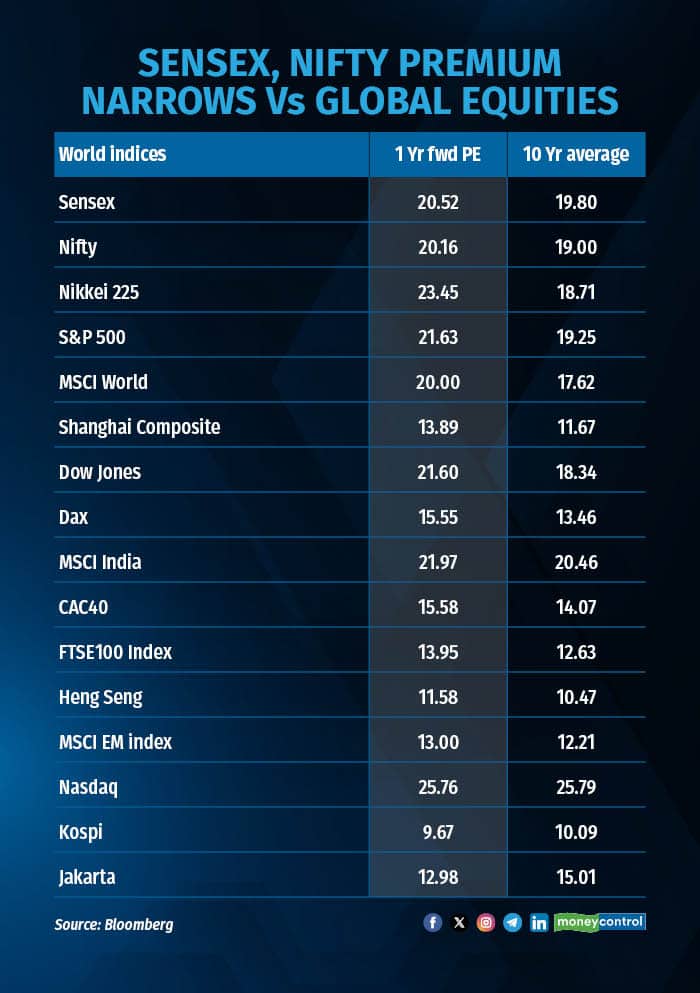
Globally, major benchmark indices continue to trade at a premium to their long-term averages. Japan’s Nikkei index is trading at 23.45 times one-year forward PE compared with 18.71 times its 10-year average. The S&P 500 is trading at 21.63 times forward PE versus 19.25 times its long-term average, while the Dow Jones is trading at 21.6 times compared with 18.3 times historically.
China’s Shanghai Composite is trading at 14 times forward PE compared with 11.7 times its long-term average, while Hong Kong’s Hang Seng index is trading at 11.58 times compared with its historical average of 10.5 times.
Investors are digesting the Union Budget outcomes alongside the final leg of the earnings season. While corporate results have not delivered any major negative surprises, overall earnings momentum remains weak, with growth in the range of 4-5 percent, reflecting subdued demand conditions. This has kept investor sentiment cautious, particularly in the absence of a strong growth stimulus from the budget.
Market strategists said the budget has highlighted limited fiscal flexibility, with tax collections under pressure resulting in restrained spending and lower expectations of additional demand-side support.
Apart from domestic policy factors, global trade developments remain another key monitorable. The final details of the India–US trade agreement are yet to be fully disclosed. While the government has maintained that the deal is positive for India from a macroeconomic standpoint and has sought to counter concerns that excessive concessions may have been made to secure lower tariffs, analysts said clearer implications will emerge only after detailed terms are released.
Attention is now shifting to potential support outside fiscal policy, including monetary measures and incremental structural reforms. Beyond policy action, corporate earnings delivery is expected to play a decisive role in determining market direction. Despite current demand weakness, earnings expectations remain optimistic at around 15 percent growth, raising concerns over whether companies can realistically meet these projections.
Capital flows are emerging as another critical variable. Foreign institutional investors sold about $4 billion worth of equities in January amid global risk aversion, although they have turned marginal buyers in recent sessions following the India–US trade deal. Some market participants expect selling pressure to ease, driven by relatively comfortable valuations in India and weakening flows into other Asian markets such as China and Hong Kong. Any stabilisation in foreign flows could offer near-term support, though a sustained turnaround is likely to depend on clearer macroeconomic or earnings triggers.
Strategists added that the market narrative is gradually shifting away from expectations of government-led stimulus towards a flow-driven framework anchored around retail participation, mutual fund inflows and foreign investor behaviour. Heightened volatility, they said, reflects a more uncertain global environment, where even traditional safe-haven assets have witnessed sharp swings.
While equities may remain volatile in the near term, analysts said markets typically track earnings and growth over longer time horizons. A durable recovery in sentiment is expected to depend less on policy signals and more on companies delivering sustainable growth.
Discover the latest Business News, Sensex, and Nifty updates. Obtain Personal Finance insights, tax queries, and expert opinions on Moneycontrol or download the Moneycontrol App to stay updated!
Find the best of Al News in one place, specially curated for you every weekend.
Stay on top of the latest tech trends and biggest startup news.





