








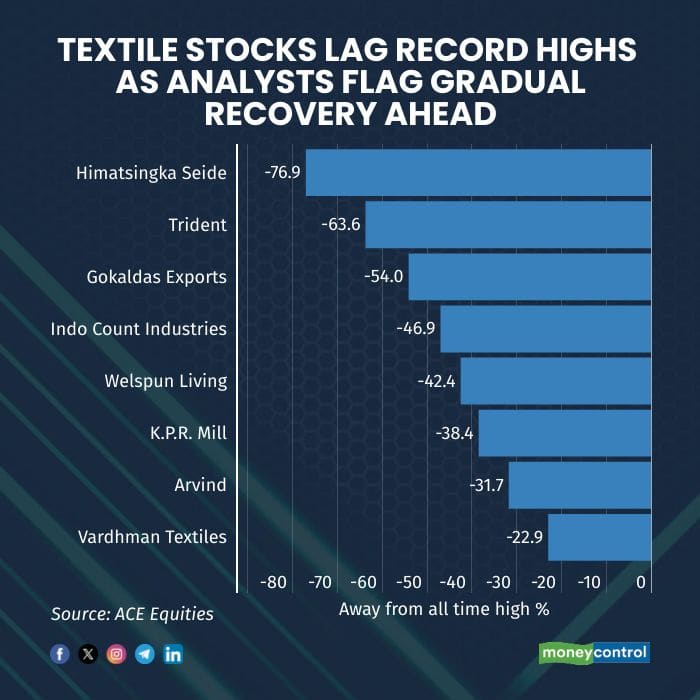
Top textile stocks such as Indo Count Industries, Gokaldas Exports, Welspun India and Himatsingka Seide remain significantly below their record highs, even as expectations rise around a potential recovery in the sector after the announcement of India-US trade deal. These stocks are still trading between 30 percent and 80 percent below their all-time peaks, reflecting prolonged pressure on textile exporters. Notably, most of these stocks hit 20% upper circuit on February 3,
Indo Count Industries is down nearly 47 percent from its all-time high, while Gokaldas Exports has declined about 54 percent. Welspun India is trading around 43 percent below its peak, while Himatsingka Seide remains sharply lower, down nearly 77 percent from its record high. These companies derive around 60 percent to 70 percent of their revenues from the US market and are seen as among the biggest beneficiaries of easing trade-related pressures.
 textile
Sunny Agrawal of SBI Securities said the underlying businesses of these companies remain well established. He noted that momentum could return as market entry was never a constraint, but tariffs had earlier emerged as a hurdle to growth and reduced competitiveness.
Companies with lower exposure to the US market are expected to see a more muted impact. These include Trident, Vardhman Textiles and SP Apparels, which have around 20 percent to 30 percent exposure to the US, as well as KPR Mill and Arvind, where exposure is below 15 percent. Even so, analysts said the broader textile sector stands to benefit from improved trade conditions.
Agrawal said exporters can now engage with customers with greater confidence, as the competitive landscape has improved, allowing companies to redraw supply plans for the next 10 to 12 months.
On the pace of recovery, analysts cautioned against expecting an immediate turnaround. Growth is expected to depend largely on the behaviour of the US consumer. While the tariff-related hurdle has eased, demand conditions will remain the key driver of business performance.
Analysts added that the September and December quarters are typically seasonally stronger for exporters, but a clearer picture on earnings recovery is likely to emerge only over the next two to three quarters.
Experts also pointed to continued policy support from the government, reiterating that textiles remain a focus area due to their labour-intensive nature. The sector continues to receive support as a major source of employment and foreign exchange earnings, with the Union Budget reinforcing textiles’ importance as a key job-generating industry.
The improvement in outlook follows a decision by the White House to roll back tariff penalties imposed on India since August 2025, including a 25 percent penalty linked to imports of Russian crude oil and a reciprocal tariff of 25 percent, bringing the cumulative tariff rate down to 18 percent.
In a Truth Social post later confirmed by the Indian side, US President Donald Trump said the two countries had agreed that India would stop purchasing Russian crude oil, increase purchases from the US and Venezuela, and in return, the US would lower reciprocal tariffs on Indian goods to 18 percent. The statement clarified that the headline tariff rate, excluding Section 232 tariffs, would fall to 18 percent, offering India significant relief and a more competitive tariff rate across the region, with Russian oil-related penalties being removed.
Discover the latest Business News, Sensex, and Nifty updates. Obtain Personal Finance insights, tax queries, and expert opinions on Moneycontrol or download the Moneycontrol App to stay updated!
Find the best of Al News in one place, specially curated for you every weekend.
Stay on top of the latest tech trends and biggest startup news.





