






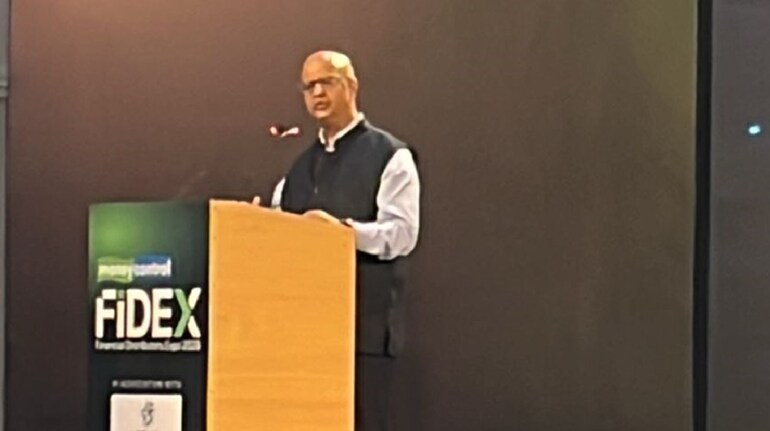

Indian households continue to hold the bulk of their wealth in physical assets such as gold and real estate, highlighting the challenge of shifting savings into financial markets despite the rapid expansion of retail investing, Sashi Krishnan, Director at the National Institute of Securities Markets (NISM), said at Moneycontrol FiDEX 2026 (Financial Distribution Expo).
India currently has about 34 crore households, with a household savings rate of roughly 18 percent of GDP, according to the SEBI Investor Survey 2025. However, only 5.3 percent of these savings flow into financial products, leaving a large portion of capital outside formal financial markets. “Only about 5.3 percent of household savings actually flows into financial products. The rest remains largely in physical assets such as gold and real estate,” Krishnan said.
Physical Assets Dominate Household Wealth
Indian households collectively hold between 30,000 and 35,000 tonnes of gold, valued at roughly Rs 450 lakh crore, Krishnan said. Residential real estate assets are estimated at about Rs 500 lakh crore, bringing the combined value of gold and property holdings to around Rs 950 lakh crore.
“Just pause and reflect. Household gold holdings alone are valued at around Rs 450 lakh crore, which is higher than India’s GDP of roughly Rs 400 lakh crore,” he said. A large portion of this wealth remains tied up in physical assets, often held in lockers or as long-term holdings that do not generate financial returns.
Financial Assets Remain Limited
Even within financial assets, participation remains relatively small. Indian households hold about Rs 353 lakh crore in financial assets, according to the RBI Bulletin. Of this amount, roughly Rs 153 lakh crore is held in bank deposits, about Rs 35 lakh crore is kept in cash, and approximately Rs 41 lakh crore is invested in mutual funds.
Until early 2025, mutual fund assets held by households were lower than the amount of cash they held, reflecting the strong preference for liquidity and safety. Fixed deposits, which typically offer around 6 percent returns, may provide limited real returns once inflation and taxes are taken into account, Krishnan said.
Retail Investing Boom Masks Participation Gap
The rapid rise in retail investment accounts also masks a significant participation gap in financial markets. Demat accounts have crossed 21 crore, but only about 4.5 crore accounts are active traders or investors, Krishnan said. Similarly, mutual fund folios have reached 26.6 crore, while the number of unique investors stands at about 6 crore, representing roughly 4 percent of India’s population.
“If even an additional 10 percent of the population shifts savings from gold, real estate or idle assets into financial markets, the growth opportunity would be enormous,” Krishnan said.
Awareness Gap Remains a Major Barrier
The SEBI Investor Survey 2025 shows that about 63 percent of Indian households are aware of at least one financial security, leaving around 37 percent — roughly 11 crore households — completely unaware of capital market investment options.
Awareness levels vary significantly across financial products. Fixed deposits have about 98 percent awareness, life insurance about 95 percent, while awareness drops to 53 percent for mutual funds and 49 percent for equities. “This awareness gap is one of the first challenges that the industry needs to address,” Krishnan said. Awareness levels also differ across regions. In India’s top nine metro cities, awareness of securities markets is about 89 percent, while outside these cities it falls to around 56 percent, highlighting substantial untapped potential in Tier-2 and Tier-3 locations.
Occupational Divide in Financial Awareness
Financial awareness also varies significantly across occupational groups. Among salaried households, awareness of financial products stands at about 81 percent. However, awareness drops to below 50 percent among agricultural workers and unskilled labour segments, highlighting a significant divide in access to financial information.
Awareness Does Not Always Lead to Investment
Even among households aware of financial products, participation remains limited. Out of around 21.3 crore households aware of financial products, only about 3.21 crore households actually invest, representing roughly 9.5 percent of total households. One reason is the knowledge gap. Only 36 percent of investors report moderate to high knowledge of financial products, while 47 percent admit they have little or no knowledge.
Behavioural Barriers to Investing
Investment behaviour also influences market participation. About 80 percent of Indian households prioritise capital preservation over returns, often viewing market volatility as a threat rather than an opportunity. Trust also plays a major role in investment decisions. Around 59 percent of investors rely on friends, family or colleagues for investment advice, while 56 percent turn to social media or influencers. Only 25 percent consult professional financial advisers or mutual fund distributors.
Young Investors Emerging as a Key Segment
Young adults aged 18 to 35 account for about 47 crore individuals in India, making them a key demographic for expanding financial market participation. Studies show that 93 percent of earning young Indians save, though only a portion transition from saving to investing. Many young investors rely on YouTube, X and other social media platforms for financial advice rather than consulting professional advisers.
Need for Simpler Processes and Trusted Advisers
Non-investors often cite complex processes, documentation requirements and confusing financial terminology as barriers to entering financial markets. Potential investors also seek simpler, jargon-free explanations of financial products and lower minimum investment requirements that allow them to test financial products before committing larger savings.
Communication in local languages is also critical to expanding financial participation, particularly in rural and self-employed segments, where English-centric financial messaging may limit outreach. Financial intermediaries therefore play a crucial role in simplifying financial concepts, communicating locally and building trust among investors, Krishnan said.
Equity Seen as Key for Long-Term Wealth Creation
For long-term financial goals such as retirement, equity remains the most suitable asset class for wealth creation, Krishnan said. “For most people, retirement may still be 30–35 years away. Over such long horizons, equity is the asset class that offers the greatest opportunity for wealth creation,” he said.
While gold may perform well during periods of geopolitical uncertainty, over long periods it often behaves as a passive asset that does not consistently generate strong returns. Research examining market behaviour over 30, 40, 50 or even 100 years shows that equity volatility over long horizons is not significantly higher than that of treasury bonds, and short-term fluctuations in equity markets tend to smooth out over longer investment horizons.
Discover the latest Business News, Sensex, and Nifty updates. Obtain Personal Finance insights, tax queries, and expert opinions on Moneycontrol or download the Moneycontrol App to stay updated!
Find the best of Al News in one place, specially curated for you every weekend.
Stay on top of the latest tech trends and biggest startup news.





