








KPR Mills, Welspun Living, and other export-oriented counters that have seen significant pain over the past year as a result of the U.S.-imposed tariffs, staged a smart rebound over the past week as the India-EU deal came to be finalised.
Most of the stocks reacting positively are from the textile segment, as the E.U. accounts for the largest Indian textile market, making up 38 percent of all textile exports. On the other hand, the U.S.market makes up around 33 percent, while the U.K. market accounts for 9 percent of Indian textile exports.
Since 2025, some textile players are lower by over 27 percent, as significant tariff overhang has impacted the attractiveness of Indian textiles. Instead, textile exports from Vietnam and Bangladesh to the U.S. have increased, given the lower tariff rate.
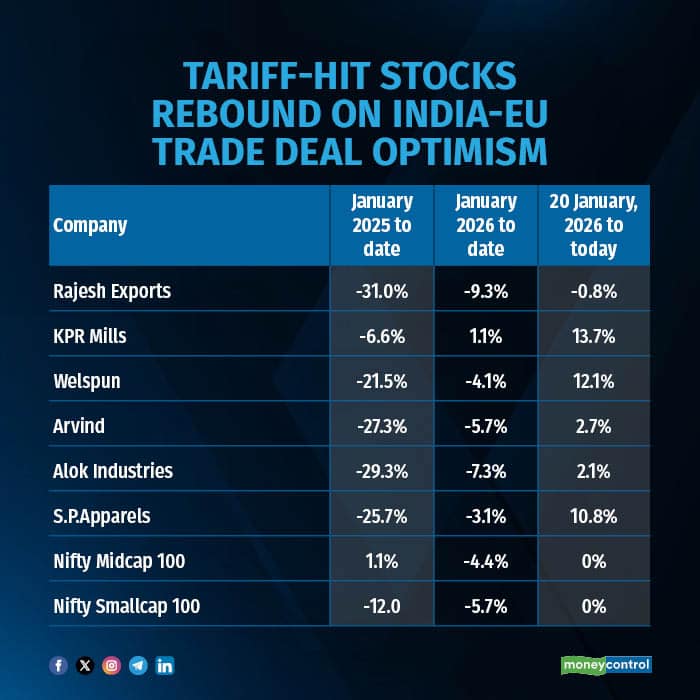
However, since January 20, the positive momentum surrounding the India-EU trade deal has lifted the outlook for these stocks. The short-term buying momentum has lifted these stocks by up to 12 percent.
As compared to the Nifty Midcap 100 and Nifty Smallcap 100 indices, these stocks have seen a higher fall over the past year, while the indices have fared better. However, on the upside, the indices have not seen much gains from the positivity surrounding the India-EU trade deal, while the textile stocks have rallied sharply.
Historically, India’s apparel exports have operated at a disadvantage in the EU market due to tariff-free access enjoyed by competing countries, while Indian exports were subject to duties of 9.96% under the GSP regime and, following its withdrawal, approximately 12%. This differential has impacted India’s price competitiveness despite strong capabilities in quality and compliance.
The proposed removal of this tariff under the India–EU FTA would be a significant positive step, helping level the playing field for Indian manufacturers. "It is expected to catalyse fresh investments in advanced synthetic raw materials, modern processing technologies and capacity expansion across the textile and apparel value chain. Over the medium term, this would strengthen India’s position as a reliable, compliant and scalable supplier to the European market," said Pearl Global Industries, a listed apparel exporter.
The December quarter marked the first full quarter with a 50 percent US tariff burden, including a 25 percent punitive levy, significantly pressuring margins for textile exporters. However, with the India-US trade deal still pending, tariff uncertainty continues to be a key overhang for the sector.
To cushion the impact, the government has taken several steps. It temporarily removed import duty on cotton until December 31, 2025, announced an export credit support package to ease financing costs and improve credit access for MSMEs, and removed Quality Control Orders on polyester yarn and viscose fibre to lower input costs and improve global competitiveness.
"Diversification of markets via FTAs with key markets remains a strategic priority, offering partial but meaningful long -term relief," said Elara Capital.
In a note, CareEdge Ratings also added that mitigating factors from the lofty tariff impact on India, include India’s strong presence in the cotton-based textile value chain, currency depreciation and expected increase in exports to the EU, UK, and the Middle East under Free Trade Agreements (FTAs).
Disclaimer: The views and investment tips expressed by investment experts on Moneycontrol.com are their own and not those of the website or its management. Moneycontrol.com advises users to check with certified experts before taking any investment decisions.

Discover the latest Business News, Sensex, and Nifty updates. Obtain Personal Finance insights, tax queries, and expert opinions on Moneycontrol or download the Moneycontrol App to stay updated!
Find the best of Al News in one place, specially curated for you every weekend.
Stay on top of the latest tech trends and biggest startup news.





