
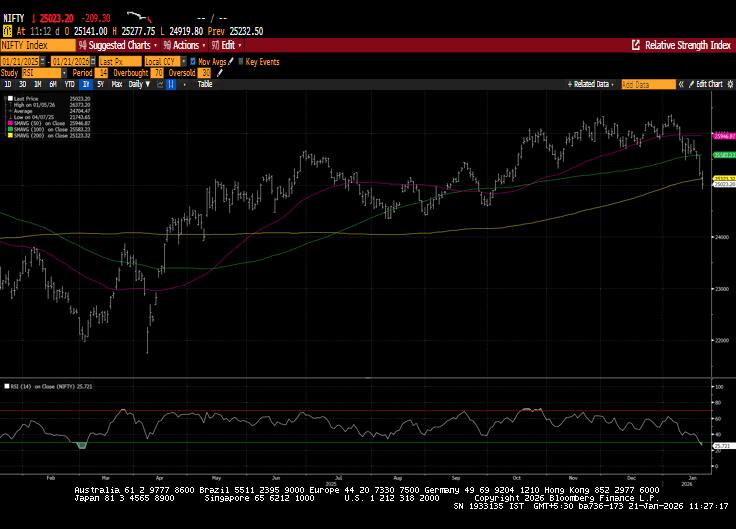
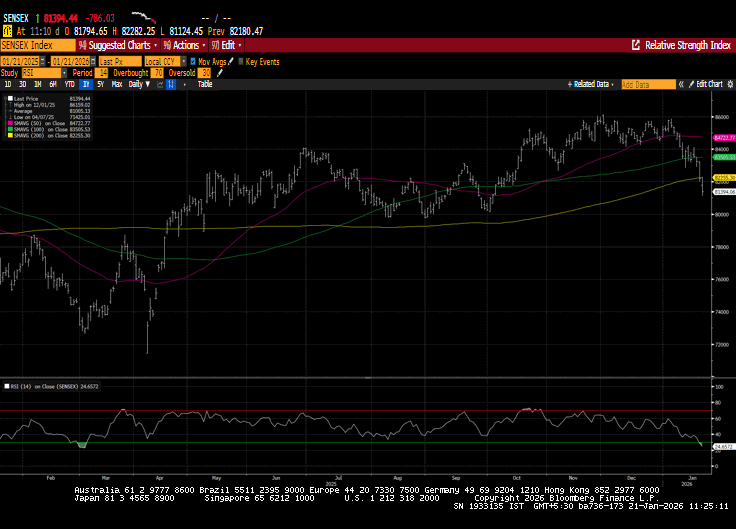
Both India’s benchmark indices, the Sensex and the Nifty, slipped below their 200-day moving averages for the first time in eight months, signalling cautious investor sentiment and a potential turning point for the market’s near-term direction amid global turmoil linked to tensions over Greenland and a sharp selloff in Japanese government debt.
The last time both benchmarks fell below their 200-day moving averages was on May 9, 2025. In intraday, Nifty was below 25,000-mark while Sensex near 81,100. At 11.40 am, the Sensex was down 1 percent, or 747 points, at 81,537, while the Nifty declined 0.77 percent, or 190 points, to 25,042.
The 200-day moving average, calculated using the average closing price of the past 200 trading sessions, is widely tracked as a key indicator of long-term trend and market sentiment. Indices or stocks trading below this level are generally viewed as being in bearish territory, though analysts note that deeply oversold readings can sometimes indicate short-term exhaustion.
Global markets witnessed a sharp selloff, with the S&P 500 sliding 2.1 percent to erase its gains for 2026. Gold prices hit fresh record highs as investors sought safe-haven assets amid escalating geopolitical tensions and stress across global debt markets.
Market volatility intensified after US President Donald Trump, currently in Switzerland for the World Economic Forum in Davos, showed no signs of retreating from his push to take control of Greenland. The developments prompted Greenland’s prime minister to warn citizens of a possible military invasion, though he said such a scenario remained unlikely.
The United States also threatened tariffs on eight European nations, including Germany, France and the UK, which opposed the Greenland move. This raised fears of a broader trade confrontation. French President Emmanuel Macron criticised Washington’s trade stance, while Canadian Prime Minister Mark Carney said the global rules-based order was effectively under strain.
The escalating rhetoric at Davos underscored the rapid deterioration in relations between traditional US allies, unsettling financial markets, weakening the dollar and boosting demand for safe-haven assets such as precious metals.
Separately, a sharp selloff in Japanese sovereign bonds highlighted concerns over the fiscal positions of major economies, fuelling investor moves away from currencies and government debt.
Long-term US Treasury yields rose to a four-month high, driven by the rout in Japanese bonds and reports that a Danish pension fund plans to reduce its exposure to Treasuries. The dollar weakened against most major currencies.
Based on average returns across major exchange-traded funds tracking US equities, Treasuries, corporate bonds and Bitcoin, Tuesday marked the worst single trading session since April’s tariff-driven market selloff.
Discover the latest Business News, Sensex, and Nifty updates. Obtain Personal Finance insights, tax queries, and expert opinions on Moneycontrol or download the Moneycontrol App to stay updated!
Find the best of Al News in one place, specially curated for you every weekend.
Stay on top of the latest tech trends and biggest startup news.