








Over the past year, Indian equity investors have faced an uncomfortable reality. The Nifty 50 delivered returns of roughly 10%, while mid-cap and small-cap indices slipped into negative territory. This matters because the average Indian investor’s portfolio is heavily tilted toward mid and small caps. As a result, many are facing the heat even when Nifty is trading close to its all-time highs.
This phase has exposed a deeper issue in how Indian investors build portfolios. Most portfolios are equity-heavy. Even within equities, investments are often concentrated in sectoral or thematic funds. While these choices may appear diversified on the surface, they are all tied to one underlying factor, the Indian economy. When growth moderates, liquidity tightens, or valuations compress domestically, the entire portfolio feels the impact at once. This is economic concentration risk, and it is far more common than investors realize.
If we step back and examine household asset allocation, the picture becomes clearer. Equity dominates. Commodities account for barely 2% of investor participation, and exposure to global markets is almost negligible. In contrast over the past 1 year, institutional investors withdrawn money from Indian market and spread it across countries, currencies, and asset classes. Retail investors, however, remain home-biased largely due to familiarity, comfort, and historical habit.
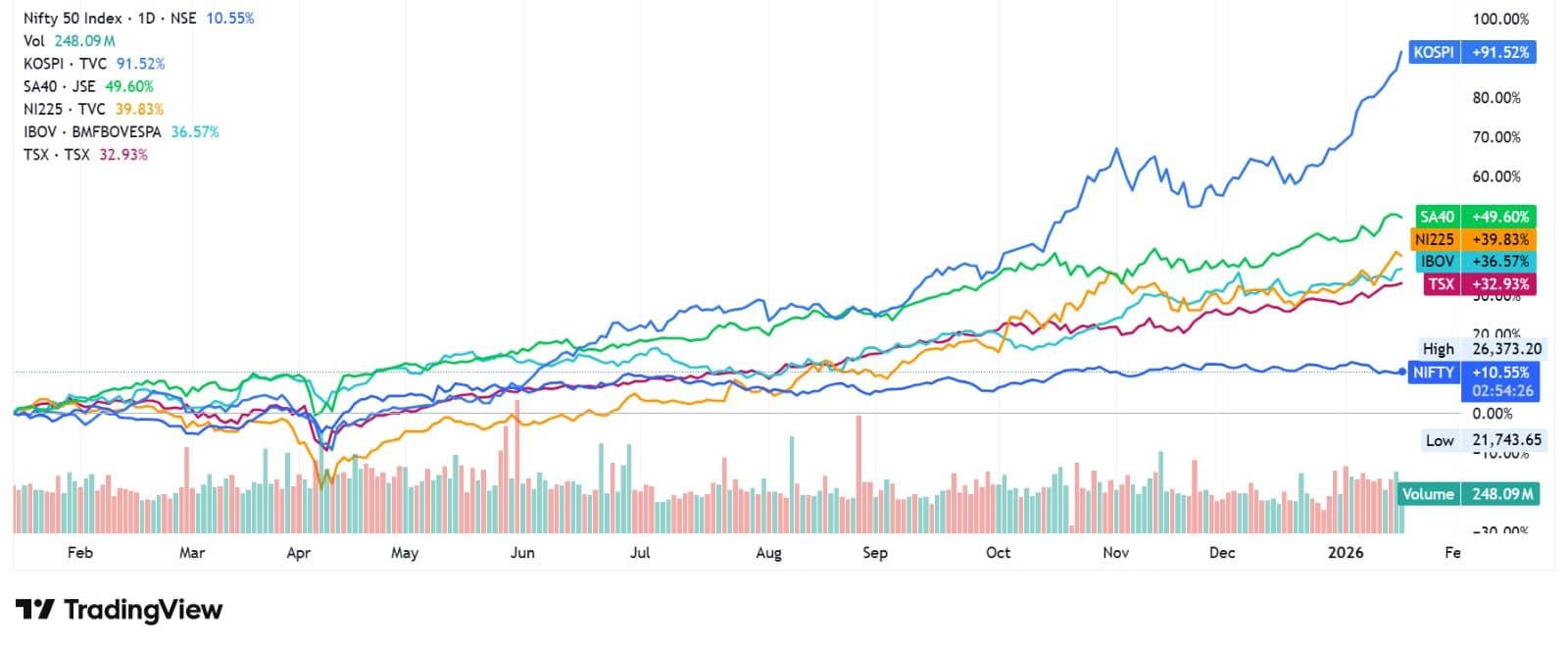
Yet the opportunity set outside India is vast. India represents around 4% of global market capitalization. By restricting portfolios to domestic markets alone, investors are effectively ignoring 96% of listed opportunities worldwide. Over the last one year itself, several global benchmark indices have delivered returns well above India’s headline indices. This is not an argument against India as long-term growth story. It is an argument against limiting portfolios to a single geography at all the times.
This is where the concept of global investing—investing beyond India becomes relevant. Global investing allows participation in economies that are at different points in the business cycle. While one region slows, another may accelerate. While one market faces valuation compression, another may benefit from earnings expansion or policy support. Country-level ETFs now make this access simple and cost-efficient. Importantly, Indian brokerage platforms have begun enabling global investing, removing operational barriers that existed earlier.
The below chart shows how different countries benchmark indices performed compared to Nifty 50 over the past 1 year.
Currency appreciation benefit:
There is also a currency dimension that deserves attention. Over long periods, the Indian rupee has shown a structural depreciation bias against hard currencies, especially the US dollar. Global assets denominated in foreign currencies act as a natural hedge. Dollar-linked investments help protect real purchasing power. In this sense, global exposure is not only about chasing returns—it is equally about capital preservation.
Non-correlated assets:
Another crucial pillar of resilient portfolios is the inclusion of non-correlated assets. Non-correlated assets are investments whose returns do not move in tandem with equities. When stocks fall, these assets may remain stable or even rise. This reduces overall portfolio volatility and drawdowns. Commodities, global bonds, and select international equities often behave differently from domestic stocks, making them effective stabilizers during periods of stress.
Diversification of Portfolio:
Portfolio construction is incomplete without geographic allocation. Just as investors diversify across sectors and market capitalizations, they must also diversify across economies and currencies. A well-constructed portfolio should reflect global realities, not just domestic optimism.
Conclusion:
India will remain a core allocation for long-term investors, driven by demographics, consumption, and structural reforms. But intelligent investing is not about loyalty to a single market. It is about discipline, balance, and risk management. The next phase of wealth creation for Indian investors will not come from investing more aggressively in the same space, it will come from investing more intelligently across the world.
Disclaimer: The views and investment tips expressed by investment experts on Moneycontrol.com are their own and not those of the website or its management. Moneycontrol.com advises users to check with certified experts before taking any investment decisions.
Discover the latest Business News, Sensex, and Nifty updates. Obtain Personal Finance insights, tax queries, and expert opinions on Moneycontrol or download the Moneycontrol App to stay updated!
Find the best of Al News in one place, specially curated for you every weekend.
Stay on top of the latest tech trends and biggest startup news.





