






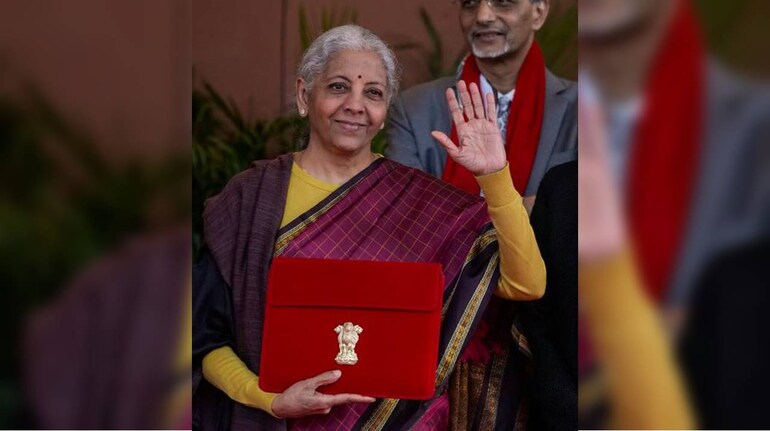

The Union Budget 2026 has largely been considered a status quo budget, focusing on policy continuity instead of big-bang measures. However, here are five key sectors that analysts expect to see significant gains going forward.
Announcement:
Defence outlay has increased to Rs 2.19 lakh crore from Rs 1.80 lakh crore earlier, with the revised estimate at around Rs 1.86 lakh crore, around 17-18%, which is broadly in line with what the market had built in, given the number of AON and BSA approvals already in place.
Total defence budget now stands at Rs 7.6 lakh crore up 7% from the revised estimate. Capex outlay for military modernisation has been raised to Rs 2.19 lakh crore, marking a 17.6% YoY increase, and lifting capital spending to its highest share of total defence expenditure in over a decade.
Aircraft and aero engines: The FY27 allocation of about Rs 63,700 crore compares with a budgeted Rs 48,600 crore last year, which was later revised up sharply to around Rs 72,000 crore.
Heavy-to-medium vehicles: From Rs 3,700 crore to roughly Rs 4,600 crore
Naval fleet allocations: Flat at around Rs 25,000 crore.
R&D spending: Rs 17,000 from Rs 17,000 crore
“Other Equipment” category: Rs 82,000 crore from Rs 50,700 crore
Outlook:
Going forward, defence is likely to become a selective space rather than a blanket sector trade. According to PL Capital’s Amit Anwani, structurally, the government’s focus on defence remains intact, orders are in place and allocations continue to support execution.
“Some pockets, particularly defence electronics, could see valuation-led de-rating, but that does not change the long-term order visibility,” he said. Going ahead, he expects stocks with reasonable valuations to stabilise, and performance will increasingly depend on execution and order inflows rather than headline budget numbers.
Stocks to watch: Bharat Electronics, BDL, Paras Defence
Announcement:
Railway capex has increased by 8.5% YoY, which looks healthy at the headline level. Rolling stock allocation stands at around Rs 52,000 crore versus revised Rs 50,000 crore last year. Kavach allocation has seen an around 10–15% increase, indicating continued focus on safety and selective tech-led upgrades.
New lines & doubling:Metro & HSR: Metro allocations remain modest at around Rs 31,000 crore.
Other announcements: High-speed rail announcements (including 7 new lines)
Outlook:
Railways appear to be transitioning from a rolling-stock-led theme to a track and coverage-led one, according to Anwani. While expectations were higher for rolling stock, locomotives, and signalling (which typically benefit higher value-added players), allocations there remain subdued.
Stock performance going forward is likely to diverge based on where the spending is directed. For example, EPC and track-laying players may see relatively better order momentum and Rolling stock, loco, and signalling players could see slower order inflows in the near term.
Valuations across railway stocks, which were elevated post the Vande Bharat-led rally, have already corrected over the past 12–18 months. Anwani adds that further normalization is possible in the near to medium term, especially given execution delays and slower order finalisation in segments like Vande Bharat and DFC.
Stocks to watch: RVNL, IRCON, Siemens, Titagarh Rail, BHEL
Announcements:
The budget provided some positive cues for the semiconductor space, though the impact is expected to materialize gradually. A provision of around Rs 1,000-1,500 crore has been made under the India Semiconductor Alliance to strengthen local IP and supply chains. The Electronic Components Manufacturing Scheme (ECMS) allocation has been raised to Rs 40,000 crore from Rs 22,000 crore previously, supporting PCB manufacturing and related initiatives.
Outlook:
According to Mirae Sharekhan’s Ankit Soni, operational revenues from these initiatives are likely to flow only after FY27, as production ramps up. On valuations, he notes that they had been elevated historically, for example, Amber traded at Rs 8,000-9,000 at peak but the stock has corrected roughly 40-45%, bringing forward multiples down to a more comfortable range of 35-40x. “Looking at the growth prospects of Amber and Sygma, the valuations could be justified,” Soni added.
Overall, experts note that the semiconductor space is at an early-phase growth stage, with performance over the medium term dependent on execution, ramp-up of chip production, and PCB manufacturing initiatives.
Stocks to watch: Sygma SGS, Kaynes, CG Power, Amber Enterprises
Announcement:
The Finance Minister proposed the Biopharma SHAKTI with an outlay of Rs 10,000 crore over the next five years. This will build the ecosystem for domestic production of biologics and biosimilars. The strategy will include a biopharma-focused network with 3 new National Institutes of Pharmaceutical Education and Research (NIPER) and upgrading 7 existing ones. It will also create a network of over 1000 accredited India Clinical Trials sites.
Outlook:
According to experts, the biopharma ecosystem will help accelerate research and production for diabetes and autoimmune conditions, but also lower costs, expand access, and position India as a global hub for affordable biologics.
"A key impact will be the expansion of biosimilars, cost-effective alternatives to complex biologic medicines such as insulin and monoclonal antibodies. Greater competition in biosimilar manufacturing can reduce treatment costs and expand access to therapies for chronic conditions like cancer, diabetes, and autoimmune diseases, making this initiative a potential game changer for public health," said Dharminder Nagar, FICCI Healthcare Committee.
Stocks to watch: Biocon, Lupin, Sun Pharma
Announcement:
The Union Budget proposed that dedicated Rare Earth Corridors would be established in the mineral-rich states of Odisha, Kerala, Andhra Pradesh and Tamil Nadu to promote mining, processing, research and manufacturing.
Outlook:
The industry celebrated the announcement of the development of rare earth corridors, stating that the strengthens India’s position in critical materials that underpin semiconductors, clean energy, defence systems, and electric mobility, while enabling higher-value research and processing capabilities within the country.
Aditya Khandelia, Managing Director & Partner, BCG added that the move builds on the Rs 7,280 crore Rare Earth Permanent Magnets scheme launched in November 2025. "By integrating mining, processing, research and manufacturing, these measures move India beyond resource extraction towards full value-chain capability. In a fragmented global trade environment, reducing import reliance strengthens supply security and industrial resilience across EVs, renewables, defence and advanced electronics, while positioning India as a credible participant in the global rare earth ecosystem," he added.
Stocks to watch: GMDC, NMDC, Hindustan Copper, MOIL
Follow our live BUDGET blog to catch all the updates
Disclaimer: The views and investment tips expressed by investment experts on Moneycontrol.com are their own and not those of the website or its management. Moneycontrol.com advises users to check with certified experts before taking any investment decisions.

Discover the latest Business News, Sensex, and Nifty updates. Obtain Personal Finance insights, tax queries, and expert opinions on Moneycontrol or download the Moneycontrol App to stay updated!
Find the best of Al News in one place, specially curated for you every weekend.
Stay on top of the latest tech trends and biggest startup news.





