
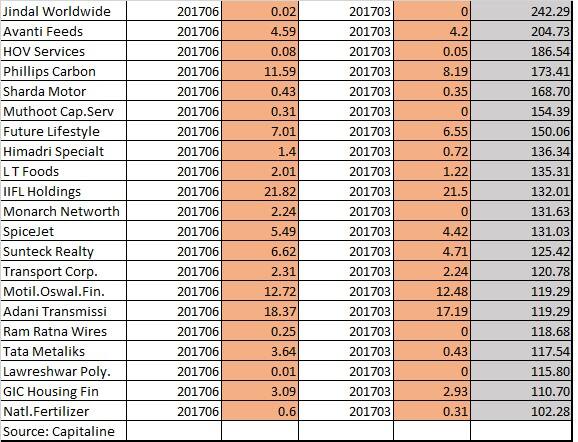
Foreign institutional investors (FIIs) poured in more than Rs 11,000 crore in the Indian equity markets for the quarter ended June and raised their stake in as much as 345 companies.
Out of those 345 companies, 21 companies have been among the standout performers so far in 2017 as they have already more than doubled investors’ wealth in the same period.
Companies which have more than doubled investors’ wealth so far in 2017 include names like Avanti Feeds, Phillips Carbon, Sharda Motor, LT Foods, SpiceJet, Motilal Oswal Financial Services, Adani Transmission, Tata Metaliks, GIC Housing Finance, and National Fertilisers etc. among others.
But, not all companies gave positive returns in which FIIs raised stake in the quarter. More than 50 companies gave negative return with Virtual Global falling a little over 49 percent so far in the year 2017, followed by SQS India which recorded a decline of 27 percent, and Dr. Lal Pathlabs plunged 27.1 percent in the same period.
Inox Wind (down 21 percent), Syngene International (down 16 percent), Alembic Pharma (down 15 percent), MCX (down 14 percent), Ajanta Pharma (down 13 percent), Crisil (down 11 percent), Ipca Labs (down 7 percent) etc. among others.
The Indian market has been one of the top performing markets across the world supported by strong macro fundamentals, stable currency, pro-growth reforms initiated by the government such as goods & services tax (GST), expectations of bounce back in earnings growth, and political stability.
All the above factors favoured India as an investment destination.
“The changing fundamentals of Indian economy under the regime of current government coupled with reviving growth prospectus has impelled foreign investor to take larger exposure towards Indian equity market,” Dinesh Rohira, Founder & CEO, 5nance.com told Moneycontrol.
Overseas investors have pumped in $25 billion (Equity + Debt) so far this year. The latest inflow follows net infusion of Rs 1.6 lakh crore in the previous five months (February-June).
According to the latest depository data, FPIs invested a net Rs 2,977 crore in equities during July 3-21, while they poured Rs 12,371 crore in the debt markets review, translating into a net inflow of Rs 15,348 crore ($2.4 billion).
Trend slowly moving towards small & midcaps:FPIs were more comfortable investing in largecap names and they have mostly shied away from small and midcap names in the past. But, it looks like the trend is fast changing.
The recent data suggests that FPIs have mostly raised their stake in companies from the small and midcap space. The slowdown in growth prospects of largecap names amid GST and demonetisation woes might have pulled FPIs towards companies with good growth prospects.
“Sluggish growth in largecap space in recent time has urged many FPI investor to hunt for value stock in mid and small cap space to offset against subdued growth reported by large cap stocks,” said Rohira.
“We continue to witness a significant FPI Inflow towards the small and mid-cap stocks. This trend is expected to be lasting for a shorter time given the volatile outlook of such stock,” he said.
He further added that on the backdrop of excess liquidity running in market mid and small cap stock witnessed a steep uptrend creating opportunities for investors across the category.
Should investors bet on FII stocks?Investors should not blindly bet on stocks where FIIs have made their presence felt. Out of 345 stocks in which FPIs have raised their stake, 97 stocks have holding greater than 10 percent and 35 stocks have FPI holding greater than 20 percent.
While fund flows may determine short term price performance, most analysts’ believe that the long term returns from stocks are a function of fundamentals.
If earnings grow and fundamentals improve such as lower debt, improving cash flows etc. then stock returns would reflect the same, suggest experts.
“The data on FPI holdings can be dissected in a number of ways. We believe for any hypothesis to be true you need to focus on data that contradicts the hypothesis. If we can find such contradictory data then we can reject the hypothesis else we would accept it,” Pankaj Tibrewal, Fund Manager – Equity, Kotak Mutual Fund told Moneycontrol.
If the hypothesis is that increasing FPI holdings lead to better stock returns then the focus should be on data that can disprove this. Let’s see some data that disprove this hypothesis
“Of the 300-350 companies where foreign ownership increased in the quarter, for more than 100 companies the returns were negative. In fact, in the case of one of the metal companies, the quarterly stock price return was (-40%) while FPI holding increased,” said Tibrewal.
There are more than 20 companies where stock price increased by more than 50% in the quarter but where Foreign ownership actually went down during the quarter
Tibrewal further added that the data suggests that a strategy of blindly buying stocks with increasing FPI holdings may not be the right strategy. “Rather one should use increasing FPI or MF holding as a screen but then do the due diligence himself/herself on individual names and invest in the ones where fundamentals are favourable,” he explains.

Discover the latest Business News, Sensex, and Nifty updates. Obtain Personal Finance insights, tax queries, and expert opinions on Moneycontrol or download the Moneycontrol App to stay updated!
Find the best of Al News in one place, specially curated for you every weekend.
Stay on top of the latest tech trends and biggest startup news.