






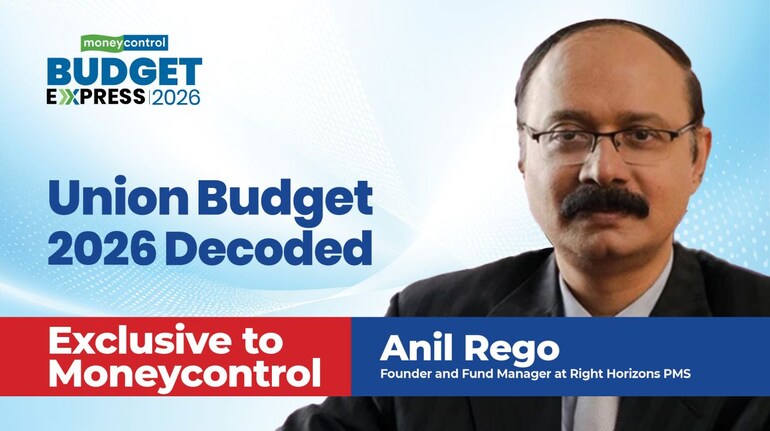

"The Budget is constructive but not immediately catalytic for the banking and financial services space," said Anil Rego, the Founder and Fund Manager at Right Horizons PMS, in an interview with Moneycontrol.
According to him, the sustained emphasis on public capital expenditure supports the medium-term credit cycle, particularly in infrastructure, MSME financing, and working capital demand linked to manufacturing and logistics. This creates a supportive backdrop for loan growth over the next few years rather than a sharp near-term acceleration.
While rating 8.5 out of 10 for the Budget, he thinks the Budget, from a long-term perspective, reinforces themes linked to domestic investment, manufacturing depth, and infrastructure formalisation.
How would you rate this budget on a scale of 1–10, considering the sharp market correction, and what is your overall assessment?
I would rate the Budget around 7.5 out of 10 from a market standpoint. In the context of a sharp market correction and elevated global uncertainty, the government has struck a balance between supporting growth and maintaining fiscal credibility. The continued emphasis on public capital expenditure, along with investments in infrastructure, manufacturing ecosystems, and digital capacity, reinforces the medium-term earnings outlook for the domestic economy. Importantly, the fiscal deficit path remains broadly disciplined, which helps anchor bond yields and preserves macro stability, a key positive for equity markets after recent volatility.
Sectorally, the push toward semiconductors, electronics manufacturing, MSMEs, and logistics infrastructure signals a clear intent to deepen India’s industrial base and reduce import dependence. Measures to support digital infrastructure and formalisation also strengthen long-term structural themes.
However, the Budget stops short of offering a strong near-term consumption stimulus, and higher transaction taxes in derivatives may weigh on trading-linked segments. As a result, while the Budget is not aggressively expansionary, it provides a steady, reform-oriented framework that supports a gradual market recovery rather than an immediate rebound.
Do you see any major unexpected negatives in the budget that could weigh on the market in the short term?
From a market perspective, there are no major macro-destabilising negatives, but a few elements could create short-term pressure on sentiment.
The most immediate overhang is the increase in Securities Transaction Tax (STT) on derivatives, which raises trading costs and could dampen volumes in the futures and options segment. This may weigh on market intermediaries and keep overall liquidity-driven momentum subdued in the near term.
That said, these are more tactical headwinds than structural negatives. The broader framework of fiscal prudence, manufacturing support, and infrastructure continuity remains intact, which limits downside risks once near-term volatility settles.
Do you think the fiscal deficit targets of 4.4% for FY26 and 4.3% for FY27 are achievable, given that they are largely in line with expectations?
The fiscal deficit targets of 4.4% for FY26 (RE) and 4.3% for FY27 (BE) appear achievable, provided growth and revenue assumptions hold broadly in place. The glide path remains consistent with the medium-term fiscal consolidation framework, rather than relying on overly aggressive spending cuts.
A key support is the assumption of around 10% nominal GDP growth, which underpins tax buoyancy and helps keep the deficit ratio stable even as capital expenditure remains elevated. With total expenditure rising but still anchored by a strong share of capital outlay, the deficit math relies more on growth-led revenue expansion than compression of productive spending.
The borrowing programme is sizeable but not out of line with market expectations, which reduces the risk of bond-market disruption. However, execution risks remain: a sharper global slowdown, commodity price spikes raising subsidy bills, or weaker-than-expected tax collections could test the targets.
Overall, the deficit numbers look credible rather than optimistic, which supports macro stability and is reassuring for financial markets.
Which sectors would you prefer to bet on after analyzing the Union Budget?
From a long-term perspective, the Budget reinforces themes linked to domestic investment, manufacturing depth, and infrastructure formalisation. Rather than short-term tactical trades, the opportunity lies in structural sectors that align with multi-year policy direction.
Infrastructure and capital goods stand out, supported by sustained public capex and multi-year project pipelines across transport, urban development, and logistics. This creates durable demand visibility for engineering, construction, and materials ecosystems.
The renewed push toward electronics, semiconductors, and advanced manufacturing signals a clear policy commitment to supply-chain localisation and import substitution. Over time, this benefits companies embedded in the broader manufacturing value chain, including components, precision engineering, and industrial automation.
Digital infrastructure, including data centres and related enablers such as power systems and connectivity infrastructure, also emerges as a structural theme as India positions itself as a global technology services hub.
Additionally, healthcare and biopharma manufacturing gain from ecosystem support aimed at strengthening domestic production of complex therapies.
How do you interpret this budget with respect to the banking and financial services segment?
The Budget is constructive but not immediately catalytic for the banking and financial services space. The sustained emphasis on public capital expenditure supports the medium-term credit cycle, particularly in infrastructure, MSME financing, and working capital demand linked to manufacturing and logistics. This creates a supportive backdrop for loan growth over the next few years rather than a sharp near-term acceleration.
For public sector banks, the proposal to set up a high-level committee to review the banking sector’s structure and preparedness for Viksit Bharat signals potential governance, efficiency, and capital allocation reforms over time. While details will matter, the direction is positive for improving institutional strength and long-term investibility. However, in the absence of immediate recapitalisation or large credit-guarantee schemes, the impact is more gradual than dramatic.
On the financial services side, deeper formalisation of MSMEs, expanded use of platforms like TReDS, and continued infrastructure spending should support NBFCs, trade financiers, and transaction banking ecosystems. That said, higher transaction taxes in derivatives may weigh on capital market intermediaries in the short term.
Overall, the Budget supports a steady, structurally improving credit environment, rather than triggering an immediate re-rating for the sector.
Do you expect the rally in PSEs and PSU banks to continue?
The rally in PSEs and PSU banks has been driven by a mix of improving fundamentals, better balance sheets, and policy visibility, and the Budget largely reinforces those structural pillars. Continued public capex, asset monetisation initiatives, and institutional strengthening in areas like infrastructure finance create a supportive medium-term backdrop for select state-linked enterprises.
That said, after a strong run, valuations and expectations are higher, which means the pace of gains may moderate. For PSU banks in particular, the story is shifting from a sharp recovery phase to a more earnings-delivery phase, where credit growth, margins, and asset quality trends will matter more than just the macro narrative. The proposed review of the banking sector is directionally positive, but its benefits will unfold gradually rather than immediately.
So, while the structural case remains intact, investors should expect more selective and earnings-driven performance rather than a broad, momentum-led rally. These are longer-cycle stories tied to domestic capex and balance-sheet strength, not short-term tactical trades.
Do you see the possibility of significant foreign inflows post-budget, or could the budget act as a dampener for foreign investors?
Global investors typically look for macro stability, policy continuity, and growth visibility, and the combination of sustained capital expenditure with a credible fiscal consolidation path helps reinforce that narrative. A stable deficit trajectory reduces the risk of bond-market stress or currency volatility, both of which matter for overseas allocators.
Structural pushes in manufacturing, digital infrastructure, and supply-chain localisation also align well with global themes such as diversification away from concentrated geographies. This strengthens India’s medium-term investment appeal, particularly for long-only institutional investors looking at multi-year growth stories.
That said, flows may not surge immediately. Higher transaction taxes in derivatives could slightly temper enthusiasm among short-term trading-oriented investors, and global liquidity conditions will still be the dominant driver of near-term FPI behaviour.
Overall, the Budget supports steady, structural foreign interest rather than triggering a sharp, event-driven wave of inflows.
Disclaimer: The views and investment tips expressed by experts on Moneycontrol are their own and not those of the website or its management. Moneycontrol advises users to check with certified experts before taking any investment decisions.Discover the latest Business News, Sensex, and Nifty updates. Obtain Personal Finance insights, tax queries, and expert opinions on Moneycontrol or download the Moneycontrol App to stay updated!
Find the best of Al News in one place, specially curated for you every weekend.
Stay on top of the latest tech trends and biggest startup news.





