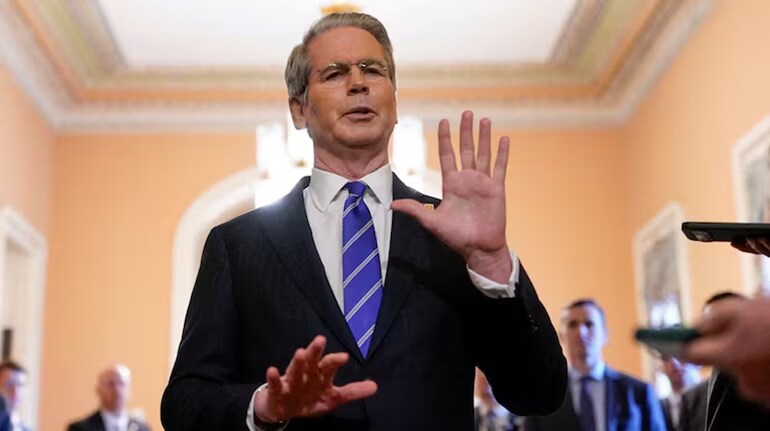

Treasury Secretary Scott Bessent cooled speculation that the US may be considering intervening in the foreign-exchange market to sell the dollar for Japanese yen, and touted the long-standing “strong-dollar policy.”
The US is “absolutely not” intervening in the currency market to strengthen the yen, Bessent said in an interview on CNBC Wednesday. Asked whether the US might take such a step, he said that “we don’t comment other than to say we have a strong dollar policy.”
The yen tumbled after the remarks, and was down about about 0.9% at 153.51 as of 10:51 a.m. in New York. Speculation that the US might join Japan’s government in selling the dollar against the yen surged on Friday, after so-called rate checks into the currency pair by the Federal Reserve Bank of New York — which serves as the Treasury’s agent.
“The US always has a strong dollar policy — but a strong dollar policy means setting the right fundamentals,” Bessent said. “If we have sound policies, the money will flow in.”
Bessent spoke a day after President Donald Trump, for his part, indicated he was comfortable with the dollar’s recent decline. Asked whether he was worried about the depreciation, Trump told reporters, “‘No, I think it’s great.” He also said that “I think the value of the dollar — look at the business we’re doing. The dollar’s doing great.”
Trump’s comments helped send the Bloomberg Dollar Spot Index down 1.1% on Tuesday. After Bessent’s remarks, it was up 0.5% on the day.
“Bessent seems to be making an attempt to calm frayed market nerves,” said Sonja Marten, head of FX and monetary policy at DZ Bank. “While the US may welcome a softer dollar in general, a rapid depreciation of the currency is clearly not in their interest either.”
Trump Policies
Bessent also said that the shrinking US trade deficit should automatically lead to more dollar strength over time.
“I think that with President Trump, with the One Big Beautiful Bill, with our regulatory policies, we are making this the best place to come build your business, have tax certainty, regulatory certainty, energy certainty,” Bessent said.
Japan’s currency has been tumbling since October, sliding near its weakest level since 1986 earlier this month. The decline has come alongside investor concerns about Prime Minister Sanae Takaichi’s embrace of large-scale fiscal stimulus despite her nation’s elevated debt burden.
Japanese authorities have repeatedly warned that they’re prepared to take action to address the yen’s slide. Finance Minister Satsuki Katayama told reporters late Tuesday that her government will coordinate with the US on currency responses when necessary.
“We’ll continue to take appropriate responses on currency moves while closely coordinating with US authorities as needed, in line with our joint statement from September,” Katayama said.
Discover the latest Business News, Sensex, and Nifty updates. Obtain Personal Finance insights, tax queries, and expert opinions on Moneycontrol or download the Moneycontrol App to stay updated!
Find the best of Al News in one place, specially curated for you every weekend.
Stay on top of the latest tech trends and biggest startup news.