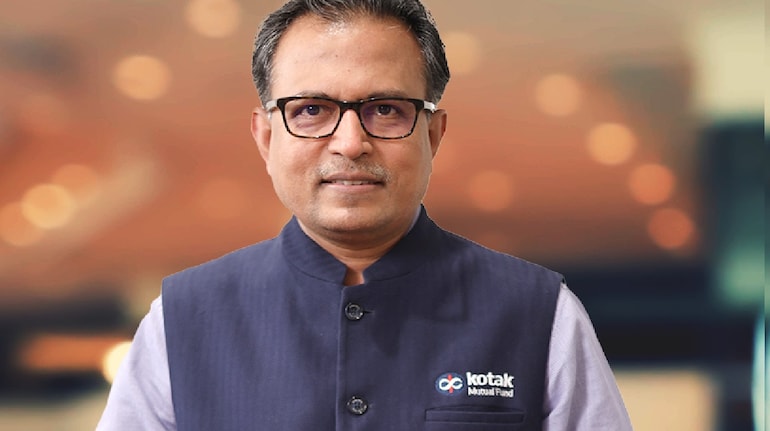

In challenging times, investors should return to basics, said Nilesh Shah, managing director of Kotak Mahindra Asset Management. By and large, markets find a bottom once the first signs of a war coming to an end appear, he said, adding that oil prices remain the biggest risk for India. Crude oil prices rising above $100 a barrel could disrupt the country’s macroeconomic calculations. Shah, who is also a part-time member of the Prime Minister’s Economic Advisory Council, said the government is working on reforms to help cushion the economy from the fallout of the war. He said there will be only a marginal impact on India’s growth rate if this war persists. Edited excerpts of an interview:
Q) How does one play a volatile market like today?
In a time as challenging as today, you go back to the basics.
You try to stay on the wicket rather than scoring runs. Our analysis of the past suggests whether it was the Gulf crisis, the Russia-Ukraine war, Operation Sindoor, or the Kargil War -- by and large, markets bottom out when the first sign of war coming to an end emerges, and by the time actual war ends, markets recover most of their losses. Of course, each crisis is different. Oil prices going up undoubtedly impact earnings, but that’s only for three months. It’s not forever. You have to keep in mind long-term objectives. You try to remain grounded.
Q) How vulnerable is India to the challenge of high oil prices, considering India is a net importer?
We benefit when oil prices are low and lose when they are high.
There is also an impact. If oil or gas is not available, it could have an impact on fertiliser production, which would impact our food production.
If food is not available, it could have an impact on petrochemicals, which could have an impact on polyester, plastics and other parts of the business. Oil has a multi-faceted impact on the Indian economy.
We have to evaluate first the availability of oil. Russia has offered that it will be happy to bridge the gap for India. But it does involve the risk of US tariffs. Availability of oil would be less of an issue, but there will be consequences. We have seen the price of oil going up. There are chances that it could go into triple digits. If it stays at that level, then the impact on the economy would be very high. The rupee, inflation and the fiscal deficit would get hit. If it’s temporary -- we have $725 billion in forex reserves -- we should be in a position to manage. But we have to be watchful about the viability vis-à-vis price and watch for the secondary impact across industries. The surprising part is that if oil prices go higher, then ONGC benefits, and that results in higher earnings per share of the Nifty50. If higher oil prices are passed on to consumers and industry, it really impacts the NSE 500 earnings. So even across various indices, the impact of rising oil prices versus falling prices will be different.
Q) How does the conflict impact FPI sentiment on India?
FPIs had turned buyers in February before the war broke out. Intensity had come down, and buying had increased, but now they are selling again because of the war. India is the third largest importer of crude and as crude prices go up, FPI selling should continue. We believe passive FPIs will be net buyers as emerging markets continue to receive flows. Active FPIs could be sellers because of concerns about the Indian economy and the valuation. Everything depends on the tenure and severity of the war. If the war becomes like Russia and Ukraine—where once in a while something happens but it has no impact on availability—then people will stop bothering. But if it continues to be severe, impacting the Strait of Hormuz, impacting the availability and price of raw materials, markets will take that into account. Markets have corrected by 5-7% because of the uncertainty. If the tenure and severity of the war increase, there could be more corrections.
Q) Do we see investors bullish on US markets?
There is a cost of the war which the US will have to bear; there will be benefits for the defence companies. Fiscal deficit will be higher, inflation will be higher, borrowing will be higher, and there will be a price to be paid by others as well. There is always a flight to safety, which benefits the US market, but the US will also have to pay the price.
Q) Your outlook on the rupee and at what point should the RBI intervene?
We believe the rupee will remain weak and the RBI should follow its time-tested policy of letting the market decide the direction and intervene to control the volatility. It’s a perfect storm for the rupee—higher deficit, higher inflation, higher FPI outflows. Undoubtedly, the rupee will depreciate, and the RBI should let the market find its own level rather than defend a particular level. They should intervene to only control volatility. Let the fundamentals determine the rupee price. We still think the rupee has scope for depreciation.
Q) How do you see the impact on India’s growth? Do we see India being an oasis of growth, or has that changed?
Undoubtedly, the pitch has become bad. There will be a marginal impact on our growth rate if this war persists. Do we have the ability to withstand, do we have a reform process which can negate the adverse impact of higher oil prices or availability of crude—the answer is undoubtedly yes. So I still believe our long-term growth story is not impacted; however, we have hit a speed breaker. Will it slow down—yes. Will it lead to a push back or a U-turn—the answer is no.
Q) How do we see AI playing out for the India story?
The bigger factor for us is not the Middle East crisis but AI and its impact on the Indian economy. Between BPO, KPO, GCC and IT services, about 4 crore Indians are directly and indirectly employed in the sector; the sector collectively gives $300-350 billion of forex revenue. It’s a substantial percentage of our economy. These employees are also large consumers. Any adverse impact on the IT sector will have a far-reaching impact on the Indian economy. Today, we are seeing a stage where there could be either an opportunity of a lifetime or a risk of a lifetime.
There could be winners or losers. Every single company is saying they are leveraging AI. Some will leverage it better, some will not be able to race as fast, and they will be losers. You have to keep observing.
Q) Are you still bullish on the Indian consumption story? Or does the war change that for us?
Rural consumption will depend a lot on how the monsoon behaves. There is pressure that El Nino is building up; we will know for sure in May how the monsoon will behave. The current sense is that while El Nino is building up, it will impact August and September rains rather than June and July rains. July rains are the most important for Indian agriculture. The rural economy is likely to be impacted by El Nino rather than what’s happening in the Middle East.
Urban consumption is likely to be impacted by the IT sector and what’s happening in the Middle East. There are 9 million Indians working in the Middle East—that will be a couple of tens of billions of dollars. Those flows should continue to support urban and rural consumption. If oil prices are hiked, the government will take a fiscal hit temporarily rather than pass it on to the consumer. However, if it persists for a longer period of time, then consumption will get hit.
Q) Policy levers that the government has at this point?
The government will have to take the lead. India is one of the few countries where 150% of our GDP is locked in precious metals, frozen in the tijori. They don’t benefit the Indian economy. We try to get 2% of our GDP as gross FDI, and we are keeping 150% of our GDP locked in our tijori—if we can monetise our frozen savings, undoubtedly the economy has more firepower to manage volatility. Second is the ease of doing business, and finally, the reforms that are required to push the economy into the next orbit. It could be divestment of assets that are not productive, improvement in ease of doing business, and encouraging research and development. The government has many options, and a lot of them are being worked on. We have the ability to bear the pain of the Middle East conflict.
Q) Your advice for investors on surviving the conflict?
Mentally be ready for volatility. We have no ability to predict.
We should remember from past experience that markets bottom out before the war ends. Asset allocation is the right way to manage volatility. Our view on gold and silver remains positive. We don’t expect them to deliver returns like last year, but we should still expect them to deliver positive returns. On fixed income, in the short duration, inflation could be higher, fiscal deficit could be higher, and the rupee could be under pressure. On equity, there could be ups and downs. Whenever the market falls, you could think of adding a little bit to your exposure. This is a fair value market—not cheap, not expensive—so maintain a neutral asset allocation. Overweight towards large cap, a bit underweight towards mid cap and small cap. Try to invest gradually in a calibrated manner.

Discover the latest Business News, Sensex, and Nifty updates. Obtain Personal Finance insights, tax queries, and expert opinions on Moneycontrol or download the Moneycontrol App to stay updated!
Find the best of Al News in one place, specially curated for you every weekend.
Stay on top of the latest tech trends and biggest startup news.