






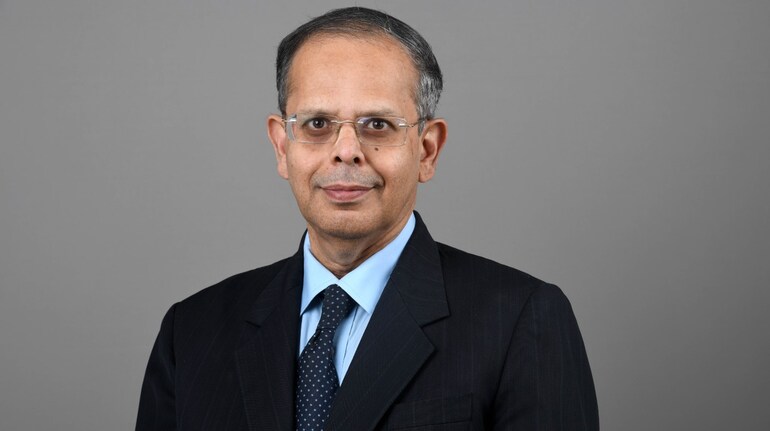
Persistently low inflation gave the Reserve Bank of India (RBI) the confidence to cut interest rates despite a stronger-than-expected GDP growth print, Saugata Bhattacharya, external member of the Monetary Policy Committee (MPC), said in an interview with Moneycontrol.
He said there are “little, if any, signs of the economy overheating”, pointing to manufacturing capacity utilisation stuck at 74–75 percent, well below levels that give firms pricing power. Stable commodity prices, including crude oil expected to remain around $60 a barrel, and continued import supply have also kept inflationary pressures in check, creating clear policy space for easing.
Bhattacharya said the GDP upside surprise was not strong enough to justify a pause, especially as forward-looking indicators show some moderation ahead. The MPC’s latest resolution projects growth easing to 7 percent in Q3 and 6.5 percent in Q4, with full-year FY26 growth at 7.3 percent, against the backdrop of a weak external environment. Slowing exports, mixed PMI readings and softer business sentiment increased the risks to growth, he said, adding that the rate cut was aimed less at lifting headline GDP and more at stimulating credit demand, particularly among micro, small and medium enterprises (MSMEs).
Edited excerpts:
Inflation has undershot expectations for months. Did that make you confident that the RBI had enough room to cut rates without risking overheating?
Let me begin with the disclaimer that I speak for myself, not the MPC. At present, there are little, if any, signs of the economy “overheating”. Manufacturing output for many quarters are at capacity utilisation levels (74-75 percent) which are lower than, in my experience in the past at around 80 percent, have given pricing power to producers. In addition, merchandise imports suggest that external supply is also adding to this “overcapacity”. Metals prices remain stable, and crude oil prices are still forecast to remain around $60/barrel, absent geopolitical shocks. Hence, this time, it made sense to be overweight on inflation.
GDP growth surprised on the upside, yet you backed a rate cut. Was the stronger print simply not convincing enough to maintain a pause? You point to weakening exports, PMI, and business sentiment indicators. How much did those red flags push you toward easing?
The forecast in the MPC resolution of GDP growth and inflation over the next few quarters shows the path of the evolution of the macroeconomic balance. The median forecasts of the Survey of Professional Forecasters (SPF) are a very credible supplement. The resolution forecasts growth to gradually moderate to 7 percent in Q3, 6.5 percent in Q4, with full FY26 growth at 7.3 percent. Again, the balance of risks, in the backdrop of an uncertain external environment, had shifted to acting on the policy space which low inflation had opened. While some high frequency indicators prior to the meeting suggested signs of a moderate slowdown, the rate cut was meant not so much to support growth, but more as an action to stimulate credit demand from MSMEs.
Transmission has now improved. Are you confident lower lending rates will actually reach MSMEs and spur investment?
As mentioned in RBI Governor’s statement, in response of the cumulative 100 basis points (bps) cut in the policy repo rate (together with the liquidity infusions), “the weighted average lending rate (WALR) of Scheduled Commercial Banks has declined by 69 bps for fresh rupee loans during February-October 2025 … [and] of outstanding rupee loans has been to the extent of 63 bps”. Given the RBI commitment to liquidity infusions, further transmission is also likely.
Bank credit offtake and the broader flow of resources to the commercial sector have been rising over the past few months, specially to both small and medium enterprises. This might be reflective of a moderate revival in private investment and a pickup in economic activity. A further cut in interest rates in the EBLR segments of banks’ loan portfolios is likely to boost credit demand, particularly in the MSME segment. This can complement the credit supportive measures (including the macro- and micro-prudential relaxations) which RBI has implemented in the financial sector.
You said you’d rather avoid being “behind the curve.” What signs would tell you the RBI is in danger of that?
Given my understanding of the evolution of “underlying” inflation over the next few quarter, in the backdrop of the forecast headline inflation, there remains a concern that prices might be less than optimal for stable economic growth. Prices are a very important incentive and determinant of economic decisions. Any significant deviation, up or down, distorts economic incentives for production, investment, consumption and savings and distorts the macroeconomic balance. Notwithstanding my concerns regarding the adverse effect of lower interest rates on household savings behaviour, and hence bank deposits, a priority now is to overweight growth in the balance of multiple objectives.
There are so many concerns on the Indian rupee, do market should be worried or RBI will keep protecting the rupee?
I do not presume to speak about RBI actions in the currency markets. However, the external balance, particularly the capital account, has been a source of some concern, given the significant re-orientation of global supply chains and asymmetric tariffs on our trade competitiveness. RBI has consistently communicated that interventions in the currency markets have only been to smoothen volatility. However, RBI has been extremely proactive and forward looking in managing system liquidity, which might have been affected by the interventions. It has maintained an ample supply of short-term and durable liquidity. The latest announcement on Tuesday emphasises this.
With the current easing, do we have a more space for further easing?
Given the persisting uncertainty, it is difficult to provide forward guidance on the policy rate path. There has been a coordinated response of multiple policy instruments and measures to stimulate growth and investment; fiscal, monetary, industrial, trade, labour and many others. Each measure has a specific set of objectives which complements the others. We need to monitor the outcomes of these measures on behaviour of economic agents before deciding the path and scope of further actions.
The decision at each meeting will be based on the available data, evaluating the appropriate balance of risks. Based on the current information set, I believe that the present policy rate and stance are well positioned for macroeconomic stability. However, this view can change as the economic environment evolves.

Discover the latest Business News, Sensex, and Nifty updates. Obtain Personal Finance insights, tax queries, and expert opinions on Moneycontrol or download the Moneycontrol App to stay updated!
Find the best of Al News in one place, specially curated for you every weekend.
Stay on top of the latest tech trends and biggest startup news.




