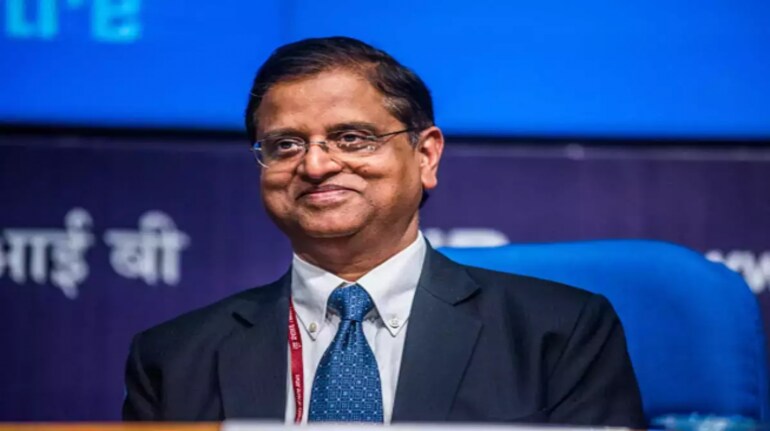
The government is unlikely to make commitments on bank privatisation in this budget, said former finance secretary Subhash Chandra Garg in an exclusive interview with Moneycontrol on January 30. Bank privatisation has been a long-pending agenda for the government but has not progressed, mainly on account of stiff trade union opposition.
“The finance minister mentioned in the 2021-22 budget that we will privatise two PSBs (public sector banks). That's not happening because that required the amendment in the banking nationalisation act,” Garg said, just ahead of Union Budget 2023. Finance minister Nirmala Sitharaman will announce the Budget 2023 on February 1.
“That amendment has not been brought in. Two years have gone by, and I don't see any possibility of that being brought in the remaining one year of the government's tenure,” Garg said.
In a freewheeling chat, Garg also spoke about a range of issues including the government’s digital drive, crypto regulations and the government’s challenges on fiscal consolidation. Edited excerpts:
What do you expect from the budget from a banking sector perspective?The budget does influence or affect the banking sector in many ways. For example, if the government raises enormous amounts of debt, that borrowing is funded by the banking sector tremendously. The budget also lays emphasis on the kind of expenditures that generate demand in the economy, for example, capital investment and the debt side of that is funded by the banking and the financial sector. So I would rather say that let us first look at the larger contours of the budget and then where the banking sector fits in.
What is your take on fiscal consolidation?In my sense, in the coming budget, the government is likely to keep the fiscal deficit at around 6 percent of GDP. This is a fairly large deficit in the context of the country, which impacts the rising debt of the government, which also then impacts interest rates in the system. I wish the government would go for reducing the fiscal deficit, but the kind of situation we are in in terms of the expenditure and the revenue projections and the government's agenda for the next year of expansionary capital expenditure, as well as some populist scheme, etc., I don't see fiscal consolidation taking place.
The Reserve Bank of India (RBI) wants to internationalise the rupee...The RBI is making efforts at internationalising the rupee and whenever we refer to internationalisation of the rupee or any currency for that matter, I think what we refer to is that the trade that takes place between countries is denominated and paid for in that particular currency. Much of India's trade has been taking place in dollars, some in yen and euros, but a large part, about 80 percent or so, takes place in dollars. Now, can you replace that trade with the rupee? There are some countries around us, for example, Bangladesh, Nepal, Bhutan and maybe Russia, which may be interested in doing some trade in rupees. But mind you, their currency is not the rupee. So when they trade, they would like to trade in their own currency, so how do you relatively fix the value of these two currencies? They (the above countries) do not have largely internationally traded currencies, etc. There is not much of a market in that. So while attempts are being made, I don't see any major momentum in internationalising the rupee.
Will bank privatisation get a push in the budget?What you're probably saying is in the context of the IDBI Bank, because that's the one on the block. The other two banks that the finance minister mentioned in the 2021-22 budget—that's not happening either because that requires the amendment in the bank nationalisation acts. That amendment has not been brought in. Two years have gone by, and I don't see any possibility of that being brought in the remaining one year of the government's tenure.
Well, a lot of time has already gone in solving some of these issues, some are still remaining. So I keep my fingers crossed, whether the government would be able to keep or offload the IDBI Bank (stake). But there is a possibility that this can be done.
Will digital banking and payment get an extra push in this budget?See, digital banking is the future. In fact, most of the banking today has become digital, in the sense that when you make your payments today, most likely you're using UPI, your IMPS or other things, except small payments, and that is through the banking system using the digital medium. Credit is increasingly becoming digital. But still, there is a lot of paperwork that is required as far as credit is concerned. That's what the 75 district banking units were supposed to reduce. But the real change in digital banking comes when banks become completely digital.
Do you expect any announcements on a central bank digital currency (CBDC)?I don't think the government needs to do anything more. They had made an enabling provision in the last budget itself by amending the RBI Act. So my sense is that as far as CBDC is concerned, there may not be anything in the budget.
Crypto was the talk of the town. Last year the finance ministry imposed 30 percent taxation (on virtual digital assets or VDAs). Do you see any changes this year?It was expected that the government at some point in time would come up with the indirect taxation system for crypto goods and services. That has not happened. It perhaps could be announced in this budget.
There were several incidents of frauds linked to digital lending apps. Can the government do something to tackle this issue?Again, this is not a budget issue. You see, the regulation of credit is entirely with the RBI, what do you permit to be delivered through credit cards, credit apps, and so on. So this is not a budget subject. And this requires a very detailed kind of regulatory arrangements to be put in place. The RBI has been doing a lot of regulatory action in this kind of thing. So my sense is, on this, we don't expect anything in the budget.
What are your views on fiscal deficit deviation from the norms prescribed under the Fiscal Responsibility and Budget Management Act, 2003, and the case for inflation-indexed taxation?We are in an era of very high fiscal deficits. It has enormous implications. Fiscal deficits need to be controlled. Fiscal deficits need to be taken care of. But the government has limitations. There has been pressure on the expenditure side, subsidies, etc. So my sense is that next year, as I said, the government will not be able to consolidate the fiscal deficit too much. It will be somewhere in the range of about 6 percent, maybe 5.8 percent or 5.9 percent. The exact numbers one can't predict, but somewhere very close to 6 percent. So fiscal consolidation is still not there. It will have to wait for probably the new government after 2024 to attend to this task.
Discover the latest Business News, Sensex, and Nifty updates. Obtain Personal Finance insights, tax queries, and expert opinions on Moneycontrol or download the Moneycontrol App to stay updated!
Find the best of Al News in one place, specially curated for you every weekend.
Stay on top of the latest tech trends and biggest startup news.