








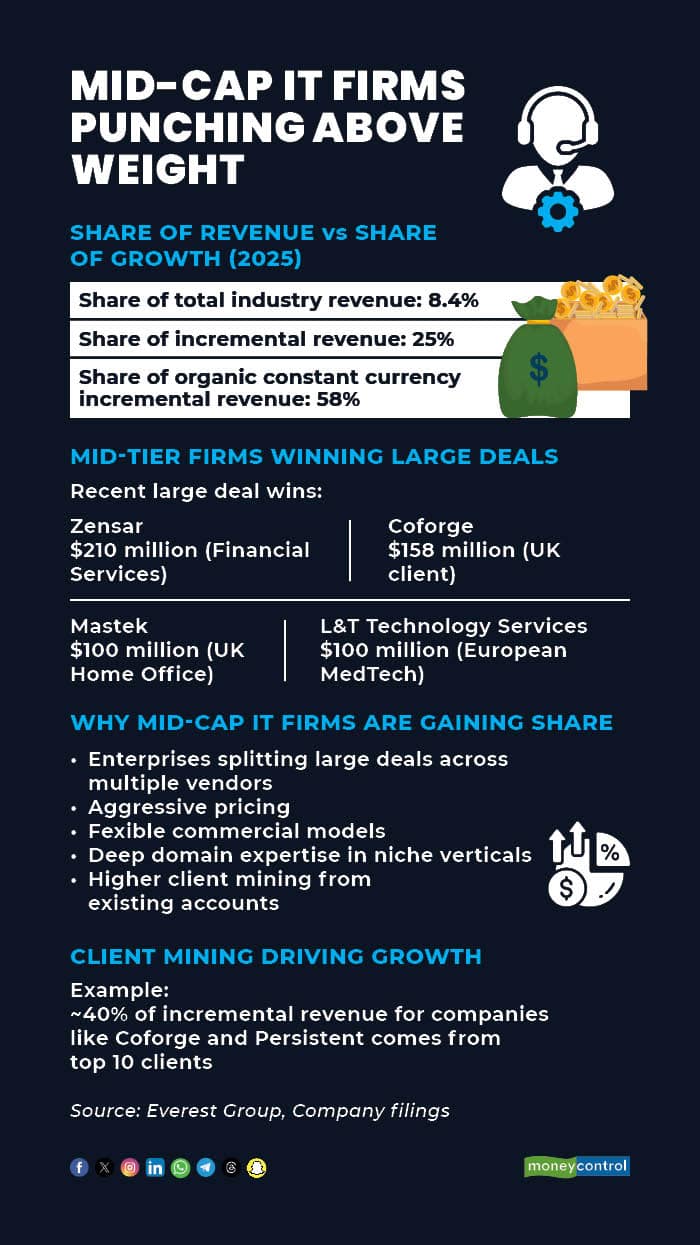
Mid-cap IT services firms captured a disproportionate share of industry growth in 2025, cornering nearly 58 percent of incremental revenue added by leading technology service providers as enterprises increasingly widened their vendor pool for large transformation deals.
Mid-sized service providers account for 8.4 percent of the total revenue among the 24 leading IT services firms that Everest Group tracks, up slightly from 7.8 percent in 2024.
Yet mid-caps contribution to industry growth has been far larger. These companies captured 25 percent of total incremental revenue and 58 percent of incremental revenue on an organic constant-currency basis in 2025, which shows how they are punching above their weight in new deal wins.
The trend is also becoming visible in recent deal announcements. Zensar Technologies signed a $210 million financial services contract, Coforge secured a $158 million engagement with a UK-based client, while Mastek won a $100 million contract with the UK Home Office. Larsen & Toubro Technology Services (LTTS) also announced a $100 million deal with a European MedTech client.
Mid-tier firms step into large-deal arena
Industry experts say the shift reflects a structural change in the outsourcing landscape, where large deals are no longer the exclusive territory of tier-one IT service providers.
Over the past few years, mid-tier firms have strengthened their ability to compete for large contracts by expanding sales teams, tightening deal governance and becoming more flexible in commercial structures such as outcome-based pricing.
“Mid-sized players are winning large deals for three clear reasons,” said Jimit Arora, CEO of Everest Group, pointing to their willingness to pursue transformation programs that often involve tighter margins and require upfront investments.
While larger companies tend to be cautious in such deals, mid-sized players are increasingly viewing them as strategic opportunities and deploying higher onshore presence to win and execute them.
Many mid-cap firms have also built strong domain expertise in specific industries and functions, enabling them to win larger engagements within existing accounts.
For companies such as Coforge and Persistent, about 40 percent of incremental revenue is coming from their top ten clients, underscoring the role of deeper client mining.
Cracking the large-deal playbook
Analysts say another factor behind the shift is that mid-tier companies have learned how to structure and compete for large outsourcing deals, which historically involved complex commercial models.
“Earlier, large deals used to be the sole domain of the big IT service providers,” said Pareekh Jain, CEO of Pareekh Jain Consulting and EIIRTrend. But the success of companies such as Persistent and Coforge over the past few years has shown that mid-sized firms can also win and execute these engagements.
A growing number of mid-tier firms are now replicating the playbook used by larger companies, including aggressive pricing strategies, longer deal tenures and financial commitments needed to secure large contracts, according to Jain.
At the same time, enterprises themselves are becoming more comfortable awarding large programs to multiple vendors instead of relying on a single large partner.
The maturity of the Indian IT ecosystem has also helped, with senior executives from tier-one firms moving into mid-sized companies and strengthening their deal-making and delivery capabilities, Jain added.
Market share shift underway
With AI-related deals still relatively small compared with traditional outsourcing contracts, analysts say the bigger growth opportunity for IT services firms continues to lie in large transformation programs.
Also, read: AI contracts start at $10 million while traditional deals run into hundreds of millions: Cognizant CFO
As more mid-tier companies develop the capabilities to compete in this segment, competition for large deals is intensifying and gradually redistributing market share within the industry.
For mid-cap IT firms, the strategy of aggressively pursuing large deals and expanding within existing clients is already translating into a larger share of industry growth.
The nature of technology spending itself is evolving, allowing specialised mid-sized firms to compete more effectively for large transformation programmes, said Kapil Joshi, CEO of IT Staffing at Quess Corp. “Enterprises are prioritising AI, cloud modernisation, data engineering and platform transformation, where specialised capabilities matter more than sheer scale,” Joshi said.
Many mid-size firms have built deep expertise in these areas and can deliver outcome-led programmes with leaner teams and faster execution.
Lower legacy burden aids AI and digital work
Executives at mid-tier companies say their operating models also make them better positioned to capture emerging opportunities in digital and AI-led work.
“Mid-size companies are better acute actually because the legacy pace that we have is lower,” said Sridhar Mantha, CEO of Generative AI Business Services (GBS) at Happiest Minds, during the company’s recent earnings press conference.
Mantha added that companies like Happiest Minds are largely focused on platform engineering, building new applications and developing new use cases for clients, which makes them better positioned to support emerging technology-led transformation programs.


Discover the latest Business News, Sensex, and Nifty updates. Obtain Personal Finance insights, tax queries, and expert opinions on Moneycontrol or download the Moneycontrol App to stay updated!
Find the best of Al News in one place, specially curated for you every weekend.
Stay on top of the latest tech trends and biggest startup news.







