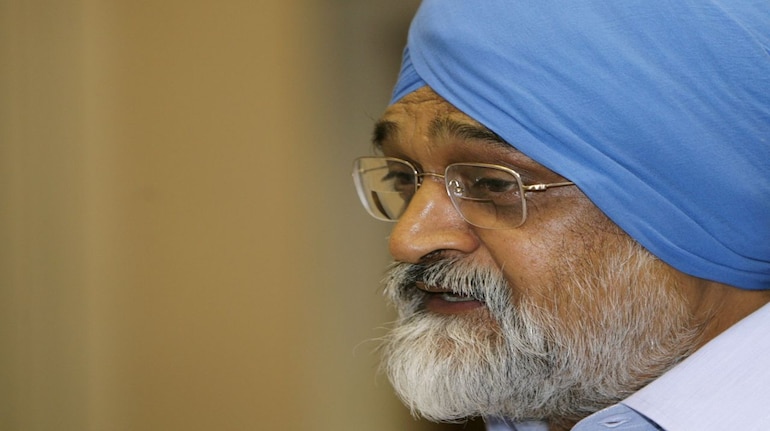
India should be open to lowering tariffs across all major partner countries through free-trade agreements, and not just the United States (US), the former Deputy Chairman of Planning Commission Montek Singh Ahluwalia said.
“Our tariffs are indeed too high for our own good and I have long argued we should lower them quite independent of the recent US pressure,” Ahluwalia told Moneycontrol in an interview.
India is currently negotiating trade deals with a slew of nations and blocs, including the US, the United Kingdom, the European Union, and New Zealand.
“I personally think India should be willing to lower tariffs across all major partners through the FTAs. The US will only deal bilaterally, so we are dealing with them bilaterally but I don’t think they will object to us giving similar treatment to Europe or the UK,” Ahluwalia, who was the country’s longest serving finance secretary from 1993 to 1998, said.
The veteran economist also batted for deeper trade agreements with larger areas or blocs rather than prioritising shallow deals with individual nations.
Edited excerpts of the interview with Ahluwalia:
India and the US have announced plans to more than double the bilateral trade to $500 billion by 2030 and negotiate the first tranche of a mutually beneficial, multi-sector Bilateral Trade Agreement (BTA) by the fall of 2025. What should be the focus areas of such a deal?
$500 billion is just the target for the trade we want to achieve. Actual outcomes will depend upon market decisions, although some decisions are taken by the government, for example, defence imports. Achieving this target will mean integrating more closely with US supply chains, and that requires a successful conclusion of the bilateral trade discussions.
On the substance of the negotiations, we know that the US regards India as a “tariff king”, so we will be under pressure to lower our tariffs. Our tariffs are indeed too high for our own good and I have long argued we should lower them quite independent of the recent US pressure. Other economists in the government, such as Arvind Panagariya, have also made the same point. I hope our negotiators recognise this aspect.
There are other issues that will also come up. The US is also concerned about intellectual property rights, investor protection, etc. I have no idea of what exactly they are demanding, but as a general rule, we should recognise that we cannot stick to our traditional positions if they are more restrictive than other developing countries. I think we need to recognise the need to align our positions with what other major developing countries are doing.
Should India open up its agriculture and dairy sectors to sign a trade deal with the US? The Trump administration has time and again pointed out that India needs to open up these sectors.
Anything involving farmers is always a sensitive issue in every country. The western countries support farmers through direct income support and therefore they have relatively lower tariffs on most areas of agriculture. We do not have the fiscal capacity to provide comparable subsidies hence we do it through tariffs. Even so, we have in the past, lowered tariffs in certain areas of agriculture such as for nuts and fruits. There are areas where we can lower tariffs in agriculture, which will not adversely impact the interest of Indian farmers. I am sure our negotiators are aware of the possibilities in these areas.
Dairy raises other issues. Our food standards prohibit the import of milk and milk-based products if the cattle that produce the milk have been fed with meat extracts and so on. This becomes a non-tariff barrier. It is not a problem vis-à-vis Europe because European cattle are not fed such products, whereas American cattle are. This is a sensitive issue and I have no idea how this can be handled.
India is negotiating a slew of trade deals with the likes of the US, the UK, the EU and New Zealand. Do you think brokering FTAs with the West is the best way to limit the fallout of global geopolitical and trade turmoil?
We have been trying to get these FTAs done for a long time. Concluding them has now become urgent because of geopolitical fragmentation. Both we and our European partners have a common interest in establishing rule-based access for each other in our markets.
Here again, the negotiations are not just limited to tariff reductions. They will also cover other areas such as access to legal services, investor protection, recourse to arbitration in the event of a dispute between the investor and the government, etc. As I have said these are all areas where we need to be more flexible.
Should India be worried that if we majorly lower tariffs and open up the market for the US we may have to do the same for other nations as well with whom we are negotiating trade deals?
I personally think India should be willing to lower tariffs across all major partners through the FTAs. The US wants to deal only bilaterally so we are dealing with them bilaterally but I don’t think they will object to us giving similar treatment to Europe or the UK.
Should India prioritise ASEAN-style larger trade agreements over pacts with individual nations?
Bilateral agreements with individual small countries are typically very shallow agreements and don’t contribute much to our total trade performance. I think we should aggressively enter into deeper agreements with much larger areas and consciously take steps domestically to bolster our domestic competitiveness. We decided to opt out of RCEP (Regional Comprehensive Economic Partnership) because our industry was not confident of being able to deal with China in a free trade environment. If that was the only real reason, we should now apply to join the CPTPT (Comprehensive and Progressive Agreement for Trans-Pacific Partnership).
I think we need to change the public posture we adopt in entering FTA negotiations. We should avoid making statements that we will ‘not sacrifice any vital national interest’. That is self-evident and needn’t be stated. Our public posture should be that we will ensure that national interests are fully protected by ensuring larger access to markets abroad while simultaneously creating a level playing field that will allow our producers to compete.
All FTAs involve reducing duties in a phased manner over a period of time, which gives enough time to take the domestic steps necessary to level the playing field. If we are aiming to become Viksit Bharat in 23 years, we should be able to implement the domestic changes needed to make our producers competitive over a five-year period.
This depends as much on state governments as the Centre. Individual states should be pushed to take steps to make their producers competitive. If they fail, their producers will lose out to producers in other Indian states.
While US President Donald Trump’s country-specific tariffs are on pause for 3 months, some measures are currently operational, including a baseline duty of 10 percent on all imports and a steep 25-percent levy on steel and aluminium. How do you see these steps impacting Indian exports given that America is our largest export destination?
Economists are pretty unanimous in suggesting that these tariffs will hurt the American consumer, and reduce growth rates in the US and also in the world. They have also greatly increased uncertainties. The extent of the damage, obviously, depends on whether the tariff increase is reversed soon.
The IMF has lowered the growth rate projection of the US for 2025 by almost one percentage point; it has also lowered growth rates for other major countries. Some economists are more pessimistic than the IMF and have projected that the US will go into recession.
A slowdown in the US and in the world will obviously hurt Indian exports even if we have a successful bilateral deal with the US. Perhaps the most optimistic outcome we can project is that some of the barriers imposed by the US on all countries will remain, but the very high reciprocal tariffs will be eliminated, except on China, where the US has other security related reasons for restricting trade.
Even under this assumption, global trade will be adversely affected and this will have a negative effect upon India. However, the effect upon India may be smaller than on other countries that are much more open.
Many observers have said that if the US retains high tariffs on imports from China, with lower tariffs on others, it might create a China plus one option for India which could offset the general negative effect. This is certainly a possibility but we should recognise that it will not materialise automatically. It depends critically on whether India is seen as an attractive destination for relocating global supply chains. Our domestic market is often mentioned as a positive factor, but it should not be exaggerated. It is much smaller in value terms than in terms of population size.
In the end, we will benefit only if we are seen as an attractive place for shifting supply chains. In recent years, both Vietnam and Bangladesh have done better than us in occupying the space vacated by China. This is because their import regime has been much more positive, and they are seen as places with greater ease of doing business.
The growth of exports of Apple iPhones from India to the US is a very positive development. But continued success in this area will depend upon free access to imported components from other countries. We can certainly hope to build up domestic supply capability in these components in due course, but it must be done gradually. Any premature forcing of indigenisation will kill the opportunity. We also need to have an FDI policy which will encourage investors to set up capacity in India and that brings in issues of investor protection and ease of doing business.
Are global factors behind India’s languishing exports?
I really don’t think we can blame our export performance on the world. India’s share in world exports has been going down in the last four to five years. In FDI also India’s share in the world is going down.
The Finance Ministry, to its credit, has acknowledged the domestic constraints that limit our performance. It has been pointed out that our labour market is not flexible enough, our capital market is not adequate and our land market is particularly distorted. And our regulations are also especially burdensome. All this impacts MSMEs much more, and since these units account for most of our exports, it is reflected in the country’s export performance. We also have an inverted duty structure, in the sense, that some of the critical inputs used by labour-intensive medium industries have higher duty rates on intermediates than other countries. As a result, input costs for our exporters are higher. These problems are much, much worse for small and medium industries than for large industries which are not very export oriented.
We should announce a timebound plan to resolve these problems, within five years, to give Indian industry the confidence that they will be able to compete in a free trade world.
How would you assess the current economic situation in the country? A slew of corporate results point to weak urban demand and some major companies have put hikes and hirings on hold. India’s GDP growth is also expected to be impacted by the global trade turmoil.
Before the US tariff action, India was projected to achieve a growth of about 6.5 percent in FY26. That was better than other emerging markets, but not at the level which we need for Viksit Bharat goals, which call for 7.8 to 8 percent growth in constant prices, as NITI Aayog has stated.
The turmoil in global tariffs has lowered growth projections for the world, including for developing economies and it will also affect India. It will certainly impact investment plans. On the whole, there is too much uncertainty at present to make reliable forecasts. We will be in a better position to make forecasts when the tariff turmoil has ended and we can see where the US tariffs will finally end up. Meanwhile, everybody would be well advised to fasten seat belts.
Discover the latest Business News, Sensex, and Nifty updates. Obtain Personal Finance insights, tax queries, and expert opinions on Moneycontrol or download the Moneycontrol App to stay updated!
Find the best of Al News in one place, specially curated for you every weekend.
Stay on top of the latest tech trends and biggest startup news.