






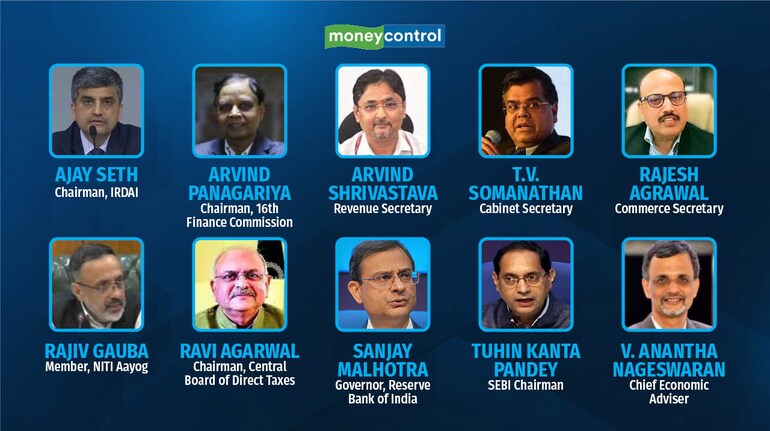

2025 emerged as a defining year for India’s economic governance, shaped not only by elected leadership but by a cohort of powerful bureaucrats who drove structural reforms across taxation, regulation, finance, trade, and institutional modernisation. From redesigning the tax architecture and advancing deregulation to steering monetary policy, strengthening financial-sector oversight, accelerating insurance reform, and guiding macro-economic policy, these senior officials translated policy intent into execution — enhancing compliance, investor confidence, and institutional resilience — and emerged as the year’s key economic newsmakers in government.
Cabinet Secretary T.V. Somanathan
Somanathan is one of the two key officials leading the Centre’s deregulation drive. He heads a taskforce overseeing state-level deregulation to improve ease of doing business, identifying 23 priority areas including land and real estate, labour flexibility, decriminalisation, No Objection Certificate (NOC) reforms, and single-window clearances. He has also directed ministries to support indigenous development of digital and social-media platforms and is steering initiatives to improve the global ranking of Indian universities, banks, and tourist destinations.
Why it matters
His work seeks to dismantle bureaucratic barriers, promote technological self-reliance and strengthen institutional competitiveness — boosting investment sentiment, economic efficiency, and governance credibility.
Arvind Panagariya, Chairman, 16th Finance Commission
In 2025, the 16th Finance Commission under Arvind Panagariya reached its key milestone by submitting its final report on 17 November 2025 after extensive consultations with the Centre and states. The report sets out how much of the Union government’s tax revenues should be shared with states overall (vertical devolution) and how that amount should be distributed among individual states using indicators such as population, income levels and development needs (horizontal devolution). It also proposes a clearer funding framework for disaster management and recommends steps to strengthen the finances of Panchayats and Municipalities so local bodies have more predictable resources for basic public services.
Why it matters
The award will shape inter-governmental fiscal transfers for 2026-27 to 2030-31, influencing welfare spending, infrastructure investment, and fiscal discipline, while balancing equity for poorer states with efficiency incentives for better-performing ones.
Sanjay Malhotra, Governor, Reserve Bank of India
Appointed RBI Governor in December 2024, Malhotra guided monetary policy in 2025. The RBI delivered about 125 bps of rate cuts amid easing inflation and stable growth, with Malhotra describing the year as a “rare Goldilocks period.” The central bank maintained a flexible exchange-rate approach, unveiled the National Strategy for Financial Inclusion 2025-30, and undertook liquidity-enhancement operations — including bond purchases and Foreign Exchange (FX) swaps — to stabilise markets and support credit conditions.
Why it matters
His calibrated easing and financial-inclusion push supported growth, credit, and consumption, while signalling a pragmatic, stability-focused stance during external volatility.
Rajesh Agrawal, Commerce Secretary
Taking charge in October 2025, Agrawal played a key role in one of India’s busiest years for trade diplomacy. India concluded or advanced major agreements including the India–UK CETA, India–Oman CEPA, the India–New Zealand FTA, while the India–EFTA TEPA came into force. The much-awaited trade arrangement with the United States remains work in progress with over 50 percent of India’s exports facing a ‘penal’ 50 percent tariff. An FTA with the European Union (EU) is however making rapid progress and is expected to conclude by January 2026.
Why it matters
His leadership expanded market access, diversified export destinations, and strengthened resilience during a period of tariff uncertainty and global trade headwinds. The new FTAs, both concluded ones and those being negotiated, will help Indian exporters looking for alternatives to the US. Importantly, policy support has already helped exporters find new markets during the current fiscal, thus blunting the impact of the higher US tariffs.
Rajiv Gauba, Member, NITI Aayog
As a full-time member of NITI Aayog in 2025, Gauba led two high-powered reform panels tasked with advancing the Viksit Bharat agenda through long-term development and regulatory-rationalisation frameworks. The panels worked with industry and ministries to identify compliance bottlenecks — including product standards and quality-control processes — and proposed reforms to improve competitiveness.
Why it matters
Gauba’s work targets the nuts and bolts of regulatory governance, reducing compliance friction, improving business efficiency, and supporting ease-of-doing-business gains across states.
Tuhin Kanta Pandey, SEBI Chairman
Appointed as Chairman of the Securities and Exchange Board of India (SEBI) in February 2025, Tuhin Kanta Pandey assumed office at a pivotal moment for India’s financial markets. His tenure coincided with a structural shift in household savings, as domestic investors increasingly moved capital from traditional instruments into equity markets. A former Revenue Secretary, Pandey has led a series of significant regulatory reforms focused on strengthening investor protection, improving market efficiency, and enhancing the ease of doing business. Key initiatives under his leadership include the simplification of Stock Broker Regulations, an overhaul of Mutual Fund Rules and the streamlining of the onboarding process for Foreign Portfolio Investors (FPIs).
Why it matters
Pandey’s proactive regulatory approach has reinforced investor confidence while signalling a pragmatic, market-friendly and growth-oriented stance by the regulator.
V. Anantha Nageswaran, Chief Economic Adviser
As CEA, Nageswaran shaped macro-economic discourse during a year of external shocks and policy transition. He highlighted resilience in domestic demand, projected that FY26 growth would be above expectations, and noted that strong consumption helped buffer the impact of US tariff-related export headwinds, allowing India to retain its growth outlook. He also played a key role in devising the Economic Survey’s analytical framework and macro-projection guidance.
Why it matters
His assessments influenced fiscal planning, growth strategy, and investor expectations — helping policymakers balance optimism with realism in a fluid global environment.
Arvind Shrivastava, Revenue Secretary
Shrivastava emerged as a key architect of GST 2.0, steering rate-rationalisation, classification simplification, and technology-led compliance reforms. He also coordinated the transition framework for the Income-tax Act, 2025, aligning processes with CBDT to reduce disputes and strengthen digital-first tax administration, while synchronising revenue mobilisation and compliance priorities during fiscal consolidation.
Why it matters
GST 2.0 marks the most significant recalibration of indirect taxes since 2017, enhancing predictability, lowering business-cost frictions, and strengthening trust in the tax ecosystem.
Ravi Agarwal, Chairman, Central Board of Direct Taxes
Agarwal led direct-tax modernisation and administrative readiness for the new Income-tax Act. Transition-period relief such as deadline extensions was paired with tighter scrutiny of high-risk refund claims, while the NUDGE campaign encouraged analytics-based, voluntary self-correction by taxpayers. His tenure was extended from 1 July 2025 to 30 June 2026 for continuity through the reform cycle.
Why it matters
His leadership anchors a shift toward a simpler, technology-enabled, taxpayer-centric direct-tax regime, improving compliance quality and institutional resilience.
Ajay Seth, Chairman, IRDAI
Seth assumed charge of the Insurance Regulatory and Development Authority of India (IRDAI) on 1 September 2025, leading consumer-centric and modernisation reforms. He oversaw passage of the Insurance Laws (Amendment) Bill, 2025, raising Foreign Direct Investment (FDI) in insurance to 100 percent, coordinated efforts to pass on GST exemptions on health and life insurance, and launched Bima Sugam, a digital public infrastructure platform for unified policy services. As Economic Affairs Secretary earlier, he helped shape the FY26 Budget, including the higher income-tax thresholds and MSME support.
Why it matters
His reforms are reshaping the insurance ecosystem for greater competition, access, and digital inclusion, advancing the goal of Insurance for All by 2047.

Discover the latest Business News, Sensex, and Nifty updates. Obtain Personal Finance insights, tax queries, and expert opinions on Moneycontrol or download the Moneycontrol App to stay updated!
Find the best of Al News in one place, specially curated for you every weekend.
Stay on top of the latest tech trends and biggest startup news.





