






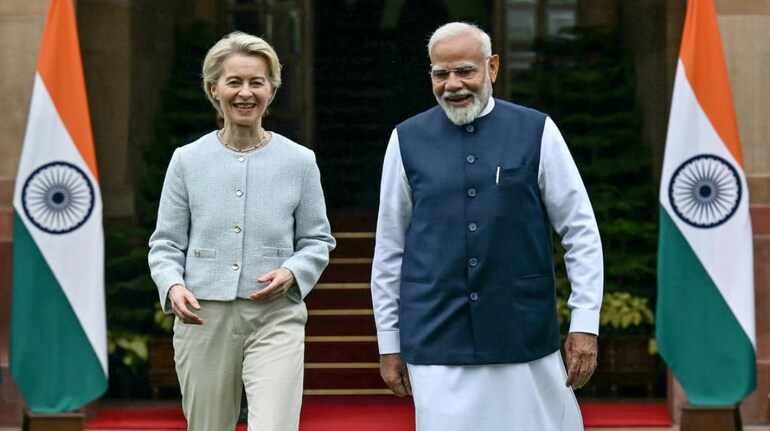

India and the European Union (EU) are on the brink of signing a long-pending free trade agreement on January 27, but the negotiations leading up to the pact have been defined by hard red lines drawn by both sides after years of talks.
Relaunched in 2022 after remaining stalled for nearly a decade, the India–EU negotiations have progressed amid shifting global trade dynamics, supply-chain diversification efforts and a growing push by both sides to deepen strategic economic ties.
“Even as momentum picked up in recent rounds, negotiators have remained careful to balance market-opening commitments with domestic policy priorities, making the talks as much about managing sensitivities as expanding trade,” an official from the commerce ministry said.
The European Union is a 27-nation bloc, with key member states including Germany, France, Italy, Spain and the Netherlands. Bilateral goods trade between India and EU was around $130–136 billion in 2024–25, making the EU one of India’s largest export destinations. Goods exports from India to the EU were about $75 billion and imports about $65 billion in recent years, while services trade also contributes sizeable flows.
India rings fences around farms, seeks gradual opening in manufacturing
Throughout the negotiations, India has maintained that certain sectors required special treatment under the agreement. Agriculture and dairy remained among New Delhi’s clearest red lines, with Indian negotiators repeatedly resisting EU demands for wider market access in these areas, citing concerns related to domestic supply chains, food security and the predominance of small-scale producers. Officials have argued that insulating these sectors preserves stability in rural supply chains, even as India seeks gains elsewhere in the agreement.
India has also consistently argued for a calibrated and phased approach to tariff reductions in manufacturing. Officials privy to the talks said the intent is to ensure that domestic manufacturers are not exposed to abrupt import competition. At the same time, India is seeking to use the agreement to attract investment, integrate more closely into European value chains, and expand exports in labour-intensive sectors such as textiles, garments, leather goods and engineering products.
EU pushes market access, holds line on climate-linked rules
The EU, meanwhile, has held firm on its core commercial and regulatory priorities.
“Brussels has been pushing for deeper tariff cuts on industrial goods, including automobiles and auto components, and greater access for European service providers,” said a second official privy to the negotiations. “Improved entry into India’s large and fast-growing consumer market is seen as central to the economic rationale of the deal.”
Besides, European companies have also sought greater regulatory predictability, particularly in sectors such as automobiles, chemicals, medical devices and professional services.
A key EU red line throughout the talks has been its climate-linked trade framework. The bloc has resisted Indian efforts to seek carve-outs or dilution of measures such as the Carbon Border Adjustment Mechanism (CBAM). It has also held firm on sustainability-related provisions linked to the EU’s broader Green Deal, due-diligence rules and environmental standards.
“EU negotiators have argued that retaining these frameworks helps ensure a level playing field for European producers and aligns trade policy with the bloc’s climate objectives,” one of the officials quoted above said.
India, for its part, has raised concerns over the trade impact of such measures, particularly on energy-intensive exports such as steel, aluminium and cement. During negotiations, Indian officials have cautioned that unilateral climate-linked regulations risk becoming de facto trade barriers, even as New Delhi seeks enhanced access to the EU market for products such as pharmaceuticals, textiles and processed goods.
Discover the latest Business News, Sensex, and Nifty updates. Obtain Personal Finance insights, tax queries, and expert opinions on Moneycontrol or download the Moneycontrol App to stay updated!
Find the best of Al News in one place, specially curated for you every weekend.
Stay on top of the latest tech trends and biggest startup news.





