




Issues related to the European Union’s Carbon Border Adjustment Mechanism (CBAM) are unlikely to be part of the proposed free trade agreement between India and the EU, and any concessions sought by New Delhi are expected to be discussed separately between the two sides, sources told Moneycontrol.
“CBAM (concessions from carbon tax) is unlikely to be part of the trade deal with the EU,” a government source said, adding that those talks continue separately.
The EU introduced CBAM on October 1, 2023, a duty that will translate into a 20-35 percent tax on select imports starting January 1, 2026 with an aim to reach net-zero greenhouse emissions by 2050.
While the sectors covered under CBAM include cement, iron and steel, aluminium, fertilisers, electricity and hydrogen, India's iron and steel, aluminium and cement industries are expected to be hit the hardest by the EU's carbon tax.
An industry source directly privy to the matter said that while concessions to the EU’s carbon tax won’t be part of the trade deal, New Delhi’s own proposed system for collecting CBAM duties in India could offset the costs related to the European bloc’s levy.
In 2024, Commerce Minister Piyush Goyal said that India is considering a suggestion from the EU for New Delhi to come up with its own mechanism instead of paying higher taxes to the bloc under the CBAM.
India is also said to be considering a carbon tax, especially for exports to European nations, even as it seeks relaxations from EU’s carbon tax, particularly for smaller exporters.
Goyal recently criticised the unilateral, environmental restrictions that certain countries are introducing, without directly mentioning the European Union's CBAM, while addressing the 16th session of the United Nations Conference on Trade and Development (UNCTAD).
The Ministry of Commerce and Industry did not respond to requests for comment at the time of publication of this report.
Carbon Conundrum
To be sure, some of New Delhi’s concerns about CBAM may have already been addressed, notably through the EU-India Agenda adopted by the 27-nation bloc last month.
Under this framework, if Indian companies pay a carbon price in India, the EU will reduce what they owe under the CBAM. This will help exporters who cut their emissions, while the bloc has also promised to simplify the carbon tax system to support small businesses.
Last month, the think tank Global Trade Research Initiative (GTRI) noted that while the EU’s new strategic agenda states that carbon prices paid under India’s upcoming Carbon Credit Trading Scheme (CCTS) can be deducted from CBAM liabilities, this is not a concession, as existing regulations already allow such deductions for all countries.
GTRI added that India’s Carbon Credit Trading Scheme is not yet ready, which means Indian exporters may have to bear the EU’s CBAM burden entire starting January 1, 2026.
Even before the implementation of the EU’s carbon tax, importers have had to submit quarterly reports on the embedded greenhouse gas emissions in CBAM-covered imports and any carbon price paid in the country of origin since October 2023.
Indian exporters, especially MSMEs have struggled with this compliance-heavy procedure, GTRI noted. In FY25, India’s steel and aluminium exports to the EU dropped 24.4 percent on-year to $5.82 billion.
India-EU FTA
The absence of matters related to CBAM in an FTA follows the approach taken when India and the United Kingdom on July 24 signed a Comprehensive Economic Trade Agreement (CETA) leaving out the carbon tax. Both sides agreed to discuss the issue separately at a later stage.
Negotiations for a trade deal between India and the EU are currently in their final stage. The 14th round of talks took place in Brussels from October 6 to 10, covering 12 policy chapters across 91 technical sessions, with discussions focussing on areas such as market access for goods and services, and rules of origin.
While virtual engagement is ongoing between India and EU, in-person interactions are also scheduled in November.
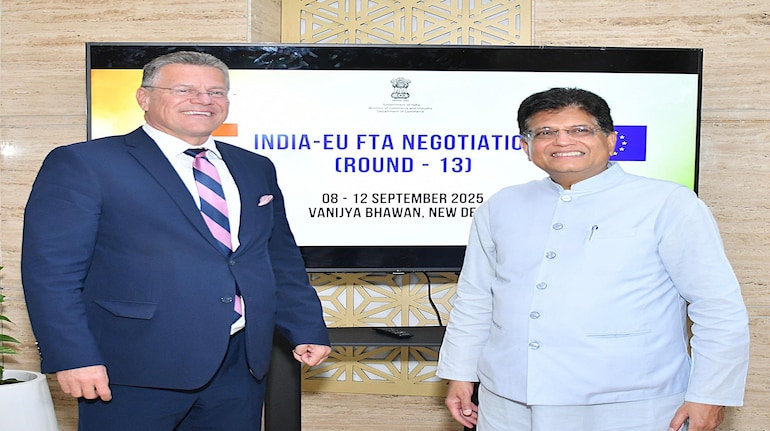
Minister Piyush Goyal on October 28 concluded a two-day visit to Brussels, where he met with Maroš Šefčovič, the EU Commissioner for Trade and Economic Security. Their discussions focused on giving further impetus to the India–EU FTA negotiations.
“The talks have significantly reduced our outstanding issues and allowed us to create the framework that will help deliver a win-win for our economies.,” Goyal said on October 28.
In February 2025, India and the EU decided to ramp up talks for the proposed FTA, targeting to close it by the end of 2025 to tide over ongoing disruptions from volatile trade policies.
Discover the latest Business News, Sensex, and Nifty updates. Obtain Personal Finance insights, tax queries, and expert opinions on Moneycontrol or download the Moneycontrol App to stay updated!
Find the best of Al News in one place, specially curated for you every weekend.
Stay on top of the latest tech trends and biggest startup news.