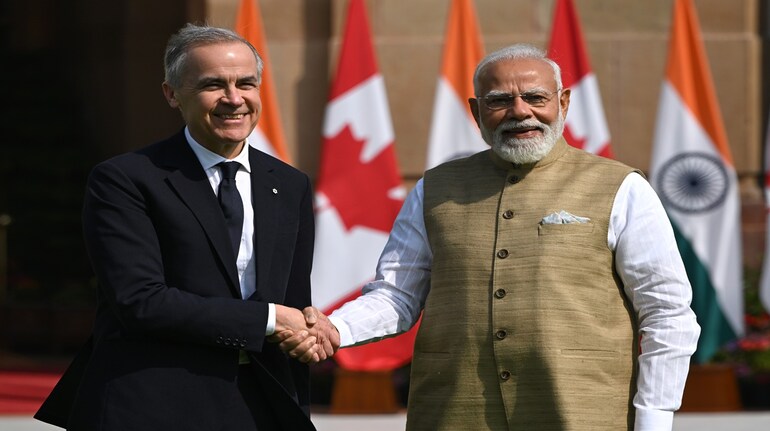
India and Canada, on Monday, signed a wide-ranging Memorandum of Understanding (MoU) on critical minerals cooperation and sealed a long-term uranium supply agreement during Canadian Prime Minister Mark Carney’s first official visit to India. This sets in motion a significant expansion of energy and technology ties between the two nations.
The agreements were concluded in the presence of Prime Minister Narendra Modi in New Delhi, where the two leaders also outlined plans to deepen collaboration across nuclear power, renewable energy, advanced technologies and space.
Speaking on the occasion, PM Modi announced the "landmark deal" for long-term uranium supply and said the two sides would deepen cooperation across renewable energy, critical minerals, nuclear power, technology and advanced research.
As part of the package, Canadian uranium producer Cameco Corp. signed a C$2.6 billion ($1.9 billion) agreement to supply 22 million pounds (about 11,000 tonnes) of uranium to India between 2027 and 2035, according to a statement from the Canadian Prime Minister’s Office.
The long-term fuel arrangement comes as India moves to sharply scale up nuclear generation capacity to 100 gigawatts by 2047, nearly eleven times its current level of 8.8 gigawatts, which accounts for less than 2% of total installed power capacity. With domestic uranium reserves insufficient to meet future demand, sustained imports are seen as critical to the expansion plan.
Canada, the world’s second-largest uranium producer with roughly 13-15% of global output, exports the bulk of its production to nuclear markets in the United States, Europe and Asia.
Alongside the uranium pact, the two countries signed an MoU on critical minerals aimed at securing resilient supply chains for resources essential to clean energy technologies, electric vehicles, batteries and advanced manufacturing. The framework is expected to promote joint research, investment partnerships and private-sector participation in exploration and processing.
The two sides also agreed to expand cooperation in liquefied natural gas, solar power, hydrogen and energy storage, and will hold an India-Canada Renewable Energy and Storage Summit later this year.
Shortly after holding bilateral talks with Canadian PM Carney in Delhi, the Prime Minister stated, “We are pleased that Canada has decided to join the International Solar Alliance and the Global Biofuel Alliance.” He added that the two sides will hold the India-Canada Renewable Energy and Storage Summit later this year to advance clean energy collaboration.
“In civil nuclear energy, we have reached a landmark deal for long-term uranium supply. We will also work together on small modular reactors and advanced reactors,” PM Modi said.
Canada announced its decision to join the International Solar Alliance and the Global Biofuel Alliance, further aligning with India’s clean energy initiatives.
In civil nuclear cooperation, the leaders said they would also explore collaboration on small modular reactors and advanced reactor technologies.
Beyond energy, both governments also committed to expanding collaboration in emerging technologies, including artificial intelligence, quantum computing, supercomputing, and semiconductors. An initial pact was signed to cooperate on AI development and deployment under the Australia-Canada-India Technology and Innovation Partnership.
The two countries also agreed to deepen cooperation in the space sector by connecting startups and industry players.
Indian IT major HCL Technologies Ltd. announced plans to expand its Canadian operations, potentially increasing its workforce there by 75% by 2030.
Highlighting innovation-led growth, the Prime Minister described the two countries as “natural partners in technology and innovation.”
“With the Canada and India innovation partnership, we will turn ideas into global solutions. I thank Prime Minister Carney for Canada’s valuable contribution to the success of the AI Impact Summit held in India last month,” he said.
PM Modi said cooperation would expand in emerging technologies. “We will enhance cooperation in AI, as well as quantum, supercomputing and semiconductors,” he said.
Referring to the agreement signed earlier in the day, PM Modi said, “The MoU signed today on critical minerals will strengthen resilient supply chains.”
He also outlined plans for collaboration in the space and energy sectors. “In the space sector, we will connect startups and industries from both countries. In the energy sector, we are building a next-generation partnership, with special emphasis on hydrocarbons as well as renewable energy, green hydrogen and energy storage,” he said.
The agreements signal a stabilisation in bilateral relations after tensions escalated in 2023 over Canadian allegations of Indian-linked involvement in violent incidents on its soil. Both sides now appear focused on rebuilding strategic and economic engagement.
Ottawa and New Delhi plan to conclude a new Comprehensive Economic Partnership Agreement this year, with a goal of doubling bilateral trade by 2030.
Nuclear cooperation between the two nations dates back to the 1950s, though it was disrupted after India’s 1974 nuclear test. A breakthrough came with the 2008 civil nuclear agreement with the U.S., which reopened global access to reactor fuel and technology for India. A bilateral nuclear cooperation pact signed in 2010 paved the way for an earlier uranium supply deal in 2015, which has since expired.
Discover the latest Business News, Sensex, and Nifty updates. Obtain Personal Finance insights, tax queries, and expert opinions on Moneycontrol or download the Moneycontrol App to stay updated!





Find the best of Al News in one place, specially curated for you every weekend.
Stay on top of the latest tech trends and biggest startup news.