






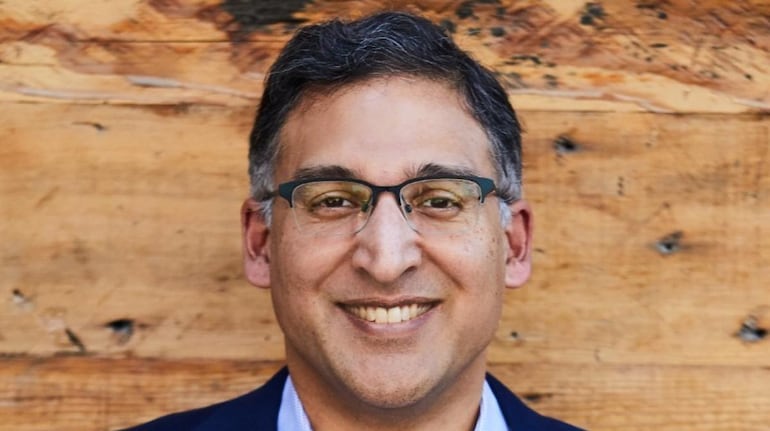

Indian-American lawyer Neal Katyal, on Saturday, raised fresh legal concerns over US President Donald Trump’s decision to impose a 15 percent global tariff, arguing that the move contradicts the administration’s own earlier position before the Supreme Court of the United States.
Katyal, who successfully argued before the Supreme Court against Trump’s earlier sweeping tariff measures, but was not a member of the bench, questioned the President’s reliance on Section 122 of the Trade Act of 1974 after the Court struck down most of the administration’s prior tariff regime.
Taking to microblogging site X, Katyal wrote, "Seems hard for the President to rely on the 15 percent statute (sec 122) when his DOJ in our case told the Court the opposite: ‘Nor does [122] have any obvious application here, where the concerns the President identified in declaring an emergency arise from trade deficits, which are conceptually distinct from balance-of-payments deficits".
Seems hard for the President to rely on the 15 percent statute (sec 122) when his DOJ in our case told the Court the opposite: “Nor does [122] have any obvious application here, where the concerns the President identified in declaring an emergency arise from trade deficits, which…— Neal Katyal (@neal_katyal) February 21, 2026
He added, "If he wants sweeping tariffs, he should do the American thing and go to Congress. If his tariffs are such a good idea, he should have no problem persuading Congress. That’s what our Constitution requires".
Katyal underscored that the Department of Justice had previously distanced itself from Section 122 in court filings, making it difficult for the President to now invoke the same provision to justify the new tariffs.
The scrutiny follows a landmark 6-3 ruling by the Supreme Court, which held that the administration exceeded its authority by using the International Emergency Economic Powers Act (IEEPA) of 1977 to impose broad-based import tariffs. The Court reaffirmed that the constitutional power to levy taxes rests primarily with Congress.
Earlier this week, speaking to CNN about the ruling, Katyal noted the unusual margin in the deeply polarised judicial climate. "Oftentimes in these high-profile cases, there are 5 to 4. But this one was 6 to 3. And notably with two of President Trump’s three appointees voting against him," he remarked.
Katyal, a former Acting Solicitor General who represented small businesses challenging the tariffs, said the administration’s legal strategy ultimately undermined its case. "Acting in a constitutional way instead of this ridiculous ‘I am the president I can do whatever I want’ stuff," he said when asked what could have been done differently.
"It is really hard to win a case against the US President in the Supreme Court but we managed to do that because the President took such an extreme position. We only cared about one thing — Constitution," he added.
Immediately after the ruling late Friday evening, Katyal had described it as a powerful reaffirmation of constitutional limits. "Today, the United States Supreme Court stood up for the rule of law, and Americans everywhere. Its message was simple: Presidents are powerful, but our Constitution is more powerful still. In America, only Congress can impose taxes on the American people," he said.
Trump had quickly responded by announcing a new 10 percent global tariff under Section 122 of the Trade Act of 1974, describing it as a temporary import surcharge of up to 15 percent for 150 days to address balance-of-payments deficits. He later increased it to the "fully allowed, and legally tested, 15% level," effective immediately.
In a Truth Social post, Trump criticised the Supreme Court’s judgment as a "ridiculous, poorly written, and extraordinarily anti-American decision," and said his administration would determine new, legally permissible tariffs in the coming months to continue "Making America Great Again".
At the centre of the renewed debate is whether trade deficits can legally be equated with balance-of-payments deficits -- the statutory basis for Section 122. Katyal has argued that the two are “conceptually distinct,” echoing the DOJ’s earlier submission to the Court.
Former IMF First Deputy Managing Director Gita Gopinath endorsed Katyal’s analysis on X, remarking that he was "speaking International Economics 101" in questioning the administration’s reliance on Section 122, as the legal justification appears to conflict with basic economic distinctions.
.@neal_katyal speaking International Economics 101:“Nor does [122] have any obvious application here, where the concerns the President identified in declaring an emergency arise from trade deficits, which are conceptually distinct from balance-of-payments deficits." https://t.co/lQyeKGJ4Hi — Gita Gopinath (@GitaGopinath) February 21, 2026
Trump’s latest move also comes amid ongoing trade negotiations between the U.S. and India. On February 7, the two countries announced a framework for an interim agreement on reciprocal and mutually beneficial trade, reaffirming their commitment to broader bilateral trade talks.
The interim arrangement envisages India reducing or eliminating tariffs on selected US industrial, food and agricultural products, while the US applies a reciprocal 18 per cent tariff on certain Indian-origin goods under an existing executive order, with provisions for removal upon conclusion of a comprehensive deal.
A White House official confirmed that countries including India would remain subject to the 10 per cent global tariff until another legal authority is invoked, urging trading partners to adhere to existing agreements.
In response to the Supreme Court judgment and subsequent tariff announcements, India’s Commerce and Industry Ministry said it was studying the implications of the developments and assessing their potential impact.
Reflecting on the broader significance of the case, Katyal emphasised that it transcended partisan politics. "This case has always been about the presidency, not any one president. It has always been about the separation of powers, and not the politics of the moment," he said.
"The idea that we have a system that self-corrects, that allows us to say you might be the most powerful man in the world, but you still can’t break the Constitution, that is what today is about".
Discover the latest Business News, Sensex, and Nifty updates. Obtain Personal Finance insights, tax queries, and expert opinions on Moneycontrol or download the Moneycontrol App to stay updated!
Find the best of Al News in one place, specially curated for you every weekend.
Stay on top of the latest tech trends and biggest startup news.





