






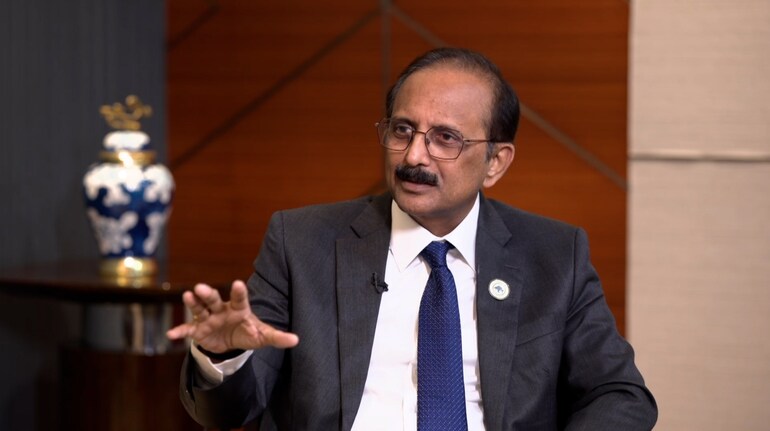

The movement of household savings from bank deposits to other instruments such as mutual funds and insurance is an irreversible trend, and the answer lies in better churning of banks’ assets through securitisation, SBI Chairman CS Setty said in an exclusive interview with Moneycontrol.
Speaking in our series Latha & The Leaders, Setty admitted that while SBI can manage 9 percent deposit growth and over 15 percent loan growth for a quarter or two, for the system as a whole, a 5–6 percentage point gap between loan and deposit growth is unsustainable.
Arguing that securitisation is the way forward, he pointed out: “In India, 99 percent of our balance sheet is built by deposits; in Western countries, only 65–70 percent is contributed by deposits, the rest is market instruments.” India’s securitisation market is too insignificant and has to improve, he said. “The mortgage-backed securities and the asset-backed securities market has to evolve, and insurance companies, mutual funds and pension funds that are staying away from the non-gsec market have to come into the securitisation market.”
The Indian financial sector has begun churning real estate and infra assets through REITs and InvITs; “hopefully we will start churning retail assets also soon,” he said.
A key highlight of the interview was Setty’s detailed explanation of how the performance gap between private and PSU banks, both in the stock market and in the P&L, is narrowing. Indeed, this is one of the key themes that stock prices are reflecting. Macquarie banking analyst Suresh Ganapathy, in a note sent to investors last week, pointed out that “at today’s price SBI trades at a mere 10 percent discount at 1.5x core P/BV compared to Axis Bank’s core P/BV at 1.7x on FY27E basis.”
Year to date in 2026 SBI share is up 23 percent, while ICICI is up only 4 percent and HDFC is down 7 percent. Ganapathy points to the many reasons for this narrowing gap:
Setty gave much credit to the government’s E.A.S.E. (Enhanced Access & Service Excellence) programme for the improvement in PSU bank performance. The asset quality review of 2015 was the inflection point for PSU banks, he said, when banks were saddled with huge bad loans. The government resorted to the three 'R' - recognise, resolve and recapitalise, Setty said.
But then began the hard work through the annual EASE programmes under the stewardship of the government and the IBA, he said. “In one of the EASE programmes, I pushed the PSU banks to resort to analytics-based lending, when some of the banks said they don’t have data warehouses. The EASE programme worked to fill this gap by setting benchmarks in areas like technology, digitalisation, governance, risk management and HR,” he explained.
Today, all PSU banks have data warehouses and analytics-driven models, and hence the narrowing of the gap between private and public sector banks on P&L and stock market performance, he said. “Of course, world over banks are witnessing a benign asset cycle,” he added in his characteristic humility.
So what does he expect from the high-level committee on the banking sector proposed by the Budget? Setty said he was not privy to the government’s plans, but hoped the committee would make as seminal a difference as the Narasimham Committee on banking reforms did in the 1990s. The committee should look beyond private and public sector banks and recommend ways to ensure the banking sector can take the economy towards the goal of “Viksit Bharat,” he said.
Discover the latest Business News, Sensex, and Nifty updates. Obtain Personal Finance insights, tax queries, and expert opinions on Moneycontrol or download the Moneycontrol App to stay updated!
Find the best of Al News in one place, specially curated for you every weekend.
Stay on top of the latest tech trends and biggest startup news.





