






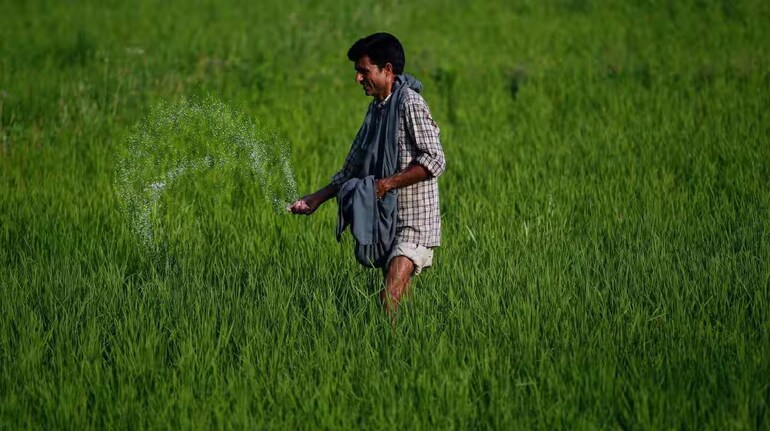

Government officials are tracking surge in prices of crude oil and fertilisers, but say that any sizeable impact on Centre’s finances can only be provided if the war prolongs – keeping the prices of these commodities "elevated for months".
"In FY26, the impact (of higher prices) would be marginal, but for FY27, the fertilizer subsidy bill may rise by at least Rs 10,000-15,000 crore, if international fertiliser prices continue to rise, and rupee depreciates further," a senior government official told Moneycontrol.
These estimates are initial, based on the assumption that conflict will not be prolonged for a long-time (not more than a few months).
During geopolitical conflicts, the subsidy burden typically rises as retail prices of major fertilisers, such as urea and DAP, are kept fixed to support farmers, while import costs and domestic production expenses increase.
For FY27, the fertilizer subsidy outlay has been pegged at Rs 170,799 crore. The finance ministry will re-look at the Budget’s numbers after Q1 of FY27 ends, the official said.
For FY26, the Revised Estimate (RE) pegged the fertilizer subsidy at Rs 186,460 crore – which is Rs 18,573 crore higher than the Budget Estimate (BE) for the current financial year.
The official said prolonged disruptions in Middle East may increase the prices of urea and di-ammonium phosphate (DAP). But, it’s too soon to factor-in those costs on the government’s feritlizer subsidy bill, the person noted.
Global prices of urea and DAP have risen by more than $100 dollar per tonne, since the Middle East conflict began 10 days ago.
India imports about 30 percent of its fertiliser requirement, with the Middle East supplying nearly 40 percent of those imports. The country also depends on the region for around 30 percent of imports of key raw materials and intermediates, including rock phosphate, phosphoric acid and muriate of potash.
Industry stakeholders have told Moneycontrol that companies have enough stocks to meet demand for the next couple of months, partly due to carryover inventory from the previous season.
'Fiscal strain not yet'
For FY26, the ministry expects Centre to reach 4.5 percent fiscal deficit as a percentage of GDP, and for FY27, it hopes to reach the target of 4.3 percent.
"However, if crude oil sustains at $100 per barrel for a few months, then fiscal pressures will rise," the official explained.
Higher crude oil prices may force the government to cut excise duty – if the present prices sustain for longer duration, but it seems unlikely as of now.
Moneycontrol reported on February 9 that the government doesn’t expect retail prices of petrol and diesel to be increased “for the foreseeable future,” as the oil marketing companies have enough cushion to absorb rising costs.
“The state-run oil marketing companies did not raise retail fuel prices earlier when crude oil prices breached $100 per barrel mark. In the past two years, they have done financially well,” a second official said.
Brent oil futures surged past $100 per barrel on March 9 touching $120 per bbl earlier in the day. But post the US President Donald Trump’s remarks that the conflict may end soon – Brent futures fell down to $95 per barrel.
According to Gaura Sen Gupta, Chief Economist, IDFC FIRST Bank: "A Rs 2 per litre cut in petrol and diesel excise duty could result in a revenue foregone of Rs 37,000 crore for the central government".
Gupta adds: "Higher prices sustaining will also lead to OMCs absorbing costs – which would result in lower dividend payouts to the government next financial year."
Discover the latest Business News, Sensex, and Nifty updates. Obtain Personal Finance insights, tax queries, and expert opinions on Moneycontrol or download the Moneycontrol App to stay updated!
Find the best of Al News in one place, specially curated for you every weekend.
Stay on top of the latest tech trends and biggest startup news.





