






The Union government is likely to float a global tender next month (January) to invite proposals under the Scheme to Promote Manufacturing of Sintered Rare Earth Permanent Magnets (REPMs), officials in the Ministry of Heavy Industries told Moneycontrol.
“The scheme has been notified on Tuesday (December 16) and the request for proposals (RFP) is being finalised. It is expected to be rolled out by the end of January,” an official aware of the matter said.
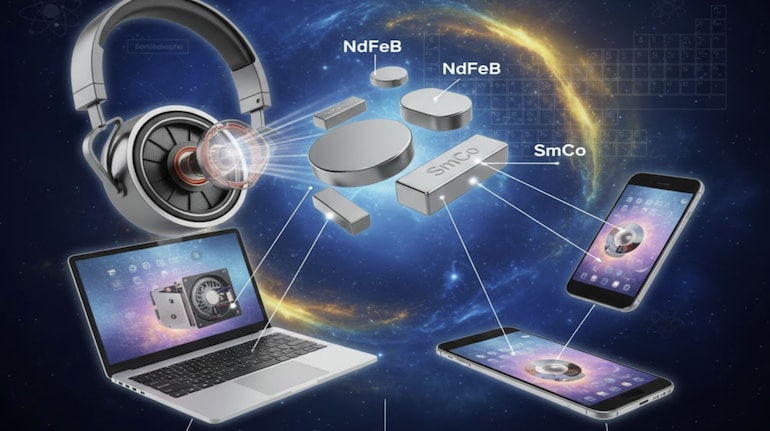
The tender will be issued through a Global Tender Enquiry (GTE) process, under which eligible domestic and international manufacturers will be invited to bid for setting up integrated facilities to manufacture sintered neodymium-iron-boron (NdFeB) rare earth permanent magnets in India.
The move comes amid tightening export controls by China on rare earth materials and magnet technologies, which have heightened supply-chain risks for sectors such as electric vehicles, renewable energy, electronics and defence. India currently imports nearly all of its high-performance rare earth permanent magnets, leaving domestic manufacturers exposed to geopolitical and pricing shocks.
The Union Cabinet approved the Rs 7,280-crore incentive scheme on November 26. Under the scheme, the government plans to support the creation of up to 6,000 tonnes per annum of integrated manufacturing capacity for sintered neodymium-iron-boron (NdFeB) magnets, with incentives linked to sales and capital investment.
Five manufacturers will be selected for the scheme. Moneycontrol was the first to report on October 17 that state-run IREL (India) Ltd will provide an assured limited supply of Neodymium-praseodymium (NdPr) oxide to the top three bidders (L1, L2 and L3) selected through the global tender. The remaining two beneficiaries will have to arrange their raw material independently.
Manufacturing sintered rare earth permanent magnets involves a multi-stage process that begins with mining of rare earth ores, followed by their separation and refining into rare earth oxides, primarily neodymium-praseodymium (NdPr) oxide. These oxides are then converted into rare earth metals, which are alloyed with iron and boron to form neodymium-iron-boron (NdFeB) alloy. The alloy is processed through powder metallurgy and sintering to produce high-performance permanent magnets.
While India has capabilities in mining and oxide refining, it lacks large-scale industrial capacity in the downstream stages—from oxide to metal, alloy and finished magnet—resulting in near-total import dependence for such magnets.
The scheme is aimed at building an end-to-end domestic value chain—from rare earth oxide to finished magnets—over a seven-year period, reducing India’s dependence on imports at a time when access to critical minerals and components is becoming increasingly uncertain.
Discover the latest Business News, Sensex, and Nifty updates. Obtain Personal Finance insights, tax queries, and expert opinions on Moneycontrol or download the Moneycontrol App to stay updated!
Find the best of Al News in one place, specially curated for you every weekend.
Stay on top of the latest tech trends and biggest startup news.




