






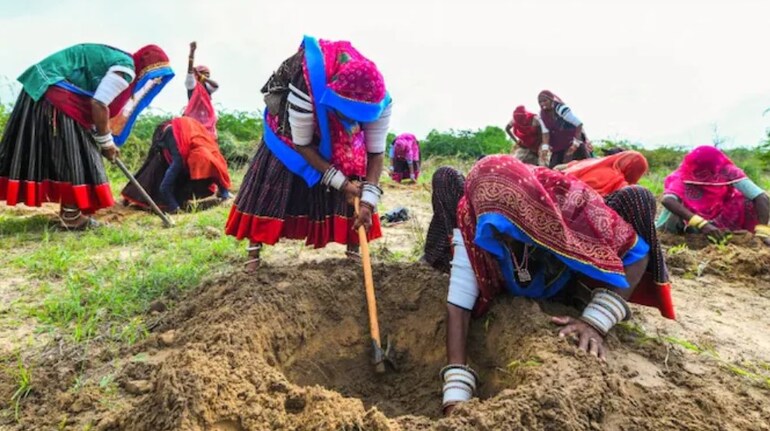
The Union government’s proposed overhaul of rural employment through the Viksit Bharat Guarantee for Rozgar and Aajeevika Mission-Gramin (VB-G RAM–G) Bill marks a significant departure from the financing architecture of the Mahatma Gandhi National Rural Employment Guarantee Act (MGNREGA), with the Centre seeking to pare back its dominant funding role and push states towards greater fiscal ownership of rural job creation and livelihood initiatives.
Under MGNREGA, while there is no explicit statutory funding ratio, the Centre has effectively borne around 90 percent of the programme’s cost across states, largely due to its responsibility for wage payments and a substantial share of material costs. In contrast, the proposed VB-G RAM–G framework introduces a 60:40 Centre–State cost-sharing pattern, with a 90:10 ratio reserved for north-eastern and Himalayan states, signalling a deliberate recalibration of fiscal responsibility between the Centre and states.
The revised funding structure comes alongside a broader redesign of rural employment policy, as the proposed mission moves away from a rights-based wage guarantee towards a livelihoods, skilling and enterprise-oriented framework. While the government has positioned the shift as an evolution aligned with the broader Viksit Bharat vision, experts caution that it could also test states’ ability to finance demand-driven employment support during periods of rural distress.
From wage guarantee to livelihoods mission
The VB-G RAM–G Bill is being framed as a shift away from short-term wage employment towards longer-term income generation anchored in skilling, entrepreneurship and asset creation. While MGNREGA provides a statutory guarantee of up to 100 days of unskilled manual work per rural household on demand, the proposed VB-G RAM–G framework extends the ceiling of guaranteed work to up to 125 days, particularly through additional employment days in aspirational and backward blocks.
More importantly, the nature of work under VB-G RAM–G is proposed to change. Rather than treating wage employment largely as a relief measure during periods of distress, the mission seeks to embed employment within district-level economic planning, linking wage work with the creation of rural growth hubs, durable community assets, skilling pathways and support for local enterprises. The intent is to use public employment not only to provide income support, but also to build productive capabilities, local infrastructure and livelihood opportunities that can generate sustained earnings beyond the guaranteed work period.
“The proposed VB G RAM–G marks a decisive and welcome evolution from the MGNREGA, signalling a shift from short-term wage support to long-term, dignified employment and enterprise opportunities,” Amit Vatsyayan, Leader – GPS (Agriculture, Livelihood, Social and Skills), EY India, told Moneycontrol. He said the new framework recognises rural citizens as “aspirational workers and potential job creators” rather than surplus labour, while pointing to features such as enhanced guaranteed workdays in aspirational blocks and the proposed National Rural Infrastructure Stack as indicators of a productivity-led approach.
Vatsyayan also flagged the revised funding model as one of the most consequential changes under the Bill. “One of the most significant shifts under the Bill is the revised Central–State funding structure, which adopts a 60:40 cost-sharing ratio between the Centre and States (90:10 for North-Eastern and Himalayan states),” he said, adding that the change encourages greater state ownership, accountability and locally responsive planning.
Concerns over dilution of statutory guarantees
However, legal experts caution that the transition from a statutory, demand-driven programme to a mission-mode framework could weaken enforceability and accountability if not carefully designed. Under MGNREGA, employment is a legal entitlement: eligible households can demand work, and the state is legally bound to provide it within a stipulated time or pay an unemployment allowance. In contrast, a mission-mode framework typically operates through government-set targets, administrative guidelines and budgeted outlays, rather than justiciable rights.
This gives implementing authorities greater discretion over the scale, timing and type of employment offered, which, while improving flexibility and planning, could also reduce workers’ ability to legally enforce access to work or compensation during periods of rural distress.
“The proposed VB G RAM–G marks a conceptual departure from MGNREGA by shifting the focus from a pure wage-employment guarantee to a more integrated livelihoods and skilling-oriented framework,” Deepika Kumari, Partner, King Stubb & Kasiva, Advocates and Attorneys, told Moneycontrol. She noted that MGNREGA’s was identified as a rights-based design, which guarantees employment as a legal entitlement, limiting administrative discretion.
Kumari warned that while convergence with entrepreneurship, self-employment and asset creation could support long-term income sustainability, any dilution of statutory guarantees could raise concerns around “enforceability, accountability and inclusivity, especially for the most vulnerable households that rely on MGNREGA as a legal safety net”.
Similar concerns were echoed by Rohitaashv Sinha, Partner at King Stubb & Kasiva. “If the VB-G RAM-G Bill is positioned as a replacement for MGNREGA, it marks a fundamental shift in the architecture of rural employment policy from a rights-based, demand-driven statutory guarantee to a mission-mode livelihoods framework,” Sinha told Moneycontrol.
He added that MGNREGA’s legal enforceability has historically provided assured wage employment during periods of rural distress, limiting the scope for discretionary curbs. “Any dilution of a statutory employment guarantee risks weakening the social safety net for the most vulnerable rural households, making it critical that the new framework preserves enforceable entitlements alongside its developmental objectives,” Sinha said.
Fiscal federalism at the core
The Centre–State funding reset lies at the heart of the proposed reform. By requiring states to co-invest more meaningfully in rural employment and livelihoods, the Centre appears to be signalling a shift towards deeper cooperative federalism, with greater fiscal discipline and contextual planning at the state level.
At the same time, the move raises questions about whether fiscally constrained states will be able to step up spending during downturns or periods of agrarian stress, particularly if the programme’s design reduces the automatic, demand-driven flow of funds that characterised MGNREGA.
As the VB-G RAM–G Bill moves through the legislative process, its final contours will determine whether the transition delivers a sustainable upgrade to rural livelihoods.

Discover the latest Business News, Sensex, and Nifty updates. Obtain Personal Finance insights, tax queries, and expert opinions on Moneycontrol or download the Moneycontrol App to stay updated!
Find the best of Al News in one place, specially curated for you every weekend.
Stay on top of the latest tech trends and biggest startup news.




