






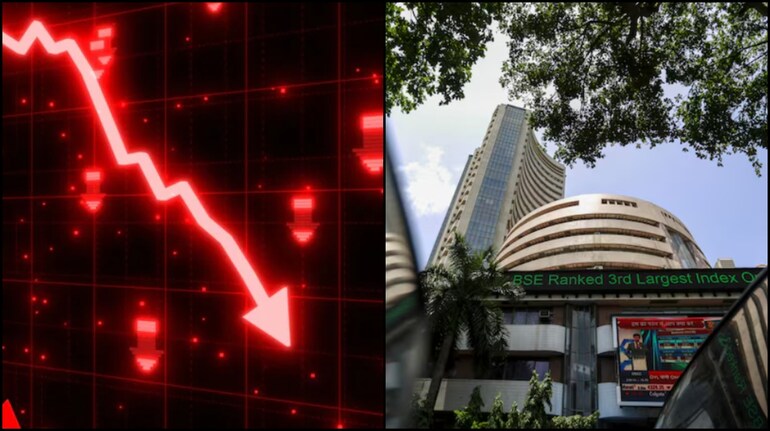

Indian equity markets delivered their weakest Budget-day performance in six years as investors gave a thumbs-down to Finance Minister Nirmala Sitharaman’s ninth Union Budget.
The benchmark Sensex fell 2.02 percent on Budget day, closing at 80,722.94, down sharply from its opening level of 82,388.97.
The sell-off marked the steepest Budget-day decline since FY21, when the index had slid 2.5 percent following Sitharaman’s second Budget.

Profit-taking was visible across sectors despite the government sticking to its fiscal consolidation path and continuing with a capex-led growth strategy.
A look at historical data shows that Budget-day reactions have often been volatile, but the FY27 outcome stands out for its severity in recent years. Over the last seven Budgets, only two have seen gains of more than 0.3 percent, while several have ended in marginal losses. By comparison, the FY26 Budget saw the Sensex end almost flat, while FY25 and FY24 recorded mild declines of less than 0.2 percent each.
The sharp contrast becomes clearer when set against the FY22 Budget, when the index surged over 4 percent, its best Budget-day performance in more than a decade, driven by a strong push on infrastructure spending and a benign global backdrop.
Historically, Budget-day moves have not always been a reliable indicator of medium-term market direction. For instance, the sharp 6.1 percent fall in the FY10 Budget was followed by a strong rally later in the year.
Discover the latest Business News, Sensex, and Nifty updates. Obtain Personal Finance insights, tax queries, and expert opinions on Moneycontrol or download the Moneycontrol App to stay updated!
Find the best of Al News in one place, specially curated for you every weekend.
Stay on top of the latest tech trends and biggest startup news.





