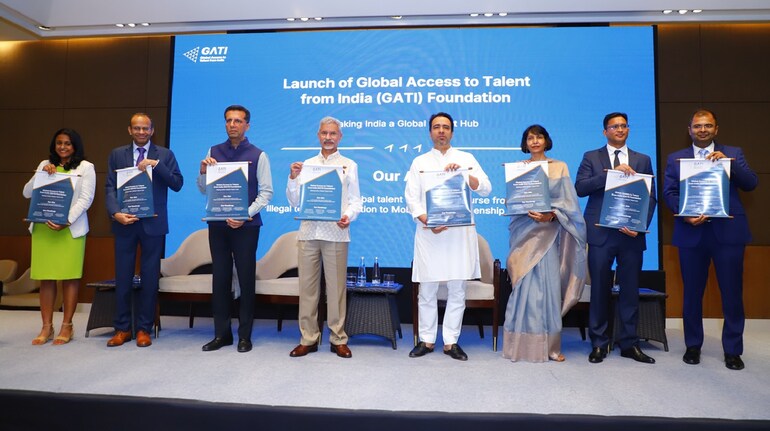
Educationist and co-founder of Ashoka University Ashish Dhawan feels that the government has had some learnings from its ongoing internship and apprenticeship programme, even though he sees room for improvement in the scheme. Dhawan while speaking to Moneycontrol, in an interview, said that India has a global pool of talent, but there exists regulatory cholesterol with respect to training and skilling of Indian workforce. “That’s why the government has pivoted more towards apprenticeship and internship. There is some learning from it, and room for improvement. The government – centre & states—are aware of this issue,” Dhawan said.
The Union government in July 2024, announced the PM-Internship Scheme (PMIS), which aims to provide internship opportunity to about 10 million youth over the next 5 years in India’s top 500 companies. In the first round of the PMIS, 28,141 candidates accepted internship offers.
Manish Sabharwal, vice-chairman, TeamLease Services, meanwhile, said that only two countries can provide workers, both blue collar and white collar, at large scale–India & China. “But China has a language and trust problem, so we think, India is the right place,” Sabharwal added.
Sabharwal and Dhawan were speaking to Moneycontrol post the launch of the Global Access to Talent From India (GATI) foundation—which works on mobilising Indian workers for global roles--are there to clear regulatory aspects. “GATI will help in reducing information asymmetries, and bringing stakeholders together,” Dhawan said.
Edited Excerpts:Q. You are talking about skilling Indian workforce for job opportunities abroad, at a time when many countries are closing their borders. Why are you proposing that India becomes a global talent pool at this juncture?A. Manish Sabharwal: The backlash is against illegal migration, not the legal one. Traditionally, it was only high skill workers countries were looking at, but now it has diversified. India already has a 17 million diaspora, which I think can go up to 30 million, and our remittances can go to $300 billion from $120 billion. The economics of retail, hospitality, healthcare, construction is not going to work for many countries unless they have an infusion of workforce.
Can we reach $300 billion of remittances, that’s around 4-4.5% of our GDP by 2030? Middle income countries usually have remittance flows of around 2 percent of GDP?
Ashish Dhawan: Philippines has a higher per capita GDP, but remittances are around 8.5%. We’re talking about going to 4.5% from 3%. We have a high market share in gulf countries, around 35% of migrants are Indians. Europe, we have a negligible market share. We’ve listed 20 skills that are in high demand in Europe—both blue collar and white collar--which India can easily supply. I think, the opportunity is real. There are some headwinds from US, but in other regions, the opportunity exists, and GATI can play a role. How do we get higher market share in countries that are opening up is what we need to focus on.
Q. Is GATI going to look at bridging the language barrier that we have in different countries.?A. Ashish Dhawan: Yes, we have to look at that as well as the skills. Language is a key issue, sending people in non-anglophone countries is different. It will require more training. We also need to consider the costs. We need to think about the financing, and work with the private sector. But the wage premium can help pay back these loans.
A. Manish Sabharwal: The MEA has to play a central role. This initiative can’t be approached vertically, but horizontally. Whole of government has to take this. In Japan, there are 300,000 Nepalese, but only 30,000 Indians. We can do substantially more than 300,000.
Q. How do you ensure proper skilling of workforce?A. Manish Sabharwal: The issue with skilling arises when they become supply-driven, not when they are demand driven. Take apprenticeship programmes for instance. The migration to different countries, will unlikely happen without proper skill set, and maybe some receiving country certification. It’s an engineering problem.
Q. There is a view within government that there is a need for private-public collaboration to make this initiative a success. How much of the private sector support you think is required?A. Ashish Dhawan: We need the private ecosystem to do skilling and certification. Shaping the supply side is critical. Say, if there are 30 language providers in Nepal to teach Japanese. We can speak to them and ask them to set up centres in, let’s say, Assam. Now the Assam government will have to facilitate their entry, and rest of the skilling work will be done through the private sector. Some kind of financial support, maybe credit guarantee can be provided to such companies. Govt can play a role in speaking to countries, and understanding what are the challenges in mobilising workers. At GATI, our role would be to talk to MEA, States and the private sector to create coordination among them. India is a large-scale provider of talent.
Q. The guest worker programme has not worked across countries, how can it be made to work? Also, can’t other countries do what India is doing?A. Manish Sabharwal: Guest worker programme has not worked in countries who don’t enforce immigration laws, but has worked in many, such as Saudi Arabia. Only two countries can provide workers at large scale – India & China. But China has a language and trust problem, so we think, India is the right place.
Q. There is a lot of regulatory cholesterol in this space in India? How do you tackle those. There is a large labour force that needs to be accommodated here as well?A. Ashish Dhawan: There is a recognition in government. The government has pivoted more towards apprenticeship and internship. There is some learning from it, and room for improvement. The government – centre & states—are aware of this issue. We at GATI are there to clear regulatory aspects, and the rest will have to be done by the government and private sector. GATI will help in reducing information asymmetries, and bringing stakeholders together.
Q. Have you mapped out some countries where you can send workers?A. Ashish Dhawan: Initially, the team has been working on East Asia, looking at Japan and South Korea, and Germany. There many G-2-G agreements, we know the market size is large, and our share is low.
Discover the latest Business News, Sensex, and Nifty updates. Obtain Personal Finance insights, tax queries, and expert opinions on Moneycontrol or download the Moneycontrol App to stay updated!
Find the best of Al News in one place, specially curated for you every weekend.
Stay on top of the latest tech trends and biggest startup news.