






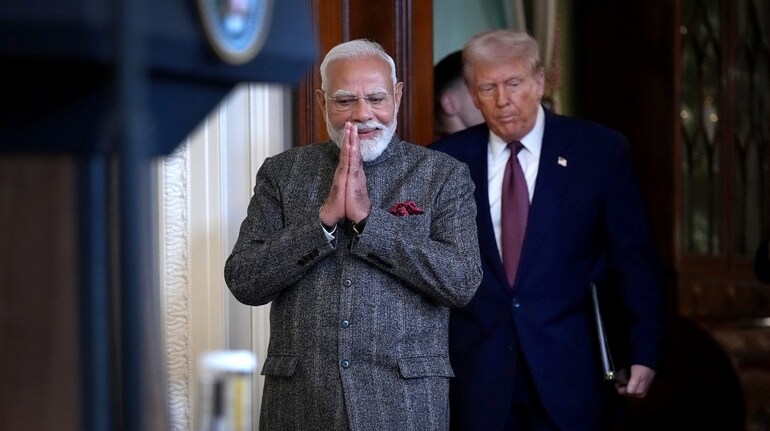

In a significant setback to President Donald Trump’s trade agenda, the US Supreme Court has struck down the sweeping tariffs imposed during his term, ruling 6–3 that he exceeded his legal authority. The decision casts uncertainty over recent trade arrangements, including India’s agreement with the US that lowered tariffs to 18 percent.
Chief Justice John Roberts, writing for the majority, said the law does not grant the president unlimited powers to impose tariffs under emergency provisions. The court held that authority over government revenues, including tariffs, rests with Congress under Article One of the US Constitution.
According to the judgment, tariff-setting powers belong to elected representatives in Congress, not the president acting unilaterally under emergency laws.
Reacting to the verdict, economist Jeffrey Sachs described it as “quite a bold, clear opinion” in an interview with CNBC-TV18. He said the decision returns to the foundational principle of the American system, that taxation powers lie with Congress.
Referring to the American Revolutionary War, Sachs noted that it was fought over “taxation without representation,” which is why tariff authority was explicitly placed in Congress.
“It’s not a narrow reading. It’s not a reading about legislative language. It’s a reading about the grab for power by the executive branch on something that does not belong to the executive branch,” Sachs told CNBC-TV18.
The timing of the verdict is significant for India, which recently signed a trade deal with the US lowering tariffs to 18 percent. Sachs argued that New Delhi should reassess its position in light of the court’s decision.
“Rip up the deal. There’s no point to it anymore. Trump did not have the authority to threaten India. He did not have the authority to impose tariffs on India. He did not have the authority to put penalties on India. All of it was unconstitutional, in violation of the law,” Sachs said in the CNBC-TV18 interview.
He advised India to pause further steps related to the agreement, especially as reports suggest Indian negotiators were preparing to travel to the US to review the legal framework.
“Absolutely. Take a break. Read the opinion, study it, think about all of this, listen to the rest of the world, and then take a trip. Absolutely. Do not act right now on something that has just been voided,” he said.
Sachs acknowledged that Trump may attempt to use alternative legal tools to reimpose tariffs but expressed doubt about their durability.
“Will Trump try something else? Most likely. But he will also fail,” he said, adding that the issue is not about leverage but constitutional limits.
He argued that the Supreme Court’s decision shifts the balance of power back toward Congress and reduces the scope for unilateral executive action on trade.
Discover the latest Business News, Sensex, and Nifty updates. Obtain Personal Finance insights, tax queries, and expert opinions on Moneycontrol or download the Moneycontrol App to stay updated!
Find the best of Al News in one place, specially curated for you every weekend.
Stay on top of the latest tech trends and biggest startup news.





