






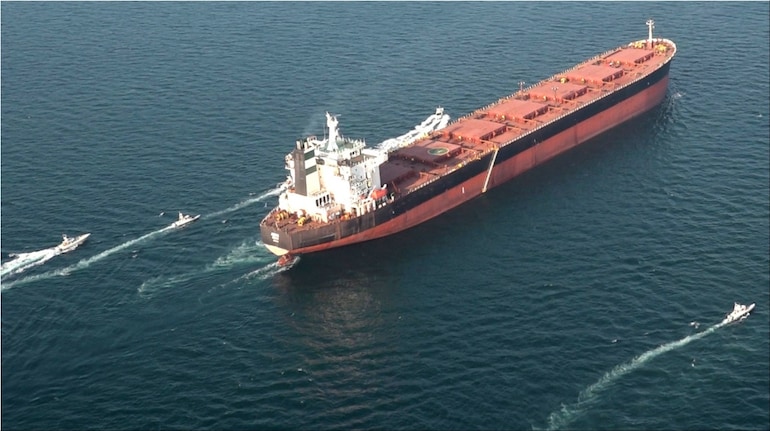

India’s trade exposure to countries around the Strait of Hormuz is significantly higher than that of several major Asian economies, exposing the country to risks from disruptions in one of the world’s most critical shipping corridors.
A Moneycontrol analysis shows that nearly 16 percent of India’s total trade is highly dependent on Hormuz-linked countries, with more than a third of India’s imports in these categories dependent on the United Arab Emirates, Saudi Arabia, Qatar, Kuwait, Bahrain and Iran.
This dependence is higher than that of several other Asian economies. South Korea’s exposure is estimated at about 11 percent, while Japan’s stands at around 10 percent, indicating that India’s trade flows are more closely tied to the Gulf corridor.
The Strait of Hormuz, located between Iran and Oman, is one of the world’s most important maritime chokepoints, linking major Gulf energy producers with global markets.
Energy imports highlight vulnerability
The dependence becomes particularly pronounced in energy trade. Japan sources nearly 90 percent of its oil imports from Hormuz-linked countries, making it one of the most exposed economies to supply disruptions.
India’s dependence is lower but still significant, with around 46 percent of its crude oil imports originating from the region. China sources about 38 percent of its oil imports from these countries, compared with 20 percent for Indonesia and about 12 percent for European Union nations.
India’s exposure is even greater in liquefied natural gas (LNG). More than half of India’s LNG imports come from Hormuz nations, compared with 25 percent for China, 23 percent for South Korea, and around 19 percent globally.
Gulf supply chains extend beyond energy
The Gulf’s importance extends well beyond hydrocarbons, feeding industrial supply chains across Asia and Europe.
For example, nearly two-thirds of the chemicals used in detergents and cosmetics in China are sourced from Hormuz countries, highlighting the region’s role as a supplier of key petrochemical feedstocks used in manufacturing.
The corridor is also important for agricultural and food trade. Nearly all of China’s saffron imports and about 61 percent of the European Union’s saffron imports come from countries connected through the Strait. Globally, over half of the sardines and anchovies also pass through the Hormuz shipping route.
Japan’s imports of carpets show significant reliance on the region, while over 60 percent of certain organic chemicals used in detergents and industrial soaps also originate from these economies.
Similarly, nearly 60 percent of South Korea’s imports of Portland white cement come from Middle Eastern nations.
Pakistan far more exposed
Despite India’s high exposure, the dependence is even deeper in neighbouring Pakistan. Nearly one-third of Pakistan’s total imports heavily depend on countries linked to the Strait of Hormuz, while almost all of its oil and more than 95 percent of its gas imports originate from these economies.
Concerns about potential supply disruptions have already prompted precautionary measures. Pakistan on Monday announced austerity steps to conserve fuel, with Prime Minister Shehbaz Sharif ordering the temporary closure of schools and universities and introducing a four-day workweek for government offices to reduce energy consumption.
Discover the latest Business News, Sensex, and Nifty updates. Obtain Personal Finance insights, tax queries, and expert opinions on Moneycontrol or download the Moneycontrol App to stay updated!
Find the best of Al News in one place, specially curated for you every weekend.
Stay on top of the latest tech trends and biggest startup news.





