






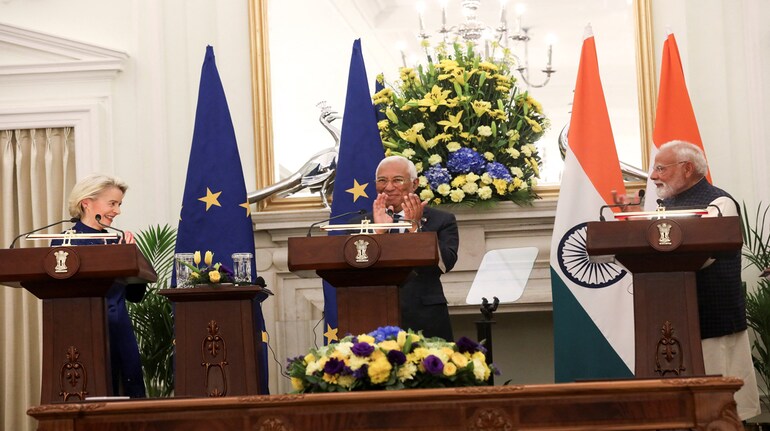

The recent conclusion of negotiations on the long-pending India-European Union Free Trade Agreement (FTA) marks a watershed moment in India’s external economic policy, one that could meaningfully reshape trade flows, competitiveness, and investor confidence over the coming decade. After nearly two decades of intermittent talks, the pact was finalised at a summit held in New Delhi, with leaders on both sides hailing it as a significant step towards deeper economic integration between two of the world’s major trading blocs.
Essentially, the deal aims at extensive tariff removal and regulatory harmony in areas of goods, services, and investment. Following its ratification, the agreement is projected to gradually eliminate or significantly reduce duties on over 90 percent of bilateral trade by value, thereby granting Indian exporters access to the EU's largely protected market and, at the same time, raising Indian tariffs on key European products.
There are several layers of consequences for the Indian industry. On one hand, export sectors like pharmaceuticals, textiles, gems and jewellery, and labour-intensive manufactures are expected to become major beneficiaries of a deeper market access through reduced tariffs and regulatory alignment with EU standards. Some initial rough calculations point to export increases amounting to billions of dollars in categories such as ready-made garments, where preferential treatment, if given, can hold out a great competitive advantage for India against its rivals like Bangladesh and Vietnam.
Besides tariff reductions, the FTA also envisages services trade liberalisation and mobility of skilled professionals, which could further boost India's current large IT, business services, and telecom exports to the EU. To many exporters, this comes as an important non-tariff factor that may help in lowering the barriers that have, for a long time, been associated with the lack of regulatory harmony in services.
On the import side, a lowering of tariffs on capital goods, intermediate inputs, and high-technology products from Europe, such as machinery, precision instruments, and specialised components, could result in reduced production costs for Indian manufacturers. In time, this cheaper access to quality inputs may lead to a closer integration with the European value chains, increase productivity, and result in more foreign direct investment in the manufacturing and technology sectors.
However, the way forward is not without its complications. The implementation will be subject to ratification by the Indian parliament as well as the respective legislative bodies of the EU member states, and full liberalisation is anticipated to be brought in gradually over several years. Meanwhile, there still remain some structural issues: the rigorous EU standards for sanitary, phytosanitary, and environmental compliance might diminish the nominal tariff benefits if Indian exporters do not improve their quality and traceability systems.
Besides, the EU's Carbon Border Adjustment Mechanism (CBAM), a climate-linked levy on carbon-intensive imports, still remains a sticking point in the overall regulatory landscape. Although not fully settled within the agreement, CBAM could significantly influence the competitiveness of the steel, aluminium, and chemicals sectors, especially small and medium enterprises that are still trying to figure out new compliance regimes.
Considering these factors, the FTA's effect on investor confidence might even be more significant than its trade provisions. The agreement shows that India is ready to align with the high-standard global trade frameworks and to change its economic partnerships to different ones, especially considering the tariff fight with the United States.
Overall, the India-EU Free Trade Agreement is a reflection of both a great opportunity and a highly challenging task. It may drastically improve the export competitiveness of India, bring the key industrial segments up to date, and help India become an even more important player in global value chains. However, to make the most of these opportunities, the necessary level of domestic reforms, strict adherence to regulatory standards, and continuous diplomatic efforts will be required on both sides as they will have to deal with the complex interaction of trade, climate policy, and strategic economic priorities.
Disclaimer: The views and investment tips expressed by investment experts on Moneycontrol.com are their own and not those of the website or its management. Moneycontrol.com advises users to check with certified experts before taking any investment decisions.
Discover the latest Business News, Sensex, and Nifty updates. Obtain Personal Finance insights, tax queries, and expert opinions on Moneycontrol or download the Moneycontrol App to stay updated!
Find the best of Al News in one place, specially curated for you every weekend.
Stay on top of the latest tech trends and biggest startup news.





