






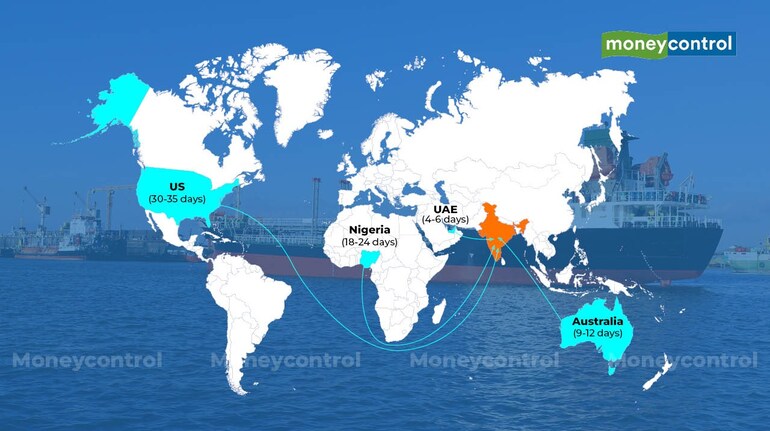

Delivery times for India’s oil and gas imports could nearly double if supplies from the Middle East are replaced with cargoes from other regions, raising costs and tightening energy markets amid rising geopolitical tensions.
India currently relies heavily on West Asian suppliers for its energy needs. A Moneycontrol analysis shows that about 59.5 percent of India’s LNG imports come from Middle Eastern countries, significantly higher than China’s 26.5 percent and Japan’s 10.7 percent, leaving India particularly exposed to disruptions in the Strait of Hormuz, a key maritime corridor for global energy shipments.
Cargoes from the Gulf typically reach India quickly. Shipments from the UAE’s Das Island take roughly 4-6 days to reach India’s west coast terminals such as Mundra or Dahej, and about 11-12 days for east coast terminals such as Dhamra or Ennore, said Sonal Ranjan, a LNG and natural gas analyst at Kpler.
However, replacing these supplies with cargoes from alternative markets would significantly extend transit times. LNG shipments from Western Australia generally take 9-12 days to reach India, while cargoes from Australia’s east coast projects can take 15-17 days, depending on the destination terminal.
Supplies from West Africa would take even longer. Cargoes from Nigeria typically take 18-24 days to reach India, with an average sailing time of roughly 19-20 days via the Cape of Good Hope.
Shipments from the US would be the slowest, requiring around 30-35 days to reach India, also via the Cape of Good Hope, Ranjan said.
Longer voyages could increase freight costs and push Asian buyers to pay higher premiums to attract cargoes away from Europe.
“For alternative supply given a Strait of Hormuz disruption, replacement sources could include US cargoes, West Africa such as Nigeria, and Australia, though incremental flexibility is limited,” Ranjan said, adding that Asian buyers may need to pay a premium over European prices to secure supplies.
Recent shipping disruptions elsewhere show how quickly logistics costs can escalate. According to ICRA, rerouting vessels between Europe and Asia via the Cape of Good Hope instead of the Suez Canal adds 10–15 days to travel time, while war-risk insurance premiums have increased to 0.75-1 percent of a vessel’s insured value, up from about 0.5 percent earlier.
India imported about $15 billion worth of LNG in 2024, placing it among the world’s major buyers. The top five suppliers account for around 83.5 percent of India’s LNG imports, underscoring limited diversification in sourcing.
Although alternative suppliers such as Australia, the US and Nigeria could help fill supply gaps, longer travel times and tight global supply could make replacement cargoes significantly more expensive.
India’s exposure also extends to crude shipments. Oil cargoes from western Russia typically take 20-35 days to reach India, while shipments from the eastern Russian seaboard take around 12-15 days, industry experts note.
India maintains over three weeks of energy reserves, which could cushion short disruptions. However, a prolonged conflict affecting Gulf shipping routes could force the country to rely on distant suppliers, raising both delivery times and energy costs.
The government has already begun rationing supplies. The central government diverted natural gas to priority sectors, ensuring households receive preference while industrial consumers see supply reduced to 70-80 percent of their average consumption over the past six months.
Discover the latest Business News, Sensex, and Nifty updates. Obtain Personal Finance insights, tax queries, and expert opinions on Moneycontrol or download the Moneycontrol App to stay updated!
Find the best of Al News in one place, specially curated for you every weekend.
Stay on top of the latest tech trends and biggest startup news.





