






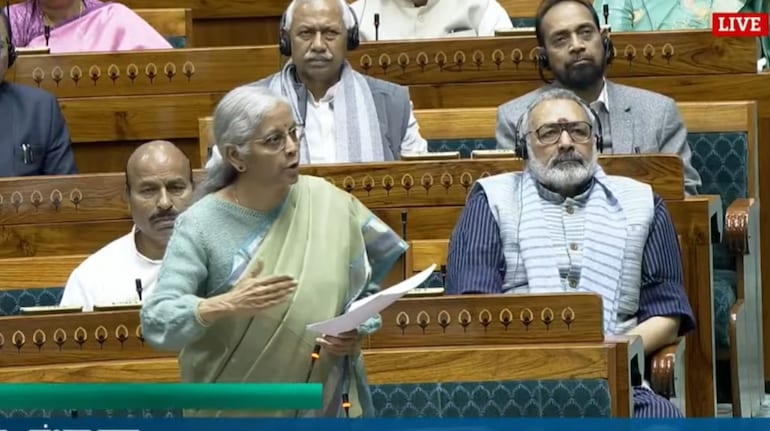

Defending the constitutional treatment of cess and surcharge collections, Finance Minister Nirmala Sitharaman on February 11 rejected criticism from states over the impact of such levies on the divisible pool of taxes. Addressing concerns raised by several members on the rising share of cess and surcharge in the Centre’s tax revenues, the Finance Minister said states must distinguish between gross tax revenue and net proceeds that are legally shareable.
“States can’t have it both ways. The states should check if the entire net proceeds which form the divisible pool i.e. removing cess and surcharge from gross tax revenue, is received by them. There is no need to discuss gross tax revenue,” she said.
Sitharaman was replying to the Union Budget discussion in Lok Sabha.
She emphasised that cess and surcharge are imposed strictly within the constitutional framework and are not part of the divisible pool used for tax devolution. “We implement cess, surcharge which is in accordance with the constitution. Cess is collected for a specific purpose,” the Finance Minister said.
The issue has been a recurring point of friction in Centre–state financial relations, with some states arguing that higher cess collections effectively reduce the pool of taxes available for distribution.
Effective capital expenditure highlighted
The Finance Minister also emphasised the scale of public investment proposed in the Budget, particularly when accounting for grants and transfers supporting state-level infrastructure creation.
“The effective capital expenditure … is Rs 17.1 lakh crore, which is 4.4 percent of the GDP,” she said, noting that the broader measure goes beyond the Centre’s headline capital expenditure figure by including grants extended to states and Union Territories.
Resource transfers to states
Highlighting the magnitude of fiscal support to states, the Finance Minister said total resources to be transferred in 2026-27 are estimated at Rs 25.44 lakh crore. She noted that this represents an increase over both the previous year’s Budget Estimates and past actuals, signalling continued prioritisation of state finances despite pressures on central revenues.
The Finance Minister also referred to the enhancement of the 50-year interest-free loan scheme for states, which has been raised to Rs 2 lakh crore to support capital expenditure by state governments.
Debt-to-GDP not a new target
Responding to concerns over fiscal sustainability, the Finance Minister clarified that the debt-to-GDP ratio is not a newly introduced policy metric.
“The debt to GDP is not a new target. Along with the fiscal deficit, debt to GDP is already included as a target in the 2018 amendment of the FRBM Act. This is mentioned under section 4(1) b of the FRBM Act,” she said.
The clarification comes as the Budget continues to balance fiscal consolidation objectives with elevated capital spending commitments.
Investment concerns in West Bengal, Kerala
In remarks that added a political economy dimension to the debate, the Finance Minister flagged what she described as declining investment trends in some states.
“Gross fixed capital formation (GFCF) is declining in Kerala, Tamil Nadu, West Bengal. Communist states have not done anything to attract investments from industry,” she said.
The statement points to the broader discussion on regional investment patterns and the role of state-level policies in shaping private sector capital formation.

Discover the latest Business News, Sensex, and Nifty updates. Obtain Personal Finance insights, tax queries, and expert opinions on Moneycontrol or download the Moneycontrol App to stay updated!
Find the best of Al News in one place, specially curated for you every weekend.
Stay on top of the latest tech trends and biggest startup news.





