






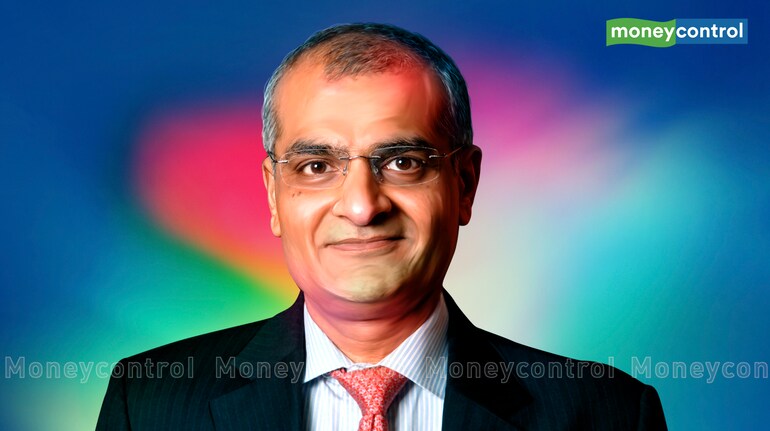

Rashesh Shah, Co-founder of Edelweiss Group, reflected on his three-decade entrepreneurial journey and the evolution of India’s financial ecosystem, saying that building businesses in the country requires the ability to balance short-term volatility with long-term opportunity.
While speaking at the Moneycontrol FiDEX 2026 (Financial Distribution Expo), Shah said that India’s financial sector transformation in the early 1990s played a key role in shaping the opportunities that entrepreneurs saw in the market.
Early inspiration and India’s financial reforms
Shah said he initially did not intend to become an entrepreneur despite coming from a business family. “I come from a business family. My father was what we today would call an MSME entrepreneur and I saw the hard work that an entrepreneur had to do. So I said I don’t want to do this hard work, I will study, get a good job and sit in an AC cabin,” he said.
However, the economic reforms following India’s balance of payments crisis in the early 1990s changed his perspective. “In the early 1990s India reimagined its financial economy. SEBI was formed in 1992, NSE came in 1994, private sector mutual funds came in 1993 and private banks in 1994. Something exciting was happening in India,” Shah said.
He added that the reforms laid the groundwork for India’s domestic capital markets to strengthen over the following decades. “It has taken us 30 years, but now we see that when foreign investors sell, Indian mutual funds and Indian investors are able to absorb that. We are becoming more self-reliant on our capital needs,” he said.
Growth is rarely linear
Shah said the early years of Edelweiss highlighted how unpredictable business growth can be. “When we started Edelweiss, we made a business plan — first year Rs 30 lakh, second year Rs 50 lakh, third year Rs 1 crore and so on,” he said.
While the first year matched expectations, the following years saw setbacks due to broader financial disruptions. “In the first year we did Rs 30 lakh exactly. In the second year we did only Rs 25 lakh and in the third year Rs 18 lakh because there was a financial crisis and an NBFC upheaval. But in the fourth year we did Rs 1 crore and in the fifth year Rs 11 crore,” Shah said.
He said this experience demonstrated that growth in India often happens in bursts rather than in a steady trajectory. “It’s not a linear growth. In the short term it can be volatile, but in the long term the growth is far more than what you estimate,” he said.
Balancing short-term volatility with long-term opportunity
According to Shah, India’s economic journey is often marked by global and domestic disruptions. “In India there is always some drama happening — global crises, geopolitical tensions or domestic events. In the short term it is filled with volatility, but in the long term there is a lot of opportunity,” he said.
He emphasised the need to maintain what he called a “bifocal vision”. “If God has given us two eyes, one should look at the short-term challenges and the other at the long-term opportunity. If you see only one of them, you will falter,” Shah said.
Reflecting on market growth over the decades, he noted that the Bombay Stock Exchange index was around 680 when he started his career in 1989 and is now around 80,000. “Having seen more than 100x growth over 35 years, compounding is visible only when you look at it from a distance,” he said.
Emotional and financial resilience matter
Shah said both emotional discipline and financial resilience are essential for investors and entrepreneurs. “The emotional impact of volatility is often higher than the actual financial impact,” he said.
He suggested adopting longer time horizons while evaluating investments and businesses. “In investing, think in three-to-five-year cycles. In building a business, think in five-to-eight-year cycles. That helps dampen the emotional impact of volatility,” Shah said.
He also stressed the importance of maintaining financial staying power. “Every business and investor needs financial resilience. Too much borrowing often forces businesses to exit during downturns,” he said.
Evaluating the quality of a business
Shah said Edelweiss evaluates its businesses based on four key parameters. The first is employee engagement, which he described as critical for financial services firms. “If employees are not energised and engaged, ethical compromises and integrity issues can arise,” he said.
The second factor is customer satisfaction, measured through feedback and net promoter scores. “You must ensure customers are experiencing what you promised,” Shah said.
The third factor is financial robustness, including liquidity, capital structure and cash flow. “Cash flow is extremely important. Many people focus on profit and loss statements but ignore cash flow,” he said.
The fourth parameter is risk and governance, which Shah said is essential in a highly regulated sector like financial services. “As custodians of other people’s money, the bar for risk management and governance must be very high,” he said.
AI will reshape advice but relationships remain key
Shah said artificial intelligence will increasingly automate execution and parts of advisory functions in financial services. “The digital journey has already made execution very easy. AI will automate a lot of advice,” he said.
However, he believes the role of human advisers will remain important. “I don’t think we will have AI relationship managers. All good relationship managers will become AI-assisted,” Shah said.
He added that advisers will need to focus more on understanding client needs. “Listening to clients, understanding the needs of the client and creating solutions around that will become the most important part of the advisory role,” he said.
According to Shah, the industry is likely to move from a product-centric approach to a client-centric one. “The client will be at the centre and the product will revolve around the client,” Shah said.
Discover the latest Business News, Sensex, and Nifty updates. Obtain Personal Finance insights, tax queries, and expert opinions on Moneycontrol or download the Moneycontrol App to stay updated!
Find the best of Al News in one place, specially curated for you every weekend.
Stay on top of the latest tech trends and biggest startup news.





