








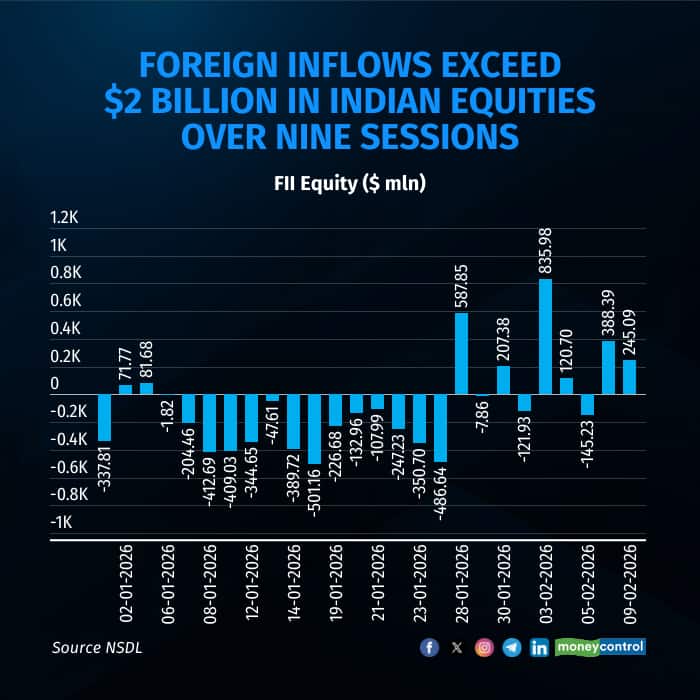
Foreign investors have turned net buyers in Indian equities over the past nine trading sessions, purchasing over $2 billion worth of shares amid a sustained rally in domestic markets. Analysts, however, said it is still too early to draw conclusions about the medium-term sustainability of the trend.
Between January 28 and February 6, foreign institutional investors were net buyers in six sessions and marginal sellers in three. On February 9, FIIs bought shares worth Rs 2,223 crore on a provisional basis.
Analysts said the renewed buying followed a recent sell-off in Indian markets, which improved valuations relative to other Asian equities. The benchmark indices, Sensex and Nifty, are currently trading at one-year forward price-to-earnings multiples of 20.5 times and 20.1 times, broadly in line with their respective 10-year averages. In the broader market, the BSE MidCap 150 index is trading at around 28 times one-year forward PE, compared with its long-term average of 27.3 times.
Manishi Raychaudhuri, chief executive officer of Emmar Capital Partners, said that relative to Asia excluding Japan, India’s forward PE multiple has returned to its long-term average premium. Over the past decade, India’s valuation premium expanded steadily as Chinese and Korean equities underperformed. The premium has now moderated to 40.1 percent, close to the 15-year average of 39.2 percent, supported by strong performance in North Asian equities and a period of flat movement in Indian markets.
He added that price-to-book valuation trends show a similar pattern, with India’s 12-month forward P/BV multiple still above its own long-term average but close to the historical premium it commands over Asia.
Some experts said the trend could continue if trade stability persists, corporate earnings improve, and global rate cuts weaken the dollar, supporting emerging markets such as India.
Vikram Kasat, head of advisory at PL Capital, said that after two years of net selling, including $18.88 billion in 2025 alone, FIIs shifted stance following a new India–US trade deal that eased uncertainties, stabilised bond yields, and improved risk appetite. He said high valuations, muted earnings, a strong dollar, and trade tensions had earlier restrained inflows, while recent market corrections created entry opportunities, aided by the Reserve Bank of India’s dovish stance and an improving GDP and earnings outlook.
Domestic institutional investors also remained active during the period, purchasing equities worth more than Rs 8,973 crore. The sustained buying coincided with a broad-based market rally, with the Sensex and Nifty gaining more than 3 percent each. Broader markets outperformed, as the BSE MidCap 150 index rose 5.66 percent and the BSE SmallCap 250 index advanced 6.3 percent.
Market participants said the India–US tariff deal resolved long-standing uncertainties affecting exporters. The latest Union Budget’s focus on long-term growth and infrastructure has also supported investor interest. The rupee saw an improvement in sentiment after a prolonged period of weakness, with current levels offering relatively better entry points for dollar inflows following the easing of trade and budget-related uncertainties.
Akshay Chinchalkar, managing partner and head of market strategy of The Wealth Company, said the RBI’s recent decision to keep interest rates unchanged signalled an environment of high growth and low inflation, conditions typically supportive of equity markets.
Discover the latest Business News, Sensex, and Nifty updates. Obtain Personal Finance insights, tax queries, and expert opinions on Moneycontrol or download the Moneycontrol App to stay updated!
Find the best of Al News in one place, specially curated for you every weekend.
Stay on top of the latest tech trends and biggest startup news.





