








A widely tracked market breadth indicator signalled positive momentum in February despite recent volatility in Indian markets. The advance-decline ratio, which measures the number of rising stocks against falling stocks, moved above 1 for the first time after remaining below that level for three consecutive months.
The average advance-to-decline ratio of all BSE-listed stocks stood at 1.03 in February, the highest level since October 2025. Prior to February, the ratio had remained below 1 for three straight months, with readings of 0.85 in January, 0.97 in December and 0.89 in November.
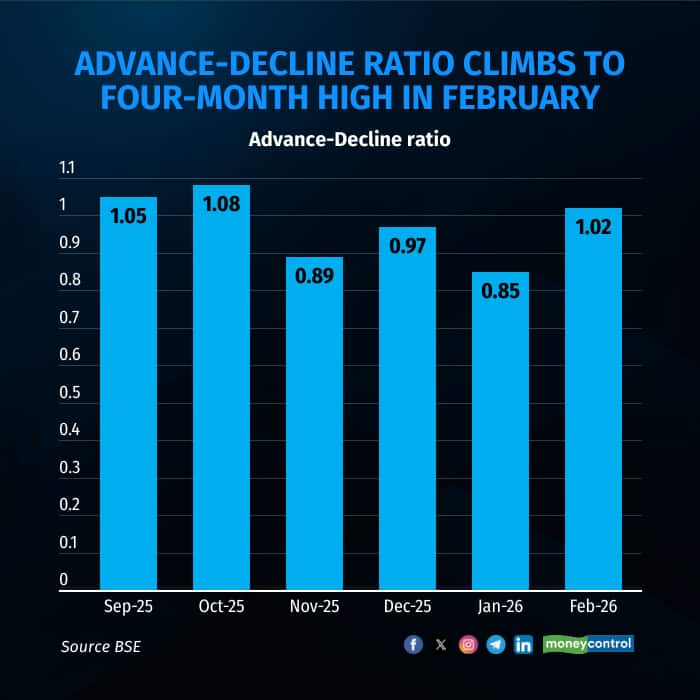
Aakash Shah, Research Analyst at Choice Broking, said this reflects a transition from bearish breadth deterioration seen in January to constructive consolidation. He noted that with Nifty facing resistance near 25,650 to 25,700 and holding support at 25,250, which aligns with the 200-day EMA, along with 25,000 as a key psychological level, a sustained advance-decline ratio above 1 suggests range-bound accumulation unless breadth weakens below neutral levels again.
Indian markets witnessed significant volatility during February. Benchmark indices Sensex and Nifty remained flat, while broader markets moved higher. The BSE MidCap 150 Index gained 2.5 percent and the BSE SmallCap 250 Index rose 1.5 percent. Sectoral performance remained mixed, with the BSE IT index declining 20 percent, while the Nifty Metal index gained 5.3 percent. Nifty Bank and Realty indices rose 2.7 percent and 2 percent respectively, while the Nifty Defence index gained 0.4 percent.
Foreign investors turned buyers during the month, purchasing over $2.4 billion in Indian equities, marking the highest monthly inflow in 17 months. Meanwhile, India VIX declined by 4 percent to 13.06 during the month.
Sentiment remained cautious amid geopolitical tensions, AI-related developments and tariff concerns. Monarch AIF said broader markets have been in bear territory for the past few months and noted that several small yet fast-growing companies are now available at one-year forward price-to-earnings multiples of less than 20 times.
Discover the latest Business News, Sensex, and Nifty updates. Obtain Personal Finance insights, tax queries, and expert opinions on Moneycontrol or download the Moneycontrol App to stay updated!
Find the best of Al News in one place, specially curated for you every weekend.
Stay on top of the latest tech trends and biggest startup news.





