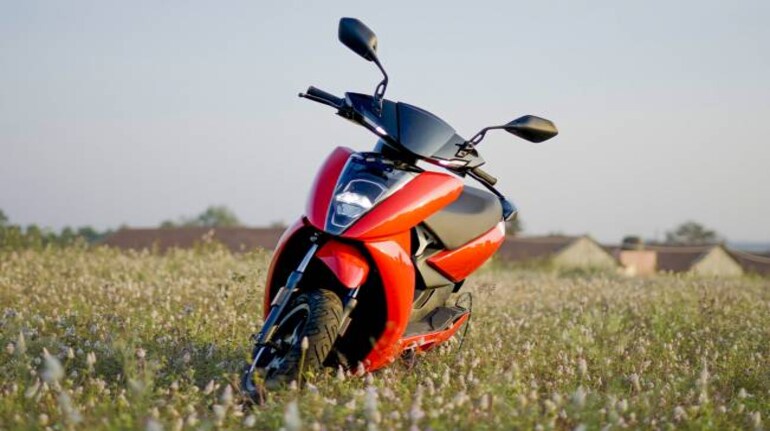
With the reduction in subsidies on electric two-wheelers (E2Ws) under the FAME-II (second phase of the Faster Adoption of Manufacturing of Electric Vehicles in India) scheme, industry players like Ola Electric, Ather Energy, Okaya EV, Okinawa, and Matter Energy, among others, will raise prices by 15-20 percent beginning 1 June.
While the companies did not share the impact of the price revisions, industry observers said that there will be some impact on sales growth in the next two to three months.
It may be recalled that the FAME-II subsidy scheme, for which the government had earmarked Rs 10,000 crore for three years, was introduced on 1 April 2019. While the tenure was extended for another two years, it also raised the demand incentives for battery-run two-wheelers from Rs 10,000 per kWh to Rs 15,000 kWh as well as the maximum cap from 20 percent to 40 percent of the ex-showroom price of the vehicle in June 2021. It recently came up with a notification that revised the demand and cap incentives at Rs 10,000 and 15 percent respectively.
The amendment comes in the background of the government's decision to reallocate an additional Rs 1,500 crore under the FAME II scheme to the E2W segment.
When Moneycontrol reached out to the key stakeholders, a majority of them affirmed that this is a “step in the right direction” and will enable the “manufacturing ecosystem to flourish”. However, a handful of them like Hero Electric have urged the government to take a relook at the recent decision as it may significantly dent the volumes of E2Ws.
As per ICRA, the upfront price differential of an E2W vis-à-vis an internal combustion engine (ICE) vehicle is expected to increase materially, given the reduced subsidy benefits. Furthermore, the payback period for a premium E2W, which had declined to about three years post the amendment to FAME II guidelines in June 2021, would increase to about five years post the latest revision in FAME II benefits. In this scenario, the E2W manufacturers decided to completely pass on the subsidy reduction amount to consumers in the form of price hikes.
“Even as the Total Cost of Ownership (TCO) for E2W remains favourable, aided by substantial savings on running costs, the lower subsidy benefits are likely to curtail the segment’s growth pace over the short term and would exert pressure on the cost structure of original equipment manufacturers (OEMs),” Rohan Kanwar Gupta, Vice President & Sector Head - Corporate Ratings, ICRA Limited, said.
As per CRISIL, the price increase could be in the range of Rs 20,000 to Rs 25,000 for a vehicle costing Rs 1.5 lakh. In terms of impact on volumes, it would be “under pressure” for about “three to four months”. EVs, which accounted for 4.6 percent of total units of automobiles sold in FY23, will see their contribution inching marginally to 5-6 percent instead of the earlier projections of 7-8 percent because of the price increase, as claimed by CRISIL.
“The amount of money that customers used to pay as down payment and will be paid now is different. Because of this differential in subsidy, it will typically be in the range of Rs 20,000-25,000 for a three-kilowatt per hour (kWh) kind of battery size. You will see that customers will shell out Rs 4,000-5,000 extra as down payment,” stated Hemal Thakkar, Director - Consulting, CRISIL Market Intelligence and Analytics. He added, “For consumers, the down payment will increase and the EMI too will go up to a certain extent because the prices of vehicles will rise as subsidy goes down.”
Companies claim no long-term impact
Ola Electric, which currently is the market leader, claims that FAME-II subsidy won't impact the growth momentum of the E2W industry. The company’s CMO, while recently interacting with Moneycontrol, said that the FAME scheme has already served its purpose and the industry should realign itself even if there are no subsidies. None of the company officials were willing to share the quantum of price hikes.
“The electric vehicle market has reached an inflexion point, with customers increasingly opting for electric vehicles over traditional internal combustion engine vehicles. The ongoing discussion on subsidies - FAME II, is heading in the right direction. Gradually phasing out subsidies is a normal course of action. Manufacturers bear the responsibility of ensuring they establish appropriate supply chains and cost structures,” stated an Ola Electric spokesperson in response to queries sent by Moneycontrol.
Seconding Ola Electric's thought is Ather Energy, which stated that very high subsidies are “great financially”, but not great for the “long-term health of the industry”.
“We've always been of the view that subsidy should be gradually toned down over a period of time. The industry needs to stand on its own, and therefore, this is a step in the right direction. It is a short-term financial hit. But from a long-term perspective, it's the right thing to do,” the company’s Chief Business Officer Ravneet Phokela told Moneycontrol on the phone.
However, he acknowledged that the company will not be in a position to absorb the entire amount. On the impact seen and profitability, Phokela said, “We will absorb a certain proportion of the subsidy hit, and some of it will be passed on to the customer. Obviously, whatever we absorb hits our P&L. So, there will be a hit on the profitability in the short term.”
On whether there will be any impact on volumes, Phokela stated that even though sales volume will be impacted, the “degree of impact” cannot be determined.
Okaya EV is of the view that the government's decision to gradually reduce the FAME-II subsidy for EVs may result in increased prices for consumers.
“It's important to note that the subsidy is not being completely discontinued. Instead, it is being tapered down. Consumer prices are expected to rise significantly, with estimates ranging from Rs 20,000 to Rs 40,000,” said Dr. Anshul Gupta, Managing Director, Okaya Electric Vehicles.
Okinawa Autotech claims that the customer price will increase to the extent of any reduction in the subsidy value. and there might be a near-term impact on the overall industry volumes. Similarly, Graves Cotton-owned Ampere Electric stated it is "evaluating" price increase in line with the new FAME guidelines.
However, Sohinder Gill, CEO of Hero Electric, opines that the sudden and sharp tapering of subsidies does not bode well for the customer and may lead to a “drop in E2W adoption”. “While the industry may still clock higher sales than last year, it may not be able to keep up the tempo of the exponential growth and may even fall short of the target of 2.3 million units, as projected by Niti Aayog,” Gill stated in an official statement to the media.
Discover the latest Business News, Sensex, and Nifty updates. Obtain Personal Finance insights, tax queries, and expert opinions on Moneycontrol or download the Moneycontrol App to stay updated!
Find the best of Al News in one place, specially curated for you every weekend.
Stay on top of the latest tech trends and biggest startup news.