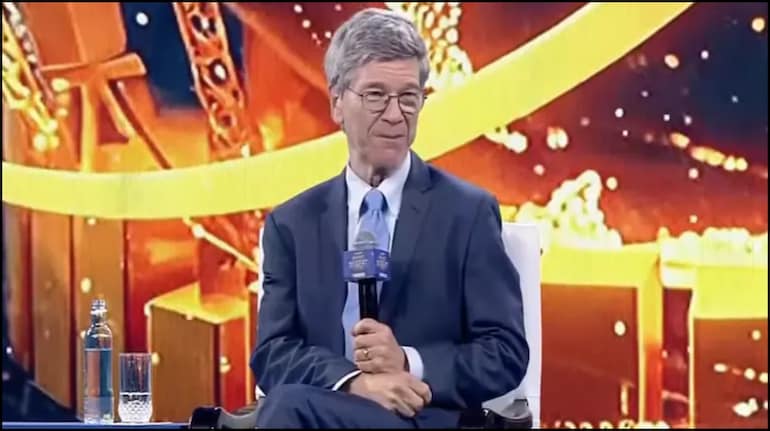
As India negotiates the bilateral trade agreement with the United States, noted economist and a Trump critic, Jeffrey Sachs warns India not to fall for "America's tricks". He says that India should try and work with China.
"And don't close the options with China. Don't close the options with Russia. Don't close the options with Europe. Don't let the United States say, 'Well, you're with us, you're against them,'" Sachs told Moneycontrol's Shweta Punj in an interview at the Rising Bharat Summit 2025, held in New Delhi from April 8 to 9.
Edited Excerpts:
It took two days for Trump to wipe out 10 trillion dollars. So where do we go from here Professor Sachs? Is this the new normal?
We're in a period where several major developments are simultaneously occurring, and I think that this is important. Geopolitically we're at the end of the US’ dominance in the world. We're in a multipolar world. That's been true for several years but now it is plainly true and obvious to everybody. We're in the midst of profound technological disruption. Obviously, every day, almost every week some major breakthrough is disrupting our lives and the economy. Some for the good, some completely shaking up things, but whether it's AI or biotech or space technology or warfare, everything is changing before our eyes at an unprecedented rate. We're in an ecological disaster. Even though it is maybe the most fundamental of the dynamics underway right now it doesn't even make the headlines because it's pushed aside by the war, the crises, the stock market and so forth.
We're smashing every limit that we promised to stay below. We're in an accelerated rate of dramatic ecological upheaval which could have huge effects for billions of people around the world for food supplies, for physical safety, for ocean levels, for mega storms, for mega forest fires, for mega droughts, you name it. We're heading in that direction. You put all of this together and not only is there no leadership in the world in a way that we would like to see, the one country that was ostensibly with some responsibility is utterly destructive right now. Sadly, that's my own country, the United States.
Not only is it not stabilising and helping it is adding to the destruction obviously in mindless, senseless, terribly destructive ways. Incidentally, Trump's trade war out of nowhere, out of his fervent imagination, out of his economic ignorance burst onto the scene. But consider that Trump's second administration started from the first day with the US saying we're not part of the climate change agenda.
Well, my god, the country that has the highest historical responsibility for the rise of greenhouse gas emissions, the country that's number two in the world in total greenhouse gas emissions behind China, but way ahead of China in per person emissions, says no not our business. And the world in a way let that pass because there's so many immediate crises that no one even has the time to say to the United States, “Huh, what are you doing? You can't walk out of planet earth.” Trump's walking out of one UN agency after another under one UN agreement after another. Now the trade wars. So, we have profound underlying changes, and I would say complete instability in the US itself.
Okay, you can take a breath and say it sounds completely disastrous but let me add one paradox which is that because our technologies are so good now, because 5G can reach the whole world, because AI can do health care, actually can help with education, can help with payment systems, can help with finance from high finance to micro finance. We have more solutions now for basic problems than ever before. For me, it is the paradox, it's like Charles Dickens - it was the best of times, it was the worst of times. You feel this could be the age of abundance. Oh my god, we're going right over the cliff. Both of those are true.
So, will it be the age of abundance, or will it be the age of disaster? And what are we really looking at? And for countries like India, how worried should we be? Because the sense that one gets—and that's what the Indian government has also been saying—is that India will continue to grow at about 6.5 percent because of low oil prices. We are worried about dumping from China. So, when we talk about the US dominance getting over, when we talk about the changing power dynamics in the world, where do we see India in that picture?
First, if you ask at a conceptual level, where are we going—is it the utopian or the dystopian outcome—the answer is: either is possible. Life and the world have choices. We're not fated to be one or the other. Second point that I think is always worth emphasising: if you want to predict the future, make the future. In other words, there are some who, if you're an investor, if you're a gambler, you sit back and you observe—what do you think is likely to happen? It's a valid activity. I'm in a different activity, which is trying to be helpful, which is quite different from observing and predicting. I'm trying to say: what could be done to get us to the better outcome?
Now, my view is maybe a little bit different from the way you phrased the question. I view China as part of the solution, not part of the problem. The United States definitely views China as part of the problem. Why? It's very important to understand why. China became a US enemy a decade ago. You can even note the dates in which the rhetoric changed—from partner or trader to adversary, and then to enemy. It started about 10 years ago. Why? For a simple reason: China became very successful. That's all.
So, the United States does not like competitors, period. China is a competitor. It is a first-rate competitor. It's outcompeting the United States on countless technologies right now—electric vehicles, battery supply chains, 5.5G transmission, renewable energy, long-distance power transmission, fourth-generation nuclear—and it is on par with the United States and others. I can't express enough how much the United States hates China's success. Not that China has done something terrible to the United States, but China has succeeded.
China said in 2014, here are 10 industries where we want to be competitive, where we'd like to lead by 2025. They made a project called "Made in China 2025." Very clever. We are now in 2025. In most of those sectors, they succeeded. They made, in 2017, a national development strategy for artificial intelligence. They wanted goals by 2025. Come 2025—DeepSeek. My God, this is really something. So, this is driving the Americans nuts.
And India has its own issues with China. India has its border issues, which are real. They go back decades. India has had violent clashes in the Himalayas with China. But the fact of the matter is India and China have a fundamental interest in a stable multipolar world. The United States—it may sound strange and a little harsh and can be easily dismissed, but I'll say it anyway, just because it's true—the United States wants to use India against China. This is natural. The United States sees that India doesn't like China. We can use India in the Quad, for example, in the military. India says, yes, we want military technology. The US is our friend. We don't know about China, and so forth.
So, the US wants to use India. Of course, India is not going to be used. India is a civilization. India is not only a country. India is not going to be manipulated by 335 million people in the United States—a little bit bigger than UP, but not so much bigger than UP. So, the truth of the matter is that fundamentally there's a kind of discordance, where the U.S. thinks, "India will be our key to maintaining dominance over China." India says, "No, well, look, it's a constructive relationship, why not? We want military. We want tech. We're not so happy about China. We're not going to be used, but we'll do this and that."
The truth is, be a little careful because the US is unstable, and don't fall into the US trap of "China's the enemy, it's going to dump on us, it's got this overcapacity," and so on. This is all US rhetoric. The US’ rhetoric is that China's terrible because it's so good. Who invented this idea of overcapacity? I shouldn't say it, because some of my friends did but I don't agree with them at all. The whole term is an absurdity from a world perspective. I'll give you a specific example. China has enormous capacity in solar modules. The productive capacity is probably 1,200 billion watts of production per year of solar power capacity. Huge. They're producing about half of that right now. The United States says "overcapacity." That's a little crazy, because the world needs all of China's capacity and more if we're going to head off climate disaster. We shouldn't be saying to China, "Cut back your capacity." That you would say if solar was somehow a destructive technology. But if solar is a world-saving technology, you don't call it overcapacity. You say, thank goodness someone's producing that. Of course, India should be producing it too.
I'm not saying one versus another, but the idea of overcapacity is an American meme that is a lazy, stupid, and phony idea, which, translated into plain English, is: "China's doing better than we are, so we better attack them for doing better than we are."
How do you think India should navigate this?
I think that India should say, "Look, the world is multipolar. We're happy to be one of those poles. We're the third largest economy in the world. We're going to overtake the United States in 10 years or 15 years." We will. This is natural. India is growing 6 percent per year. The United States maybe won't grow this year. Maybe it'll grow at 1 percent this year. But India will overtake the US. China's already overtaken the US in purchasing power terms. This is natural. India is more than four times the population of the US, so why not?
In a multipolar world, the major poles all need to be peaceful vis-à-vis each other. The key needs to be mutual respect. So, if the major poles right now are the United States, Europe, Russia, China, India—and I hope soon some others: African Union, ASEAN, West Asia, the Arab League—there are other groupings that absolutely should be playing their role.
First, don't get into each other's nerves to the point of major conflict. Major regions, please stay out of conflict with each other. These are, by and large, nuclear powers. Nuclear powers can end the world if they even step on each other's toes and then annoy each other to the point of escalation and war. So, what should India's policies be? Mutual respect—China, Russia, Europe, US. Now, this comes naturally to India. India invented the Non-Aligned Movement. India said, we're not siding with one or the other. India, in my view, should not play in the Quad, for example. That's just my view. I think the Quad is a completely terrible idea, frankly. Why should this group align against China?
Now, some people say, "No, the Quad's not anti-China." Of course, the Quad is anti-China. That's playing the US game. China and India should have strong bilateral relations—that's my view. Trading with each other, investing with each other, having normal relations, settling the Himalayan border issues, which, another theory of mine—all problems in this world go back to the British. So, this unfortunately, is true. Not a coincidence: Britain was the global hegemon. It was, of course, the imperial power in this country. But it made a mess all over the world because it acted in arbitrary self-interest, not in global interest. This is not news.
And, at some point in the middle of the 19th century, Mr. McMahon drew a line in the Himalayas to places he never visited. And that became the basis of the border disputes between China and India for the last 75 years. China and India are two great civilizations. They can resolve these issues.
We are in the middle of a trade negotiation with the US. We are hoping to conclude a bilateral trade agreement by September this year. And the US is pushing us to open up our agriculture sector, which is a contentious sector for us. We want to protect our farmers. In your view, how should we go about these negotiations? I was reading that in your address at the EU Parliament, you told Europe to not trust the United States. What would your advice be for India as it negotiates probably one of its most difficult trade agreements in the last several decades?
I don't want to be pessimistic, and I don't want to be negative. And I'm not inside the negotiations. But frankly, I'd be hugely surprised if India pulled off an agreement with the United States this fall. I may be wrong. The US wants to use India against China. The US government has no interest in India's goodwill per se. Believe me, this is a game from the US’ side. And the game is: what can we do to displace China? Now, India is going to become a very, very successful economy. When that happens, and as that happens, the United States will not like India any more than the United States likes China right now. This is fated.
So, we are the underdogs at the moment, which is why we're getting all the love.
It's not so much love, believe me. Trump will not open the doors for Indian manufacturing, even if India were to open the doors for agriculture, because Trump's whole idea is, low-cost industry should not destroy American industry. Trump is not going to do what India wants, which is to make India the replacement for China. It's not going to happen. Again, I'm not on the inside, and I don't want to in any way mess up the...(negotiations)
So then how is the United States using India? Because one would think that they would want to move their supply chains to India from China.
Donald Trump doesn't want supply chains. He really believes... He's a very unsophisticated person. He really believes that America should consume what America produces. He doesn't want India's supply chains.
But America doesn't produce anything anymore.
That's what he says.
Except defense.
So, he wants all those jobs to come back. He doesn't understand the world economy doesn't work that way.
Also read: We have created path of possibilities from policies: PM Modi's top quotes at Rising Bharat Summit
And America has moved on. All the big tech companies are coming out of India.
That there's a division of labor. He doesn't get that. The idea that, yes, he'd prefer India to China right now because he wants to bash China, but he doesn't want India either in American supply chains. I'm just saying, don't get the hopes up so much. And don't close the options with China. Don't close the options with Russia. Don't close the options with Europe. Don't let the United States say, "Well, you're with us, you're against them." That is the American trick. Learn from the British. Don't play that game, whatever. Good luck on the negotiations. Maybe something will happen, but it would really be counter to the underlying politics of Trump and the underlying politics of the United States right now.
Watch the full interview here.

Discover the latest Business News, Sensex, and Nifty updates. Obtain Personal Finance insights, tax queries, and expert opinions on Moneycontrol or download the Moneycontrol App to stay updated!
Find the best of Al News in one place, specially curated for you every weekend.
Stay on top of the latest tech trends and biggest startup news.