






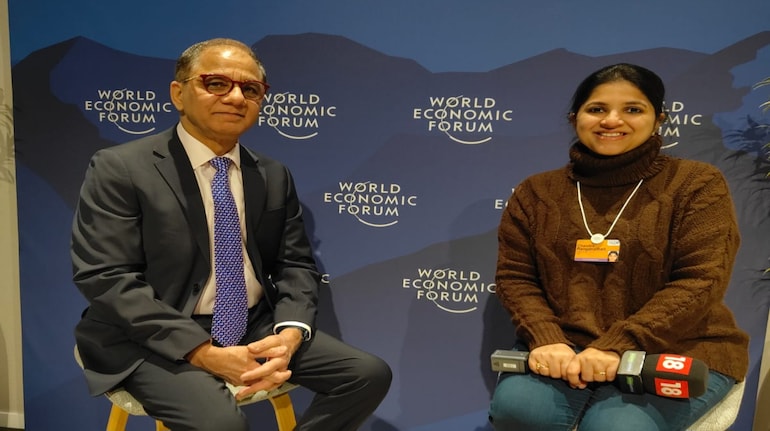
India’s digital public health infrastructure, anchored by the Ayushman Bharat Digital Mission (ABDM), is emerging as a global template for scalable, interoperable and affordable healthcare systems, Dr Shyam Bishen, Head, Centre for Health and Healthcare, and Member of the Executive Committee at the World Economic Forum, said at the global forum in Davos.
“I think India is already serving as a trailblazer when it comes to digital health,” Bishen told Moneycontrol. “From the healthcare perspective, when it comes to using breakthrough technologies and digital data, India is going to actually spearhead some of the work that we have ongoing with our partners in India, whether it’s the Government of India or whether it’s the Government of Telangana, and on the private sector, obviously, with Apollo Hospitals and others.”
Bishen was speaking on the sidelines of the 56th edition of the World Economic Forum’s annual meeting in Davos-Klosters, scheduled between January 19 and 23, which will bring together nearly 3,000 leaders from over 130 countries, including around 400 top political leaders and 850 chief executives.
Digital public infrastructure at scale
ABDM, which has covered over 800 million people, is an example of large public-sector digital infrastructure that enables interoperability across healthcare providers, payers and patients, Bishen said. He added that India’s early investments in digital identity systems such as Aadhaar made it possible to build such platforms at population scale.
“ABDM, that’s a great example of a large public-sector digital infrastructure,” Bishen said. “That was, I believe, possible because of the digital personal identity Aadhaar card and others that were created early on.”
With this infrastructure in place, India can now accelerate the adoption of artificial intelligence and other breakthrough technologies to address challenges around healthcare access, outcomes and system efficiency, he added.
Frugal innovation amid rising global costs
Bishen said India’s digital health model is particularly relevant at a time when global healthcare expenditure has climbed to $10–12 trillion, accounting for more than 10 percent of global GDP and growing three times faster than economic growth.
“We can’t continue like that,” he said. “We must control the overall efficiency. We must control the overall cost.”
At the same time, nearly half of the world’s population still does not have access to healthcare products and services, while many systems continue to pay for activity rather than outcomes, contributing to higher costs.
Public-private collaboration
India is also playing a central role in global healthcare initiatives being led by the World Economic Forum in partnership with governments and the private sector. These include collaborations with the Government of India, the Government of Telangana and private healthcare providers such as Apollo Hospitals.
“There is now an infrastructure, and then we can use that to accelerate adoption of AI and other breakthrough technologies,” Bishen said. “Whether it’s on the access side, on the outcome side, or on the efficiency side.”

Discover the latest Business News, Sensex, and Nifty updates. Obtain Personal Finance insights, tax queries, and expert opinions on Moneycontrol or download the Moneycontrol App to stay updated!
Find the best of Al News in one place, specially curated for you every weekend.
Stay on top of the latest tech trends and biggest startup news.




