






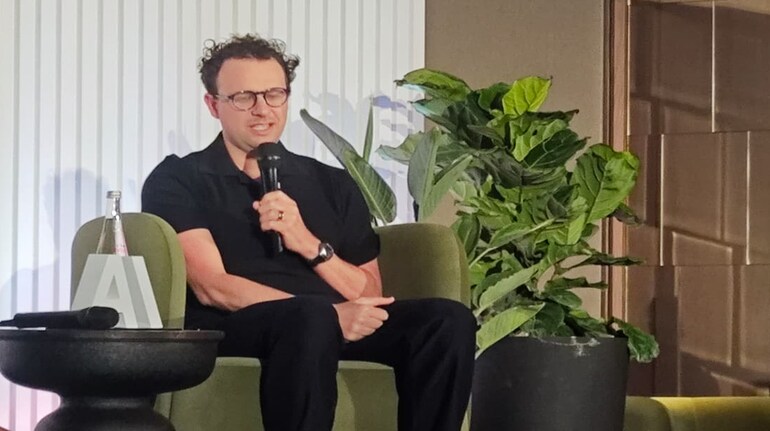

Artificial intelligence is advancing toward human-level capability far faster than most people realise, and society is underprepared for what lies ahead, according to Dario Amodei.
Speaking on Zerodha co-founder Nikhil Kamath’s podcast WTF Is, Amodei likened the current moment in AI development to “standing on the shore while a massive wave gathers in the distance” , a transformation that could reshape industries, careers and education pathways.
For young Indians choosing careers today, his advice boiled down to three pillars: build on AI rather than against it, consider sectors linked to its physical and supply-chain backbone, and above all, sharpen critical thinking in an era where reality itself may become harder to verify.
‘What should a 25-year-old learn today?’
Framing the conversation around young Indians trying to choose their careers, Kamath asked related questions many students grapple with: which industries will be disrupted first, which ones have a longer runway, and what skills someone starting out today should focus on.
“I’m trying to figure out what book to read, which college to go to, what skill set to learn if I’m starting a startup today,” Kamath said. “What has some kind of a tailwind? For a short period of time is okay as well.”
Amodei’s response was clear: think human.
“I would think about tasks that are human-centred, tasks that involve relating to people,” he said, suggesting that jobs rooted in interpersonal understanding and real-world context may prove more resilient than purely technical roles.
Coding first, engineering later?
On the question of whether coding and software engineering would be disrupted, Amodei drew a distinction.
“I think coding is going away first, or coding is being done by the AI models first,” he said.
While basic coding tasks are increasingly handled by AI systems, he added that the broader discipline of software engineering — architecture, system design and end-to-end execution — may take longer to automate.
“And then, the broader task of software engineering will take longer. But I think doing that end-to-end, I think that is gonna happen as well,” he said.
However, he noted that certain elements — such as design thinking, understanding user demand and coordinating AI systems — are likely to remain human-driven for longer.
“The elements of design or making something that’s useful to users or knowing what the demand is, or managing teams of AI models, those things may still be present,” Amodei said.
The ‘5 percent’ advantage
One of the more striking insights from the discussion was Amodei’s idea of “comparative advantage” in an AI-powered world.
“Even if you’re only doing five percent of the task, that five percent gets super-amplified and levered,” he explained. “Because it’s like you’re only doing five percent of the task, the AI does the other 95%, and so you become 20 times more productive.”
While he acknowledged that as AI moves from doing 95 percent to 99 percent of tasks the human role may shrink further, he suggested there is significant opportunity in the transition phase.
“But I think there’s surprisingly much in that zone of comparative advantage,” he said.
The Safe Bet: Human + Physical + Analytical
For young Indians planning their careers, Amodei suggested focusing on a blend of skills, human-centred capabilities, engagement with the physical world, and strong analytical foundations.
“I would really think about the things that are human-centred,” he said. “I think there’s something to that. I think there’s something to, kind of, the physical world, or things that mix together, human-centred, the physical world, one of those two, and analytical skills that somehow tie them together.”
As AI systems become more capable, Amodei’s message was not to avoid technology, but to position oneself where human judgment, empathy and real-world understanding intersect with intelligent machines.
For India’s vast young workforce, the takeaway from the podcast was simple but sobering: the AI wave is building fast, and preparing for it requires rethinking what it means to build a future-proof career.
The Bigger Warning
Amodei’s broader message was sobering: AI’s progress is accelerating rapidly, and many institutions from education systems to regulatory frameworks, are not ready.
As the AI wave gathers strength, he suggested, those who position themselves wisely could ride it — rather than be overwhelmed by it.
Discover the latest Business News, Sensex, and Nifty updates. Obtain Personal Finance insights, tax queries, and expert opinions on Moneycontrol or download the Moneycontrol App to stay updated!
Find the best of Al News in one place, specially curated for you every weekend.
Stay on top of the latest tech trends and biggest startup news.





