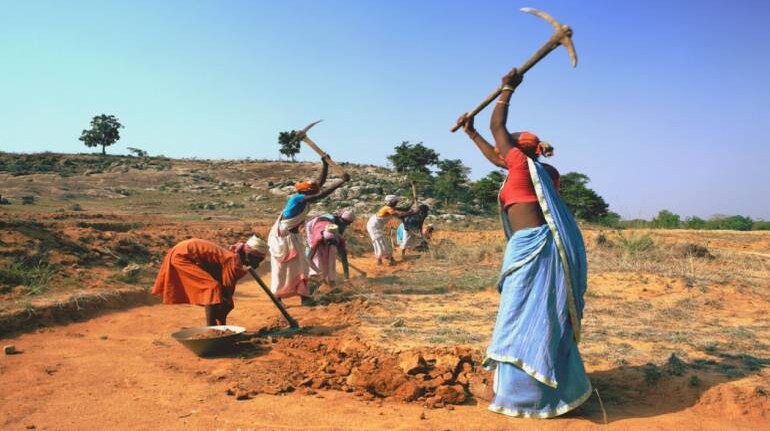
The participation of women in the labour force in India is underrepresented because of measurement issues, the government said, calling for an improved quantification of “work” through redesigned surveys.
Adding the correct proportion of women in the official labour force participation rate (LFPR) results in an augmented female LFPR of 46.2 percent, which is much higher than the 32.5 percent estimated by the conventional definition, according to the Economic Survey for FY23 released on January 31.
The LFPR is based on the Periodic Labour Force Survey (PLFS), which is a conceptual framework of key employment and unemployment indicators.
Measurement of employment through the survey design and content can make a significant difference to final LFPR estimates and this matters more for measuring female LFPR than male LFPR, according to the Economic Survey.
The Economic Survey highlighted three main measurement issues: overly broad categories, reliance on a single question to categorise labour force status, and the narrow approach of limiting productive work to labour force participation.
Economic Survey 2023 LIVE Updates: Haven't given up hope of India's 8% GDP growth, says CEA
The design of the PLFS relies mainly on the single question for measuring the labour force status of an individual, which eliminates the scope to rectify any error in self-reporting, considering the large rural population and literacy levels, the survey said.
ILO norms
The use of overly broad categories that club productive work such as collection of firewood and poultry farming with domestic duties can shift a significant proportion of women in the labour force to the out-of-labour-force category.
Unless production of primary goods is identified as the main activity by the respondent, the PLFS questionnaire would categorise women who do both domestic activities and primary goods production/collection as out-of-the-labour-force.
The International Labour Organization recommends using multiple probing or recovery questions such as whether the person helped in the family business, whether the person worked in his or her own business in the past one week/year and whether the person helped the family with a job.
There is a need to broaden the horizon of measuring work, which constitutes productive activities alongside employment, according to the Economic Survey.
According to the latest ILO standards, limiting productive work to labour force participation is narrow and only measures work as a market product. It does not include the value of women’s unpaid domestic work, which can be seen as expenditure-saving work such as collecting firewood, cooking, and tutoring children, and contributes significantly to the household’s standard of living.
Discover the latest Business News, Sensex, and Nifty updates. Obtain Personal Finance insights, tax queries, and expert opinions on Moneycontrol or download the Moneycontrol App to stay updated!
Find the best of Al News in one place, specially curated for you every weekend.
Stay on top of the latest tech trends and biggest startup news.