







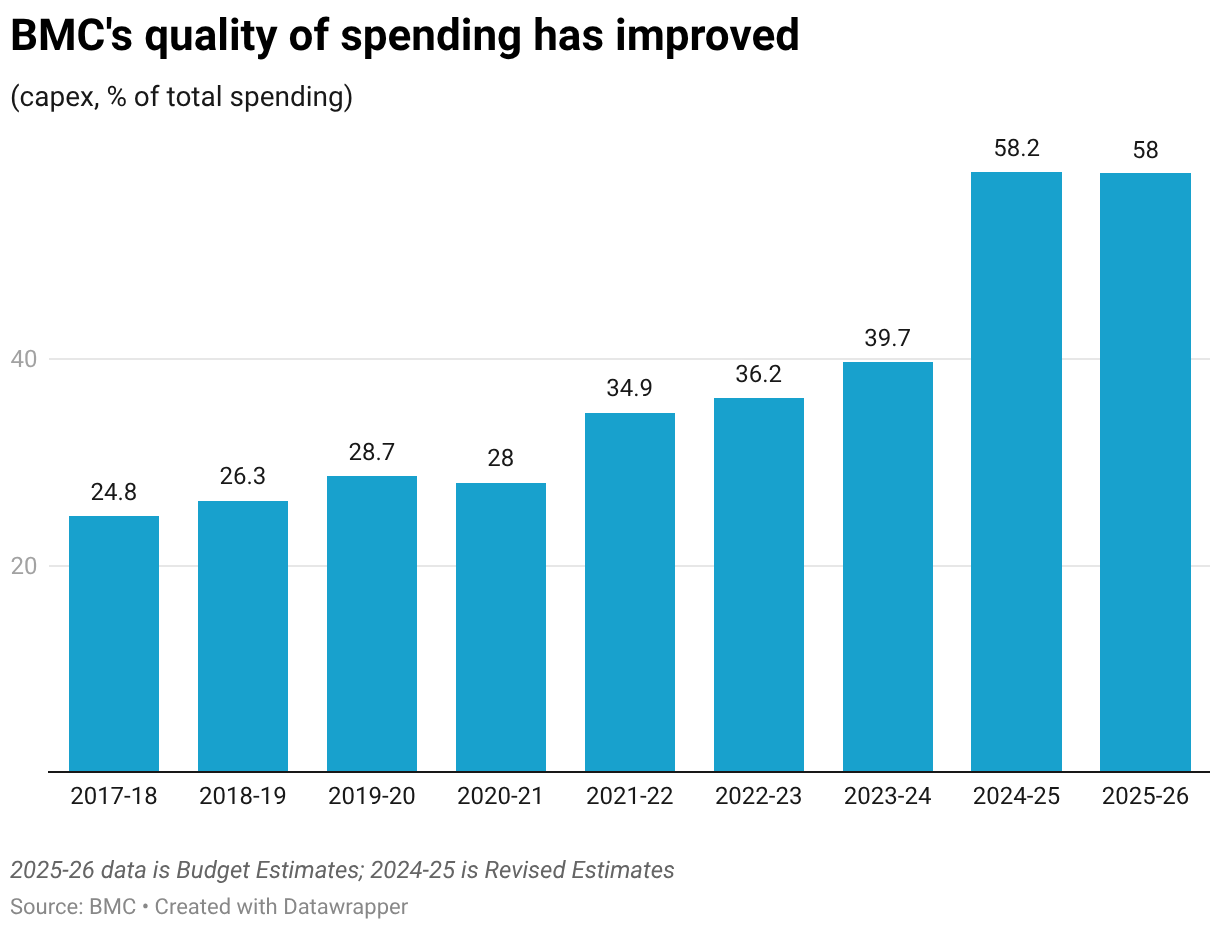
Mumbai’s civic body, the Brihanmumbai Municipal Corporation (BMC), stands out among India’s major urban local bodies for both the scale of its spending and its priorities, with capital expenditure now accounting for close to 60 percent of the corporation’s total outlay, one of the highest such ratios in the country.
Over the past decade, BMC’s expenditure has expanded sharply. Total spending has risen from just over Rs 20,000 crore in 2017–18 to an estimated Rs 74,367 crore in 2025–26. What distinguishes this expansion is not just its size, but its composition. While revenue expenditure has grown steadily, capital spending has surged at a much faster pace, jumping from around Rs 5,000 crore in 2017–18 to more than Rs 43,000 crore in 2025–26.
Large investments in roads, coastal infrastructure, flood mitigation works, transport projects and health facilities have driven this transformation, reshaping Mumbai’s civic balance sheet.
This aggressive investment-led approach, however, is increasingly raising questions about sustainability—an issue that is likely to confront the new civic leadership that takes charge after January 16. Mumbai goes to the polls on January 15 to elect its councillors after a gap of nearly a decade, and the fiscal choices of the next administration will be closely watched.
The concern stems from the growing mismatch between spending and revenue growth. While expenditure has surged, BMC’s revenues have risen far more slowly, increasing from about Rs 22,400 crore in 2018–19 to roughly Rs 43,160 crore in 2025–26. This divergence has gradually tightened the corporation’s fiscal headroom, even as infrastructure ambitions have expanded.

The pressure is especially visible in BMC’s own tax streams. Property tax, typically the most stable source of revenue for urban local bodies, has remained volatile in Mumbai and has yet to show a strong, sustained uptrend. In FY26, property tax is expected to contribute only about 12 percent of BMC’s total revenue, sharply lower than peers such as Bengaluru, where the share is closer to 40 percent. Instead, Mumbai relies heavily on state transfers, which account for more than a third of its income.

Octroi compensation, which became a critical revenue line after the introduction of GST, has provided some support. However, its growth has not been sufficient to fully offset the rapid rise in expenditure commitments, particularly on the capital side.
For the next city government, the challenge is clear. BMC’s spending quality has improved significantly, and its emphasis on long-term infrastructure sets it apart from most Indian cities. But sustaining such high levels of capital investment will require more predictable and buoyant revenue sources, stronger property tax performance, and sharper monetisation of municipal assets.
Without a parallel strengthening of the revenue base, even India’s richest civic body could find its ambitious infrastructure push constrained.
Discover the latest Business News, Sensex, and Nifty updates. Obtain Personal Finance insights, tax queries, and expert opinions on Moneycontrol or download the Moneycontrol App to stay updated!
Find the best of Al News in one place, specially curated for you every weekend.
Stay on top of the latest tech trends and biggest startup news.





