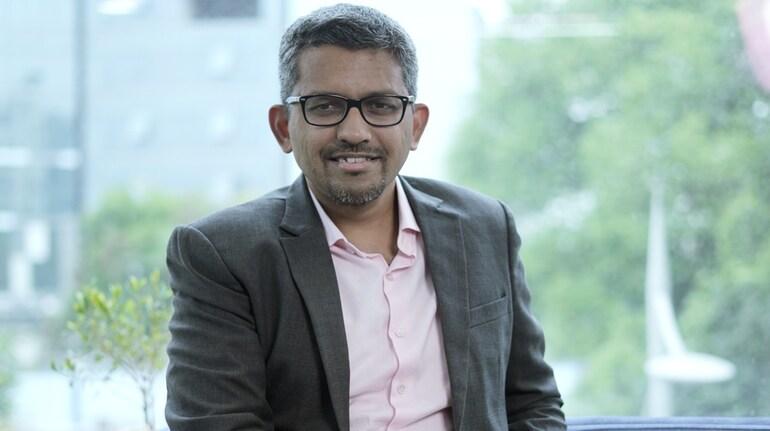

Vivriti Group’s founder Vineet Sukumar said on February 24 that the company will look to offer a new suite of services such as capital markets, technology solutions, financing, among others under Vivriti Next, a new operating and holding company. This will make the mid-sized non-banking financial company into a full-stacked financial services provider.
As part of the change in organisational structure, Sukumar will infuse about Rs 200 crore into Vivriti Next in his personal capacity, he said. This will add to the existing funds that have been raised by its marquee investors such as US-based Creation Investments, London-based Lightrock Capital, and TVS Capital Funds.
Post the infusion of the capital, Sukumar’s stake in the firm will increase to 11 percent from sub 10 percent before.
Following the creation of Vivriti Next, the shareholders of Vivriti Capital will transition to the new holding company structure, maintaining a similar diversified and institution-led cap-table from April 1, 2026, according to Sukumar. Under the new structure, Vivriti Capital and Vivriti Asset Management will be wholly-owned subsidiaries of Vivriti Next.
“As our mid-market clients have scaled over the years, their needs have moved well beyond standalone borrowing to strategic solutions. Vivriti Next has been created as a platform to respond to this complexity by building new business models in how we support our clients beyond lending,” Sukumar said.
Edited excerpts of the interview:
The company is now undergoing a massive restructuring. What is the thought process behind this?
At the end of the day, we also want to set up more ventures under Vivriti Next. The current structure that I am having right now, the NBFC, and then below that the AMC, does not give me any flexibility. There are regulatory restrictions to what we can do in our existing structure today.
Our transition to Vivriti Next gives us far more flexibility to build more growth engines either within Vivriti or future subsidiaries, which I do not have today. This new structure will be a lot more flexible. So, when I am thinking about 15 years, I think this structure is what will really help me grow and scale. I am going deeper actually within lending. With my mid-market customer, what more can I do? I am not changing my customer.
You offer an interest rate of about 14%. The RBI had cut 125 basis points in the repo rate till now. What is the rationale of not passing down those rate cuts to your customers?
My business is not very different from let us say a steel company, right? Iron ore and coal demand is driven by iron ore and coal markets. And steel demand and market is driven by steel markets.
So, at the end of the day, it is a demand-supply question. That is why I say, money supply in the mid-market space is far lower than the large corporate space. In the large corporate space, companies can force mutual funds and the bank to cut rates, to mirror the repo rate. In the mid-market space, liquidity is much lesser and lenders are able to therefore maintain rates.
In case of these high interest rates, there could also be a chance of default, right?
You are right and at the end of the day, that is where our underwriting skill will come in. There are two things we will assess, simplistically speaking.
We are by no means the only lender. It is important for me that there are banks who are lending. A bank may be lending at 9-10 percent because they have taken collateral etc.
We may be lending at 14 percent. The blended cost of borrowing for the company could be 11 or 12 percent. because they are mixing various pools of capital to come to a sustainable number for them. That’s number one.
Number two, we lend to companies who have ambitious promoters. Typically, these companies are operating at a return on capital employed (RoCE) of 18-25 percent. Also, they are growing. If their capital is earning them 18 to 24 percent, they can pay 14 percent to me and still make money. If I find a company that is growing slow or loss-making or does not have banking support, that is outside the box.
How has the company's asset profile evolved in the last 12-18 months? In your annual report, while the gross NPA for 2025 is at 1.89 percent, there is a specific segment of unsecured personal loans which have increased to more than 7 percent from 5.15 percent.
In the last three years, we have gone between 0.5 to 0.8 to 0.9 percent of core non-performing assets (NPA). So, it has been very range bound, sub 1 percent since the day we started.
With regards to the GNPA, I’ll explain. In the NBFC’s book, there is more than 10,000 crore. Roughly, out of which, Rs 3,900 crore is into a product called co-lending. With regards to Vivriti Capital, as at the end of this December, the gross NPA was at around Rs 250 crore, out of which Rs 170 crore was from this co-lending product. This was fully backed by cash deposits lying in scheduled commercial banks which I can draw down to square off the NPA. Which is why our core NPA is based.
So, what you see in the annual report is the declared disclosed NPA which is not a true reflection of our performance because 70 percent of that is backed by cash deposits. You always point out the core NPA. The core NPA is 0.9 percent. The gross NPA is not really a number. It is not reflective because it is a regulatory problem.
You had mentioned that you’re looking to go for an initial public offering by 2029. Why is there a time lag, especially when you mentioned that you have the parameters now to list in the public markets?
One is to do with the fact that, I would like to make sure that we build upon our return on equity (ROE). I think the kind of fee income that Vivriti Next can generate will be a significant component of that. Second, I do feel that the market will appreciate larger scale. I believe that results in more public liquidity on the stock. There will be a larger float and a larger valuation when we go to the market. Lastly, I would like to increase my stake as well.
Discover the latest Business News, Sensex, and Nifty updates. Obtain Personal Finance insights, tax queries, and expert opinions on Moneycontrol or download the Moneycontrol App to stay updated!
Find the best of Al News in one place, specially curated for you every weekend.
Stay on top of the latest tech trends and biggest startup news.