
After a sharp 43 percent drop in 2025, Indian companies are expected to ramp up offshore dollar issuances in the new year. With around $13 billion in foreign debt set to mature, bankers expect India Inc to return to the international market to refinance these bonds.
According to LSEG data, issuances declined 43 percent to $5.5 billion in 2025 from $9.6 billion a year earlier, as Indian borrowers turned cautious amid a challenging global funding environment marked by elevated US interest rates, a weaker rupee and heightened trade-related uncertainties.
Market participants said the slowdown was expected and represented a tactical pullback rather than a structural shift away from offshore markets.
“The slowdown was largely anticipated. Elevated US interest rates and heightened forex volatility pushed up the all-in cost of dollar funding, reducing the relative attractiveness of offshore issuance for Indian borrowers,” said Shobhit Bahl, Head of Financing for India at Barclays.
He added that strong domestic liquidity and competitive onshore borrowing costs encouraged issuers to shift funding onshore, leading to a measured decline in offshore bond activity rather than a lasting contraction.
The domestic debt market remained deep and accessible through the year, offering Indian companies an attractive alternative amid global volatility.
Strong demand from banks, mutual funds and insurance companies helped keep onshore borrowing costs relatively stable, particularly for high-rated issuers.
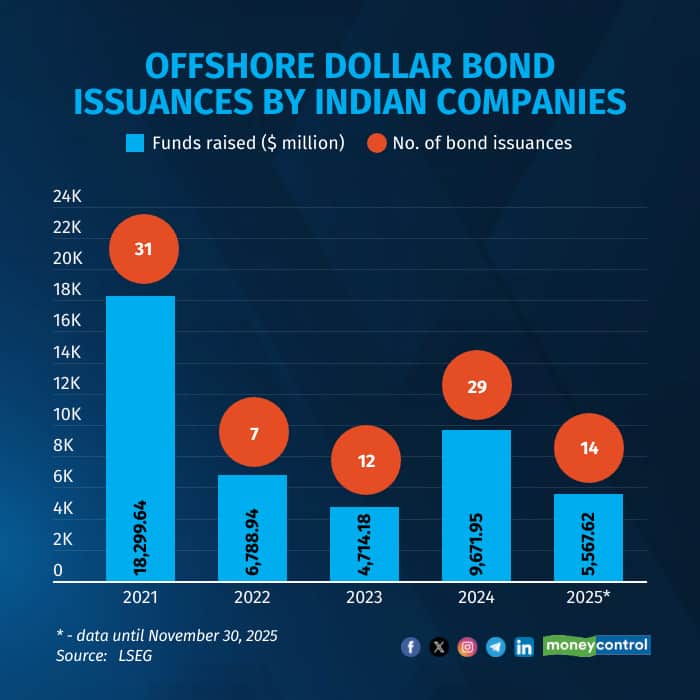
Looking ahead at 2026, bankers expect a gradual recovery in offshore dollar bond issuance, driven primarily by refinancing requirements rather than fresh capital expenditure funding.
Indian corporates are estimated to face around $13 billion in offshore bond maturities over the next year, which is expected to create a visible issuance pipeline.
“We see conditions aligning for some recovery in offshore USD bond issuance in 2026, led primarily by refinancing activity. Indian corporates face meaningful bond maturities estimated at around $13 billion, which should provide a clear issuance pipeline,” Bahl said.
He also pointed to the possibility of regulatory easing by the Reserve Bank of India, including changes to minimum tenor, end-use and pricing norms, which could widen market access and support a broader issuer base in offshore markets.
The sharp drop in the rupee, while a key concern for borrowers, has not eliminated appetite for offshore dollar debt. Instead, it has prompted issuers to adopt a more disciplined and selective approach, with greater emphasis on hedging strategies, balance-sheet resilience and timing of issuance.
“Rupee depreciation has increased issuer discipline rather than materially suppressing appetite for offshore dollar debt. Borrowers are approaching the market more selectively, with a sharper focus on hedging strategies, balance-sheet strength and timing,” Bahl said, adding offshore funding continues to play a strategic role, particularly for refinancing and diversification purposes.
Some market experts, however, remain cautious on the outlook, given the likelihood of a structurally strong dollar.
Soumyajit Niyogi, director at India Ratings and Research, said dollar bond issuance could remain subdued to moderate as rupee weakness coincides with fading expectations of aggressive US Federal Reserve rate cuts.
“Dollar bond issuances have slowed as rupee weakness—driven by tariff-related uncertainties—collides with fading expectations of aggressive Fed rate cuts,” Niyogi said.
Unlike earlier cycles, the current environment is shaped by persistent trade tensions and strong capital inflows into US technology sectors, which are likely to keep the dollar firm for longer, he said.
For Indian issuers, the challenge extends beyond currency depreciation. Niyogi cautioned that even exporters, who typically benefit from natural hedges, may find those protections increasingly tested.
Still, bankers believe that offshore markets will regain relevance as rate visibility improves and global volatility eases.
While domestic markets will continue to dominate near-term borrowing, offshore dollar bonds are expected to re-emerge as a complementary funding channel, particularly for tenor extension and investor diversification, as refinancing needs rise in 2026.
“US Fed policy remains the dominant driver of sentiment for offshore dollar bonds. Improved rate visibility, easing volatility and relatively tight credit spreads should support a more constructive issuance environment, even if absolute yields remain above pre-2022 levels,” Bahl said.
Discover the latest Business News, Sensex, and Nifty updates. Obtain Personal Finance insights, tax queries, and expert opinions on Moneycontrol or download the Moneycontrol App to stay updated!
Find the best of Al News in one place, specially curated for you every weekend.
Stay on top of the latest tech trends and biggest startup news.