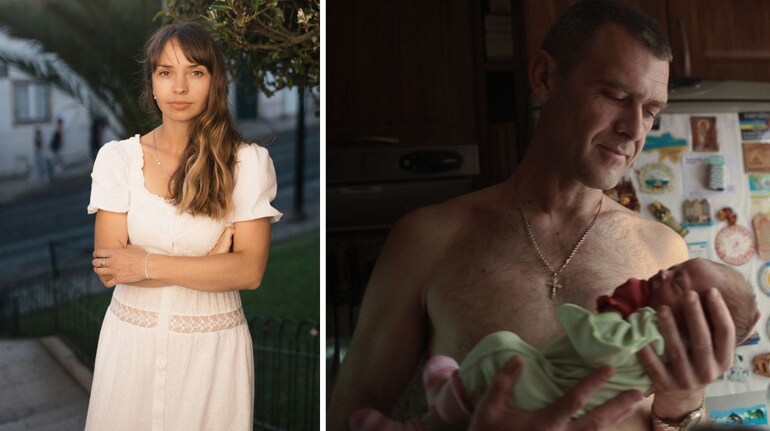
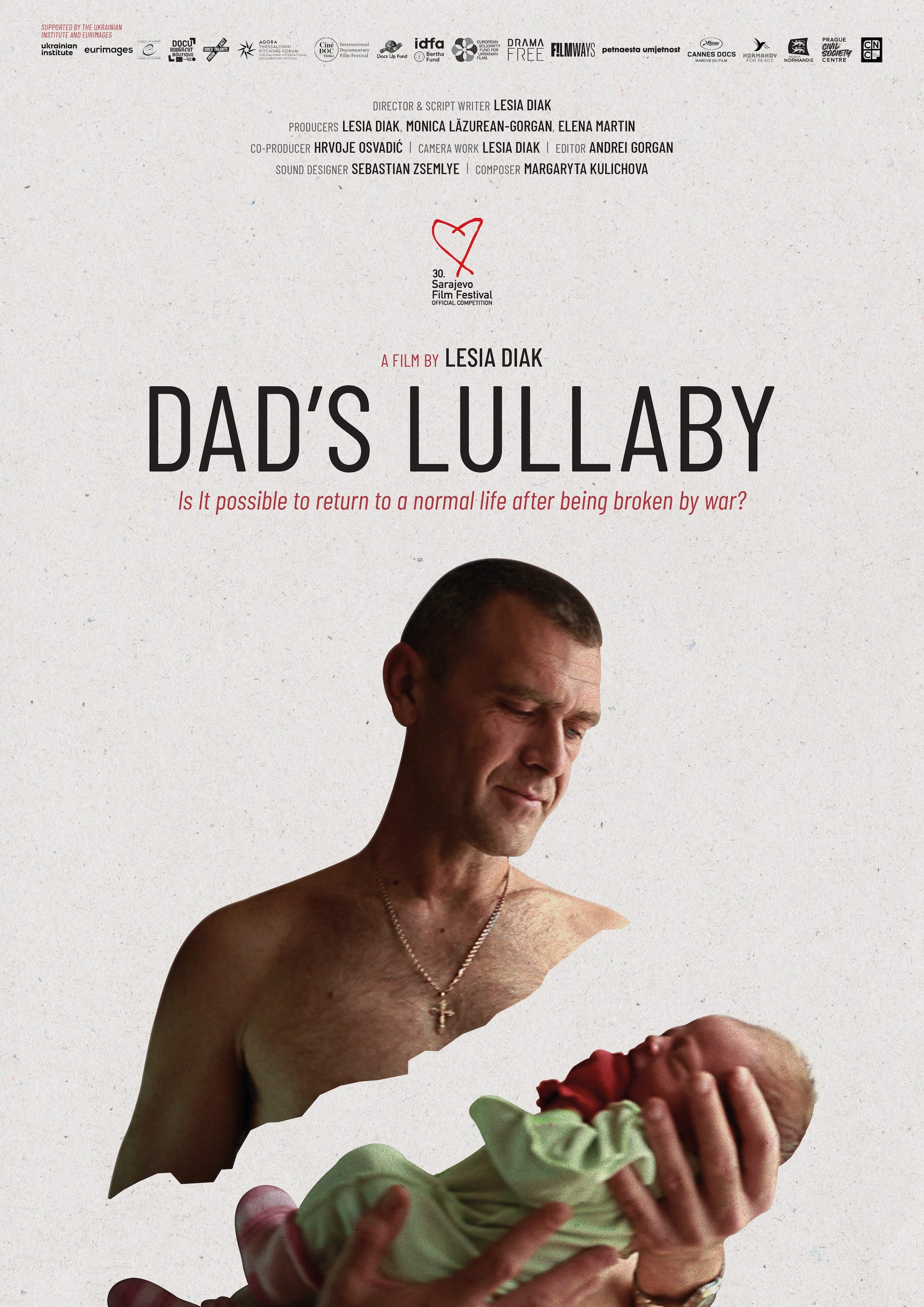
Serhiy is a Ukrainian war veteran who returns home after three years at the battlefield. At home, as he tries to reconnect with his family, his wife and three young sons, he struggles with war trauma and emotional upheavals, and the challenge of rebuilding his lost bond with his own. Serhiy is the protagonist of Ukranian documentary filmmaker Lesia Diak’s raw and intimate debut feature-length documentary Dad’s Lullaby, which had its Asia Premiere at the recently concluded 13th Dharamshala International Film Festival (DIFF) 2024.
Her earlier short documentary, Wounds (2024), was about three women who have lost their husbands and sons in Russia’s full-scale war against Ukraine and find themselves mourning in the Carpathian Mountains. “The stunning landscapes cannot fill the unbearable void left by their loss. Still, they are trying to learn to live with their unhealed wounds through poetry, sisterhood, and deep conversation,” says Diak. While Wounds was made after a large-scale Russian invasion of Ukraine in 2022 when the grief and negative psychological impact multiplied hundreds of times. Dad’s Lullaby was filmed during 2017-19, when the Russians were maintaining the military operations in the East of Ukraine. Both of Diak’s films focus on war and loss. “Dad’s Lullaby aims to capture the invisible damage of war. [Protagonist and soldier] Serhiy returned to his home in Kyiv but his mind was just stuck in the reality of war in the East of Ukraine. He didn’t have the same emotional availability as a father to his kids and as a husband to his wife. In a way, a part of this man was lost, especially for his family.”
Diak, 36, who splits her time between Lisbon, Portugal and Kyiv, Ukraine, further adds, “Since war-related trauma is invisible and it is very difficult to make it ‘seen’ with the tools of documentary filmmaking, at some point of editing of Dad’s Lullaby, I decided to include my dialogues with the main protagonist throughout the film in a way that they are hinting on how the story could unfold or where the story is heading. Serhiy verbalises that he feels isolated in his own world and that he does not want to let others on the territory of this world. He is also mentioning the loss of his comrades and sharing that he was craving for his time alone after returning from war.”
Excerpts from an interview:
You appear in the film, and your conversation with the soldier Serhiy runs through Dad’s Lullaby intercutting his family story. As a documentary filmmaker, how did you decide to shift the lens from the objective to subjective? Was it emotionally taxing for you to revisit your own war-related trauma?
When I filmed the dialogue with Serhiy, I felt that he is really cracking, that, for him, the presence of the camera was becoming very heavy [mentally] and I gave him the camera and said that he could film me if he would feel better that way. Later, during editing, this material turned out to be very useful for opening up Serhiy through my story and my experience of a broken relationship with my ex-partner. For war veterans, it is not easy to speak about their own pain, often they prefer to shift to the stories of others. I remember that my ex-partner [a soldier] was constantly avoiding the form of a first-person while talking about his dreadful experience.
I believe that documentary filmmakers should be at peace with being exposed. It’s a natural process. And it is organic for me as a filmmaker to be confronted by my film’s protagonist. Of course, I felt complex emotions when Serhiy was asking me about my personal life but my break-up had already happened, I had already entered the darkest state of depression and I started getting out of that state with the help of therapy and filmmaking.
To what extent is the film autobiographical/personal, besides you appearing in it?
Dad’s Lullaby is an autobiographical/personal film, yes. But I would like to highlight that Dad’s Lullaby conveys a universal story. By telling my story and the story of Serhiy’s family, the film delves into the relationship struggle of many couples whose genuine connection was broken by war, and not only in Ukraine but in many other countries of the world. For Serhiy and his wife Nadiia, the stakes are much higher because they have four children whose growing up is overshadowed by war and separation. I often ask myself ‘What will happen to these children in the future? Will they be able to maintain healthy relationships, to have families, to find their place in this world?’
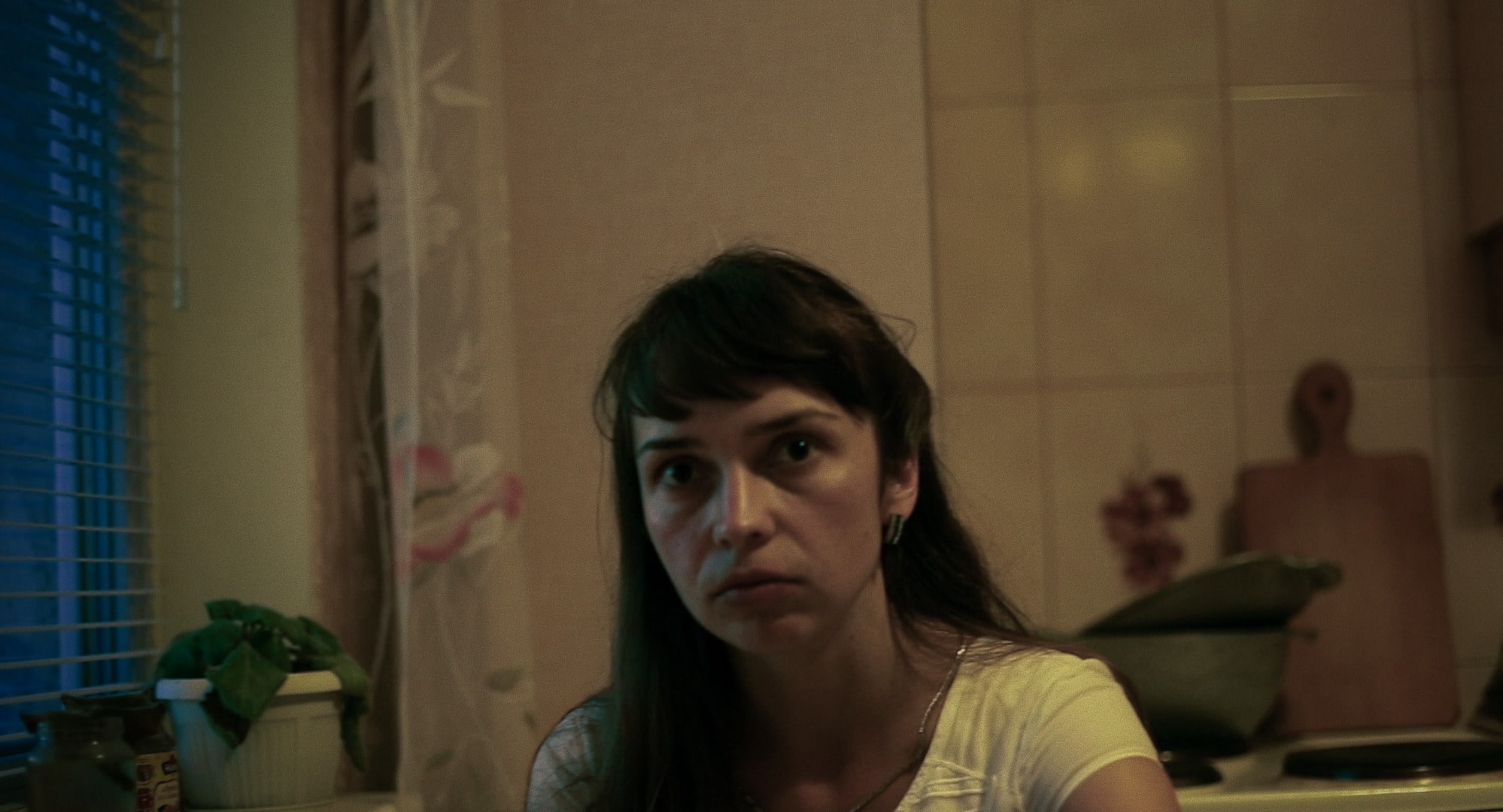 Filmmaker Lesia Diak in a still from 'Dad's Lullaby'.
Did you re-shoot any scenes? In the edit room, what was it like to be looking at yourself on the monitor?
It was not easy to watch the footage with myself. What helped is the time distance that I had because we entered the final editing stage after 2 years since I stopped filming. I felt stronger, I felt I have gotten tools to cope with my mental health and I wanted to help others. I am convinced that the filmmaking really contributed to bravery and empowered me.
In terms of the dialogues, we were faithful to the original footage. I only reshot some night window shots so that we had more options for the editing. I don’t think that the docufiction style would serve well for such a vulnerable film and subject.
What kind of challenges did you face while making this film?
The biggest challenge was to overcome fears and to develop filmic relationship with Serhiy, my main protagonist. I had to earn his trust, to be understanding of his mood changes and the wish to stay away from people.
As I am the main producer of the film, I can say that it took me several years to raise funds for Dad’s Lullaby. And it was very frustrating creatively because I knew I cannot finish the film without having the financial part secured. It literally drove me to a burnout stage. Luckily, I had other projects to balance this frustration and to continue creating.
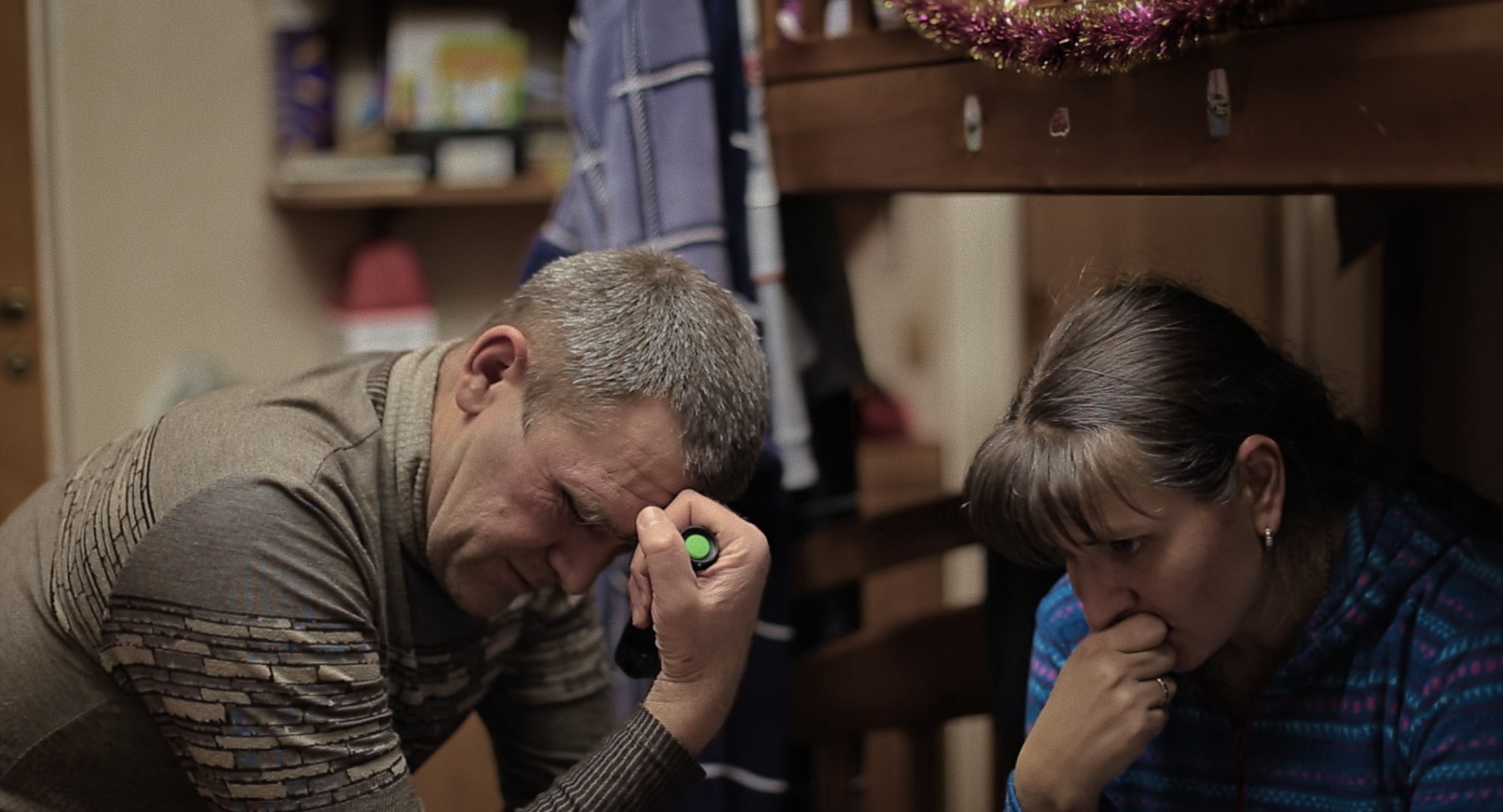 Ukrainian war veteran Serhiy with his wife in a still from the documentary 'Dad's Lullaby'.
The male character is shown with an empathetic lens.
I felt that Serhiy is the most broken and I need to put him in the centre of the film, to tell this story from his point of view. The female perspective to war-affected relationships is covered with my presence. I have made other documentaries (like Wounds) where the protagonists are female.
The point is that the burden (of war) on men is huge nowadays in Ukraine. I feel very deep empathy for men. We also have women in the army. But women are not drafted on the obligatory basis, except for the medical stuff. And men don’t have a choice. They need to join the army efforts to defend Ukraine from the aggressor. And there are lots of ethical dilemmas running through my mind because of this. As a woman, I feel devastated.
Male film directors and producers face difficulties crossing the border, they have to go through hell of bureaucracy to be able to get permission to cross the border to present their work at international events. It literally puts them in a very fragile position.
What kind of impact has the war had on Ukraine’s film industry? Are movies being made?
The Russian war against Ukraine has a tremendous impact on the Ukrainian film industry. Firstly, there are many filmmakers who were killed in war while they were defending Ukraine or documenting the reality on the front. It is not possible to fill in the void of their loss in our culture. Russia simply terminated their lives, work, and their creative potential. And we will never forgive this to our aggressor.
Secondly, as a country, our cultural sector suffers from financial difficulties because Ukraine prioritises military needs. There were two years after 2022 when it was not possible to secure funding for filmmaking from Ukrainian sources. Personally, I had to fight a lot for getting the grants to finalise Dad’s Lullaby abroad with the support of international partners.
The production of fiction films in Ukraine is significantly reduced because of lack of funding and because it is very difficult to film in Ukraine as the Russian missiles can hit any place at any moment. It is a big risk to film there. But Ukrainian creatives continue to make films with their own funds, with little support, taking all the risks because they feel responsible for telling the stories of our nation. So do I. At the moment, documentary filmmaking feels more relevant because the events are very intense and it also has a value for history to document real people and to reflect on changes within our society.
Is Ukraine being able to handle Russia’s military offensive?
The truth is that Ukraine cannot handle it on its own. That’s why we are constantly trying to reach out for support. The enthusiasm, health of Ukrainians is very much exhausted but our spirit is not broken. And we are the shield of Europe nowadays, because the imperialistic ambition of Russia will not end with Ukraine.
As a Ukrainian documentary filmmaker, how do you gauge Russian documentaries like Anastasia Trofimova’s Russians At War (2024)?
Films such as Russians At War make me feel very angry and uneasy. I recently watched another Russian film, Shards, at Doclisboa. And, unfortunately, the authors of these movies portray Russians as the victims of war, as people who can’t have the same enjoyable lives as they used to. These documentaries don’t acknowledge the responsibility of regular Russian citizens for killing Ukrainians everyday and turning our lives into terror. It is very hypocritical and it jeopardises filmmaking in general and especially in the regard of critical thinking as a crucial element of culture and art. Since 2022, I haven’t watched a single Russian documentary that would reflect on terrorism and war crimes their country is conducting against my country. And it is a pity. The Russian films I encountered were made with the purpose to whitewash their guilt and to stress out how painful the reality for a Russian person is nowadays. I felt as if someone was stabbing me in my stomach and I wanted to vomit after watching the Russian film Shards by Masha Chernaya.
The 20th century philosopher Hannah Arendt left a very well formulated wisdom for us: ‘No dictatorship justifies or excuses the responsibility of broader masses for their compliance with war crimes committed by their state’.
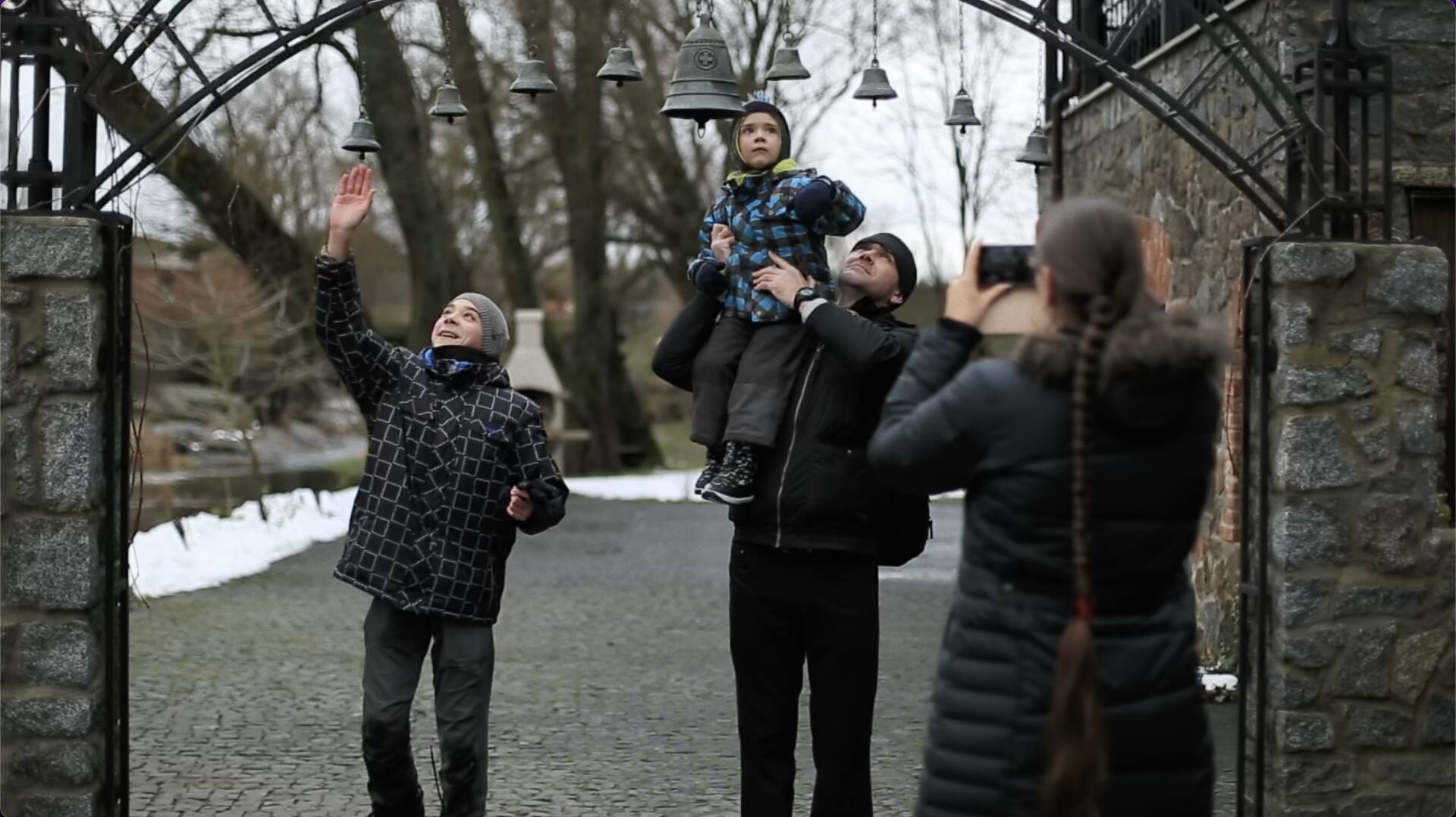 Serhiy with his family in a still from the documentary 'Dad's Lullaby'.
What impact do you hope Dad’s Lullaby will have on the current discourse surrounding the war and its consequences?
There are four levels for the impact, if not more: the international, the national, the local community level, and the individual level.
I know that there will be no impact of the film on international politics and on the destiny of Ukraine as a whole. My film will neither stop the war nor motivate the countries which are constantly creating hindrances for the weapon supply to Ukraine to simplify their inner processes. In terms of the community level, the film screenings and the discussions that follow could give viewers a sense of togetherness, belonging, and sharing the pain. Will the film bring the couples who have similar stories back together? No. But it can create a space for dialogue, or for dialogue between those struggling to maintain relationships. In terms of individuals, I believe that the film can help people to cope with guilt and sadness, to realise that there is an external force — the war — and one single individual can’t cope with it. I do hope that my film could lead people to realise they need to ask for help from the community or mental health professionals.
Discover the latest Business News, Sensex, and Nifty updates. Obtain Personal Finance insights, tax queries, and expert opinions on Moneycontrol or download the Moneycontrol App to stay updated!
Find the best of Al News in one place, specially curated for you every weekend.
Stay on top of the latest tech trends and biggest startup news.