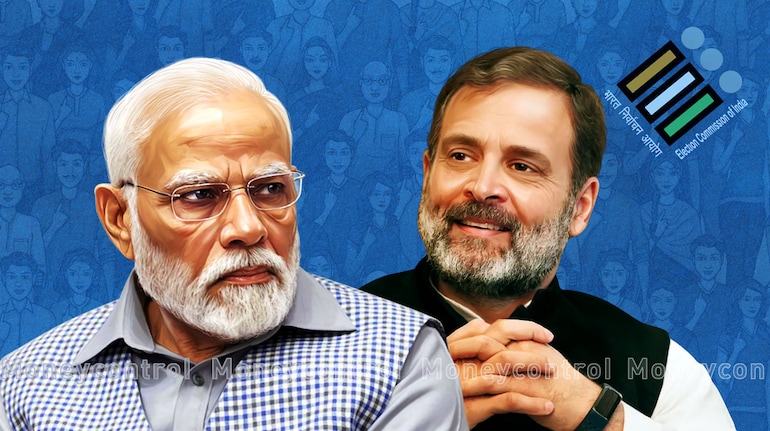
It has been a dramatic day as results for the world’s biggest elections have so far defied exit poll predictions. Though the Bharatiya Janata Party (BJP) and its allies are nearing the 300-seat mark, the Opposition INDIA bloc has put up an unexpectedly strong show, with leads in more than 220 seats.
The BJP is leading in around 244 seats, still short of the 272 majority mark. The saffron party alone had won 303 seats in the 17th Lok Sabha elections in 2019, securing a bigger mandate than in 2014.
So far, it looks like that the BJP is unlikely to get a majority on their own making it necessary for Narendra Modi to rely on two of his key allies - the Telugu Desam Party and the Janata Dal (United) - who are together leading in 30 seats so far.
As the numbers trickle in for the 543 seats in the Lower House of Parliament, Moneycontrol examines the potential impact on government policies if it is helmed by the National Democratic Alliance (NDA) with a weaker majority.
A weaker Modi mandateShould Prime Minister Narendra Modi secure a third term, albeit with a weaker mandate for the NDA, fiscal policy could witness a recalibration, with a clear focus on welfare measures to bolster consumption.
So far, the government’s fiscal prudence has often come at the cost of stepping away from direct measures to spur consumption. Barring a few steps, such as the free food grain scheme that will cost the Centre Rs 11.80 lakh crore for the next five years from January 1, 2024.
Hard data points to India’s relatively weak consumption and rural story. At a time when the country is expected to grow at a world-beating 8.2 percent for FY24, private consumption of around 4 percent is at a 20-year low, while farm sector growth remains at an abysmal 1.4 percent as against 4.7 percent in 2022-23.
“A weaker parliamentary mandate would imply more focus on central government-led social welfare provisions. The scale of technology expansion in government services may accordingly be higher, with legislation to regulate the use of personal data and domestic digital infrastructure, and on the use of AI systems,” said a report by S&P Market Intelligence on May 27.
An economist, on the condition of anonymity, pointed out the same that if the BJP and its alliance do not win the numbers it has targeted — the party has been speaking of “abki baar 400 paar” (this time, more than 400) — then a big-bang Budget oriented towards welfare measures to boost consumption may be on the anvil.
More expenditure to boost consumption therefore could necessitate stepping away, to an extent, from quicker fiscal consolidation.
Remember, the current BJP-led government that enjoys absolute majority on its own, has been fiscally strict of late, scaling down the deficit to 5.8 percent in FY24 and another 70 basis points lower for the current financial year. The interim Budget for 2024-25 was short of any big-bang announcements in a bid to keep to the medium-term aim of bringing the gap down to below 4.5 percent in 2025-26.
In fact, data released on May 31 showed that the fiscal deficit gap for FY24 was even lower at 5.6 percent versus the revised estimate, thanks to a cut in expenditure.
When it comes to boosting incomes and demand in the economy, the current BJP-led government has mostly relied on capital expenditure by allocating record outlays, including in the current financial year, at Rs 11.11 lakh crore.
Beyond consumption, in such a scenario, the Modi government is seen encouraging foreign investment by attempting to ease bureaucratic requirements, providing project-specific tax breaks and to channel these through production-linked incentive schemes (PLIS).
“However, rather than the central government passing directives, there is likely to be a greater need for cooperation with the state governments. Accordingly, competition among Indian states for marquee investment projects will increase, as is already occurring, with the Modi government likely exercising its central authority to guide the allocation of investment,” the S&P report said.
Discover the latest Business News, Sensex, and Nifty updates. Obtain Personal Finance insights, tax queries, and expert opinions on Moneycontrol or download the Moneycontrol App to stay updated!
Find the best of Al News in one place, specially curated for you every weekend.
Stay on top of the latest tech trends and biggest startup news.