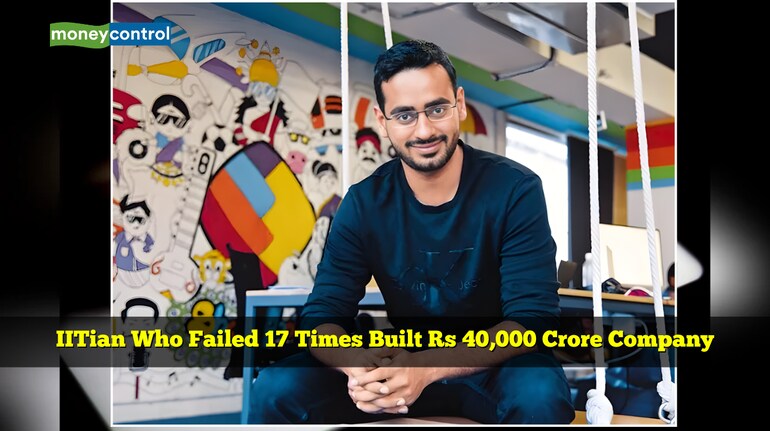

In the buzzing final year hostel rooms of IIT Kanpur, while most of his batchmates were celebrating crore-rupee job offers from global giants, Ankush Sachdeva was quietly nursing his 5th failed startup idea. His laptop was a graveyard of apps and websites that never took off—a study platform, a local services app, a social experiment. “Another one?” his friends would ask, half in jest, half in concern. Ankush would just smile and reboot his computer. Little did they know, he was in a marathon no one was watching, and the starting gun had fired long ago.
His story isn’t the typical IIT genius tale. It’s grittier, more human. Armed with a computer science degree, Ankush did not walk into a plush corporate office. Instead, he walked into a cycle of 17 consecutive failures. Seventeen. That’s not a typo. For years, every idea he poured his heart into—from e-commerce to utilities—crashed. To outsiders, it looked like a stubborn man refusing to get a “real job.” But to Ankush, each failure was a vital data point. He wasn't losing; he was learning. He was stripping away what didn’t work, inching closer to a problem so big, most of the tech world had overlooked it.
That problem was India itself—not the English-speaking, metro-dwelling fraction, but the overwhelming, vibrant, linguistic heartland of the country. In 2015, he teamed up with his IIT Kanpur friends, Farid Ahsan and Bhanu Singh, and they saw it clearly: while the internet was exploding in small towns and villages, there was no social space that spoke their language, literally. Platforms felt foreign. The content didn’t resonate. This was their eureka moment.
They built ShareChat, a simple yet revolutionary idea: a social media platform that spoke your language. It started with Hindi, then bloomed into 15 Indian languages—Malayalam, Gujarati, Bengali, Punjabi and more. It wasn’t just a translation of an English app; it was built from the ground up for the cultural context, the humour, the local news, and the everyday realities of non-metro India.
The result was electric. ShareChat didn’t just grow; it ignited. It connected a farmer in Punjab to a poet in Assam. It gave a homemaker in Madhya Pradesh a viral recipe channel. It became the digital nukkad (neighbourhood hangout) for millions who had been invisible to the global internet. By 2021, it had over 160 million active users. The valuation followed this massive adoption, soaring to a staggering Rs 40,000 crore (about $5 billion) by 2022.
Today, Ankush Sachdeva’s name is mentioned with reverence in startup circles. But the most inspiring part of his story is not the Rs 40,000 crore figure. It’s the 17 zeros that came before it. It’s the quiet resilience that treated every “no” as a “not yet.” It’s the lesson that in a world obsessed with overnight success, true impact is often built brick by brick, failure by failure.
His journey screams a powerful truth: You are not your failures. You are what you build with the lessons they leave behind. In the grand lab of life, Ankush wasn’t failing 17 times. He was just running the experiments needed to finally change the game.

Discover the latest Business News, Sensex, and Nifty updates. Obtain Personal Finance insights, tax queries, and expert opinions on Moneycontrol or download the Moneycontrol App to stay updated!
Find the best of Al News in one place, specially curated for you every weekend.
Stay on top of the latest tech trends and biggest startup news.