






In the eastern theatre of 1971, geography did much of Pakistan’s defensive work. Rivers, marshes, and broken communications could slow any attacker who insisted on moving along roads and bridges. The Meghna was one of the biggest of those natural obstacles: wide, difficult to cross quickly with heavy equipment, and positioned in a way that could force an advancing army into delays that would be measured in days.
That was precisely the kind of delay Pakistani planners needed. They were losing ground across East Pakistan, but time still had value. Every day bought space for units to withdraw, regroup, and defend the approaches to Dhaka. Every day also increased the chance of international pressure creating a pause.
The Indian Army’s problem was equally clear. Speed was not just a tactical preference. It was an operational requirement. The campaign needed to keep moving, keep Pakistani formations off-balance, and reach Dhaka before the war became politically complicated.
Then, at the key moment, the expected crossing point failed.
Ashuganj and the bridge that changed the plan
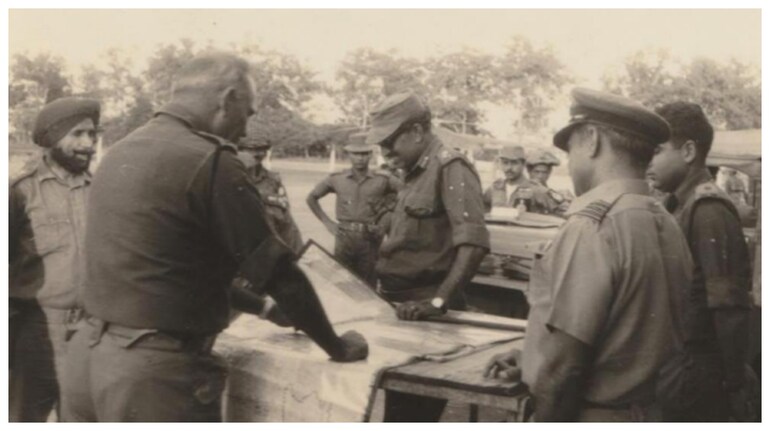
The advance of IV Corps under Lieutenant General Sagat Singh had pushed hard in the Brahmanbaria–Ashuganj sector. Ashuganj mattered because it offered a route over the Meghna via the Coronation Bridge. When Pakistani forces withdrew, the bridge was demolished. The map now offered India a choice that commanders hate: either pause and build a conventional crossing under pressure, or find a way around that did not exist on the ground.
This is where the Meghna heli-bridge begins. Not as a heroic flourish, but as a practical response to a roadblock.
Instead of treating the Meghna as a barrier to be solved by engineers and time, Sagat Singh treated it as a space to be crossed by air. He had already seen what helicopter mobility could do in the Sylhet operations. Now he wanted to apply the same logic at scale, on a river line that Pakistan assumed would impose delay.
The idea was deceptively simple: lift infantry across, establish a lodgement on the far bank, and then use that foothold to outflank Pakistani strongpoints and keep the axis of advance alive.
The mechanism of surprise: Helicopters, landing grounds, and night navigation
The “heli-bridge” was not one big dramatic air assault. It was a conveyor belt. Indian Air Force Mi-4 helicopters flew repeated sorties, carrying troops, light equipment, and in some accounts even limited artillery elements, into landing grounds on the far side. The key was not one flight but sustained rhythm.
Landing zones had to be identified and marked in an environment where navigation aids were limited and the risk of landing in the wrong field was real. Local support became part of the operation’s architecture. Mukti Bahini fighters helped identify and mark landing grounds, using improvised lights and guides in paddy fields. Pilots and ground parties then did the unglamorous work of turning a dark, flat landscape into a temporary airfield.
The point of all this was not simply to cross the river. It was to cross it in a way that Pakistan did not have time to react to.
For a defender, a river line works when the attacker must concentrate at predictable crossing points. The heli-bridge broke that predictability. It also created a different kind of fear: the sound of helicopters behind your line is rarely interpreted as “a few companies”. It is interpreted as “a larger force has landed”. That psychological effect matters because it makes defenders cautious precisely when they need to be aggressive.
Infantry first: The fragile logic of a bridgehead
The first troops across were not sent to win a conventional set-piece battle. They were sent to create a problem the defender could not quickly solve.
An airlifted battalion on the far bank is vulnerable. It has limited heavy weapons, limited vehicles, and no easy way to retreat. It has to win quickly in a local area or hold until follow-on forces arrive. That is why the Meghna heli-bridge was a wager on tempo.
The battalion group that landed near Raipura moved to expand the lodgement and threaten key routes, including towards Narsingdi. The intention was to get astride communications and create a situation where Pakistani formations at Bhairab Bazar and Ashuganj could not simply pivot to smash the landing. Meanwhile, other Indian elements used boats and local craft to cross at additional points, widening pressure on the Pakistani defensive layout.
The brilliance of the plan was not that it eliminated risk. It redistributed it. It shifted risk from a slow, predictable bridging operation under enemy observation to a fast, uncertain airlift where speed itself was protection.
Outflanking Bhairab Bazar: Turning a strongpoint into dead ground
Bhairab Bazar was a serious Pakistani hold-up position on the route to Dhaka. If an attacker had to take it head-on with conventional movement, it could consume time and lives.
The heli-bridge reduced Bhairab Bazar’s value. Instead of battering straight through, Indian forces threatened the rear and flank, creating the conditions for isolation. A strongpoint stops being strong when it is no longer on the main line of movement and no longer controls what it was meant to control.
This is the operational meaning of cracking “defensive depth”. Defensive depth is supposed to absorb an attacker’s momentum, forcing repeated slowdowns at successive lines. The heli-bridge skipped a line. It made the Meghna less of a defensive belt and more of a space the attacker could traverse at will.
Once the lodgement held, more forces could be lifted in, and the advance could resume at pace. Within days, Indian formations were far closer to Dhaka than the river line had suggested possible.
Air Force as enabler, not ornament
It is easy to tell this story as an “Army operation supported by helicopters”. That is accurate but incomplete. The heli-bridge only worked because the Indian Air Force treated helicopter lift as a core operational task, not a side mission.
Sustained sorties require maintenance discipline, pilot endurance, air traffic management in makeshift conditions, and protection against interference. Where necessary, fixed-wing aircraft were used to suppress or distract Pakistani positions that could threaten the landing or the movement of troops around the lodgement. The helicopter force itself had to keep flying in a rhythm fast enough to build combat power on the far side before the defender could react effectively.
This is what modern mobility looks like in practice: not a single spectacular act, but repeated competence under stress.
Why the Meghna heli-bridge changed the campaign’s clock
In operational history, some actions matter because they seize ground. Others matter because they seize time. The Meghna heli-bridge did the latter.
Had India been forced into a conventional bridging operation at the Meghna under pressure, the advance on Dhaka could have slowed enough to create operational breathing room for Pakistani forces and political room for external intervention. Instead, the airlift compressed the timeline. It kept the campaign moving when the terrain was designed to slow it.
This also shaped morale and perception. For Indian troops, it reinforced the sense that the offensive had momentum and creativity. For Pakistani units, it signalled that even a major river line could be bypassed, which eroded the psychological value of defensive planning based on geography.
The lesson that outlasted 1971
The Meghna heli-bridge remains one of the clearest demonstrations of how mobility can rewrite a campaign. It shows that defensive depth is not only about how many lines you have, but whether you can force the attacker to fight through them in sequence. Helicopter lift broke the sequence.
It also highlights a broader truth about combined operations: when commanders use air assets to solve a ground problem at the operational level, they do not just win a battle. They change the shape of the map and the meaning of distance.
In 1971, the Meghna was supposed to be a pause point. For a few decisive days in December, it became an air corridor.
Discover the latest Business News, Sensex, and Nifty updates. Obtain Personal Finance insights, tax queries, and expert opinions on Moneycontrol or download the Moneycontrol App to stay updated!
Find the best of Al News in one place, specially curated for you every weekend.
Stay on top of the latest tech trends and biggest startup news.




