






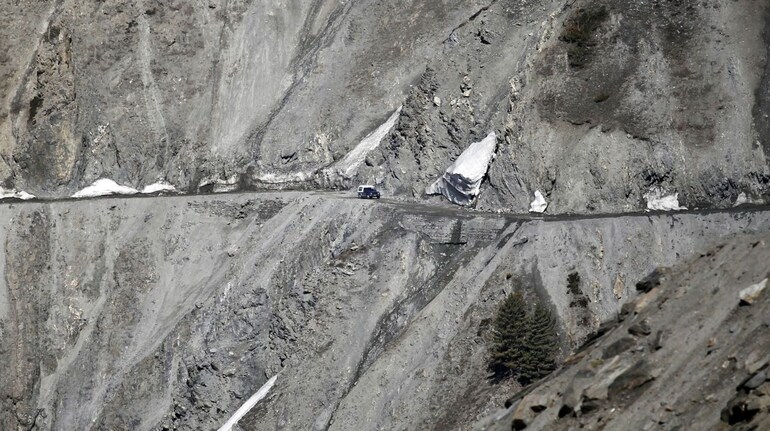

By early 1948, the fight in Jammu and Kashmir had spilled into the high, harsh geography of Ladakh, where control was less about cities and more about routes. If Leh fell, India would lose its administrative and military foothold in Ladakh, and any later attempt to return would have meant clawing back ground across some of the toughest terrain in the region. The problem was that Leh was effectively cut off. The Srinagar side was blocked when Zoji La, Dras and Kargil were in hostile hands, and the Manali route was long, slow and seasonal. In practical terms, Leh could be defended only if it was reinforced and supplied before an enemy thrust reached it.
A garrison that was too small for the map it had to hold
One reason the Leh story is so stark is the mismatch between what had to be defended and what was available to defend it. The Ladakh front was a huge, river and valley network that could not be sealed off by a few pickets. When hostile forces pushed east and the situation around Skardu worsened, the fear was straightforward: once Skardu went, Leh would be next. In that context, “holding Leh” was not a neat siege narrative. It was an attempt to keep a thin garrison alive, armed and confident, while working out how to get reinforcements across mountains that were still locked in winter.
The winter trek that bought Leh time
The first lifeline was not an airlift. It was a winter march. Tribune reporting describes Major Prithi Chand volunteering to lead a small party through extreme winter conditions toward Ladakh between mid-February and early March 1948. The trek is remembered because it was brutally simple: men moving through deep snow with weapons, supplies and the urgency that if Leh did not get help quickly, it could be overrun before any larger plan matured. That march helped stiffen local defences and buy the critical commodity Ladakh lacked most in 1948: time.
Turning a barren strip into a lifeline
Once you accept that roads would not open in time, the logic shifts to air. But Leh in 1948 was not the kind of airfield modern readers imagine. It was high altitude, unforgiving, and at that point, not a comfortable place to land transport aircraft. The Indian Air Force’s own history notes Air Commodore Mehar Singh’s feat of landing at Leh, a milestone that mattered because it made reinforcement and resupply possible even while the land routes were contested or closed. Getting aircraft in changed the entire problem from “can Leh be reached at all?” to “can Leh be sustained until the passes are reopened?”
The air bridge and the infantry flown in
With the air link established, reinforcement could finally happen at speed. The wider narrative of the Ladakh defence consistently returns to the idea that Leh was strengthened by flying troops in, not marching them across Zoji La. That mattered because hostile forces still held the gateway positions on the Srinagar side, which meant conventional relief columns would have been delayed and vulnerable. By using air to put disciplined infantry into Leh, India avoided the fatal scenario of having to fight a major defensive battle with an understrength garrison and limited ammunition.
Holding actions, not one decisive battle
This phase is often misunderstood. People look for one dramatic “Battle of Leh.” What actually protected Leh through much of 1948 was a grim pattern of small actions, local patrols, and an insistence that the defending force would not be pushed out of position, even when the surrounding geography made manoeuvre difficult. The defenders were trying to do two things at once: keep the immediate approaches stable and prevent panic in the town, while also preparing for the bigger operational requirement, reopening the Srinagar-Leh axis. Leh was not saved only by heroics. It was saved by refusing to be dislodged while the larger campaign caught up.
Why Zoji La mattered more than any single outpost
If Leh was the anchor, Zoji La was the gate. As long as Zoji La remained in hostile hands, Leh could be supported by air, but it could not be reliably supplied at the scale required for a long holding period. That is why the Indian decision to retake Zoji La before winter became existential for Ladakh. The National War Memorial’s official depiction frames it plainly: when Zoji La fell, it became vital to recapture it before winter to relieve Leh, and that urgency drove the planning that followed.
Operation Bison and the shock of tanks in the snow
The Zoji La assault in November 1948 is remembered because it did something unexpected for that altitude: it brought armour into the fight. The Print’s account describes the surprise effect of tanks at roughly 11,553 feet, a move that hit the defenders like a bolt because it was not what they expected in that environment. According to the National War Memorial’s depiction, Stuart light tanks of 7 Cavalry were moved in dismantled condition, and engineers improved the track to make armour movement possible. This was not just bravery. It was a problem-solving exercise under time pressure, using engineering and surprise to break a bottleneck that infantry attacks had struggled to crack.
The road opening and the psychological shift
Once Zoji La was forced and the advance pushed on, the campaign’s effect went beyond miles gained. It changed the mood of the Ladakh defence. A garrison that has been living on a thin air bridge and uncertain mule columns suddenly sees a land corridor reopen and friendly forces advancing. Even if air supply continues, the knowledge that relief is not only possible but already moving has a stabilising effect that is hard to overstate in isolated high-altitude warfare. The Print notes that the surprise and momentum of the Zoji La battle helped change the equation on the route that connected Ladakh to the Kashmir Valley.
The link-up at Kargil that sealed Ladakh’s survival
The operational story of “saving Leh” does not end at Zoji La. It ends when the forces advancing from the west and the forces operating out of Leh connect and consolidate the corridor. Tribune’s account of the 1948 campaign describes elements moving toward Leh and the broader Ladakh theatre, including reinforcements and supplies being pushed in difficult conditions, while the Zoji La operation enabled the wider liberation sequence. Once that link-up and corridor control became real, Leh was no longer a vulnerable island. It became a defended node with a survivable logistics chain.
What “overwhelming odds” really meant in Ladakh
The odds were not only about troop numbers. They were about altitude, time, and logistics. Leh was defended in a period when snow could shut the world, when a single pass could decide a campaign, and when building an air link was itself an act of operational imagination. The defenders held because a winter trek brought early reinforcement, an air landing created an emergency supply line, and a larger offensive broke open Zoji La before the season could lock it down again. The story is not one miracle. It is a chain where each link had to hold, because if even one failed, Leh’s fall would have been far easier than its defence.
Discover the latest Business News, Sensex, and Nifty updates. Obtain Personal Finance insights, tax queries, and expert opinions on Moneycontrol or download the Moneycontrol App to stay updated!
Find the best of Al News in one place, specially curated for you every weekend.
Stay on top of the latest tech trends and biggest startup news.





