






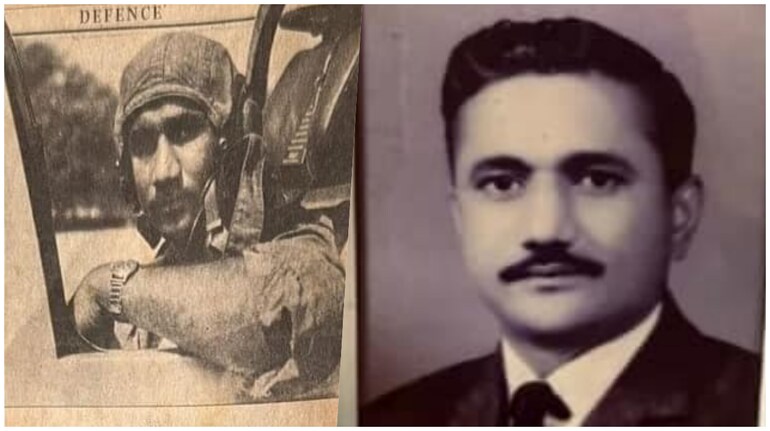

In the air war of 1965, a lone Indian pilot flying an early MiG-21 took on superior enemy fighters deep over hostile territory. He never returned, but the truth of what he did emerged decades later.
The air war of September 1965 between India and Pakistan was brief, violent, and improvisational. Both air forces were still finding their feet with new aircraft, new tactics, and incomplete intelligence. In that setting, individual missions often carried disproportionate weight. Some ended quietly. Others left behind unanswered questions that lingered for years.
One such mission was flown on 7 September 1965 by Ajjamada B. Devayya, a Squadron Leader in the Indian Air Force. His aircraft, a MiG-21, did not return. At the time, India believed he had been shot down by ground fire. The story would have ended there, as so many wartime stories do. Instead, it resurfaced decades later, reshaped by evidence that turned a routine loss into one of the most remarkable air combats of the war.
Who Devayya was, before he became a name
Devayya was not a flamboyant ace or a publicity figure. Accounts in The Hindu and The Indian Express describe him as a solid, professional officer, respected for discipline and flying skill rather than bravado. He was part of the Indian Air Force’s early MiG-21 cadre, pilots tasked with mastering a cutting-edge aircraft that had arrived with promise but limited operational experience.
In 1965, the MiG-21 was still new to Indian service. It was fast and sleek, but early variants lacked the avionics and weapon sophistication that later made the aircraft famous. Pilots were learning under pressure, while also being asked to fly deep into contested airspace.
The mission over Sargodha
On 7 September, Devayya was tasked with a ground-attack mission over Sargodha, home to one of Pakistan’s most important air bases. Indian strikes on Sargodha aimed to disrupt Pakistan Air Force operations by hitting infrastructure and aircraft on the ground.
By all contemporary Indian accounts, Devayya pressed his attack successfully. What happened next was unclear for years.
Indian records initially assessed that his MiG-21 had been hit by anti-aircraft fire during the strike. No radio distress call was received. No visual confirmation of an air-to-air engagement came back. In the fog of war, the explanation seemed sufficient.
But the Pakistani version, which emerged much later through reporting and memoirs, told a very different story.
An unexpected encounter in the air
According to Pakistani accounts cited in The Indian Express and The Print, Devayya’s MiG-21 was intercepted after the strike by two Pakistan Air Force F-104 Starfighters. The F-104 was a very different beast: fast, heavily armed, and designed as a high-altitude interceptor. On paper, it had advantages over the early MiG-21 Devayya was flying.
What followed was not a straightforward interception.
Pakistani sources acknowledged that Devayya did not disengage or attempt to flee. Instead, he turned to fight. In the ensuing dogfight, one of the F-104s was hit and destroyed. The pilot, Flight Lieutenant Amjad Hussain, was killed.
Only after that engagement did Devayya’s aircraft go down. Pakistani records suggest his MiG-21 was eventually hit during the encounter, leading to his death.
For decades, this account remained largely outside Indian public memory. The loss of an F-104 was officially recorded by Pakistan, but its cause was not widely connected in India to Devayya’s mission.
Why the truth took so long to surface
Air combat is notoriously hard to reconstruct, especially in the 1960s. Radar coverage was patchy. Gun cameras were unreliable. Wreckage fell across hostile territory. Each side wrote its own narrative based on incomplete information.
It was only years later, as Pakistani pilots wrote memoirs and journalists revisited archival material, that the pieces aligned. The Indian Express and The Hindu have both reported on how confirmation of the F-104 loss, matched with the timing and location of Devayya’s disappearance, made the link undeniable.
The reassessment forced a quiet correction of history. Devayya had not been a victim of ground fire. He had fought, alone, against superior odds and taken an enemy aircraft with him.
The MiG-21 and the odds he faced
To understand why this matters, it helps to look at the aircraft involved.
The MiG-21 Devayya flew was an early variant. It was fast, but it lacked advanced radar and had limited situational awareness. The F-104 Starfighter, by contrast, was designed to intercept at speed and altitude, and was considered one of the Pakistan Air Force’s elite platforms at the time.
Engaging one F-104 would have been dangerous. Engaging two was extraordinary.
Indian Air Force veterans quoted in The Print have pointed out that Devayya’s decision to turn and fight speaks to a particular mindset common in the IAF during 1965: mission first, disengage only if necessary. That mindset came with costs, but it also produced moments of exceptional courage.
Recognition, delayed but decisive
For years, Devayya’s gallantry went officially unrecognised beyond his being listed as killed in action. Once the full picture emerged, the case for formal recognition became compelling.
In 1988, more than two decades after his death, Devayya was posthumously awarded the Maha Vir Chakra, India’s second-highest gallantry award. The Hindu reported on the unusual nature of the decision, noting both the delay and the strength of the evidence that finally supported it.
The citation acknowledged that Devayya had engaged enemy fighters and shot one down before being killed. It was a rare instance of wartime heroism being formally recognised long after the war had ended.
Why his story matters beyond medals
Devayya’s story is not just about one dogfight. It says something larger about how wars are remembered and how individual actions can be lost in the blur of larger narratives.
The 1965 air war is often discussed in terms of aircraft types, base strikes, and strategic outcomes. But it was also made up of moments like this: a single pilot, deep over enemy territory, making a choice under pressure that would cost him his life.
There is also something instructive about how long it took for the truth to emerge. It underlines how easily history can flatten complexity, and how important it is to revisit old assumptions when new evidence appears.
A quiet place in Indian air force memory
Unlike some wartime figures, Devayya does not dominate popular culture. There are no blockbuster films about his mission. His name circulates mostly among air force veterans, historians, and those who dig into the details of 1965.
That quietness suits the story. By all accounts, Devayya was not chasing legend. He was doing his job, under extreme conditions, and he did it to the end.
As The Indian Express once noted in reflecting on his award, the measure of his courage lies not just in the enemy aircraft he destroyed, but in the fact that he chose to fight at all when retreat would have been the safer option.
What remains
Today, Squadron Leader Ajjamada B. Devayya is remembered as a man who flew into hostile skies knowing the odds, completed his mission, and then turned to face his attackers. His last flight over Sargodha stands as one of the Indian Air Force’s most remarkable single-pilot actions of the 1965 war.
It is a reminder that behind every official war history are individual stories waiting to be fully told, sometimes long after the guns have fallen silent.
Discover the latest Business News, Sensex, and Nifty updates. Obtain Personal Finance insights, tax queries, and expert opinions on Moneycontrol or download the Moneycontrol App to stay updated!
Find the best of Al News in one place, specially curated for you every weekend.
Stay on top of the latest tech trends and biggest startup news.





