






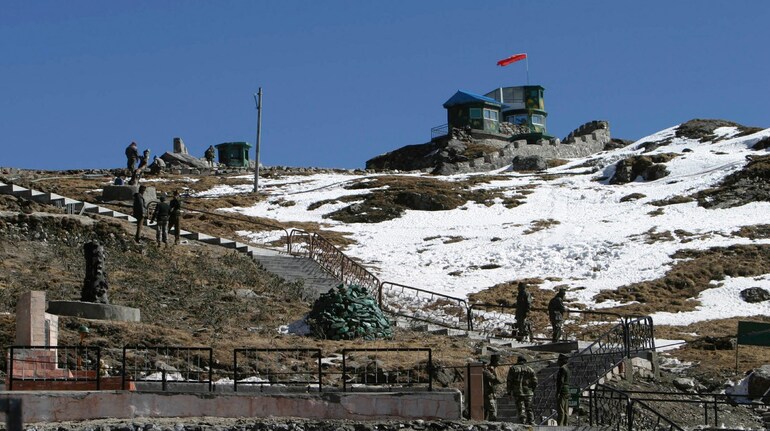
In 1967, Sikkim was not yet an Indian state, but a protectorate where Indian troops guarded key passes on the old trade routes to Tibet. Nathu La, more than 14,000 feet up, was one of those choke points: narrow, steep, and tactically unforgiving, with dominant heights deciding who could see and hit whom first. After the 1962 war, both sides watched each other closely along this sector, but the confrontations stayed mostly limited to patrol standoffs.
Nathu La, September 1967: A fence line becomes a flashpoint The immediate trigger was not a sweeping offensive. It was work by Indian Army engineers to put up fencing from Nathu La towards Sebu La to mark the border. According to the Government of India’s Bharat Ranbhoomi Darshan account of the episode, Chinese troops objected, a scuffle followed, and the work continued. Soon after, the Chinese side opened fire with machine guns and artillery. India responded from stronger positions on higher ground, including Sebu La and a feature described as Camel’s Back, using heavy artillery to smash bunkers and push the attackers back. The exchange lasted about three days before a ceasefire, with India holding its ground.
This mattered because it showed a different Indian posture from 1962: better prepared artillery, tighter local command and control, and a willingness to absorb the first shock and then escalate hard within the tactical box.
Cho La, October 1967: The confrontation moves along the ridge Less than a month later, the confrontation shifted to Cho La, another high pass in Sikkim. Bharat Ranbhoomi Darshan describes the Cho La clash as a result of Chinese troops entering what India regarded as its territory, after which fighting broke out. The Indian side again used the advantage of terrain and firepower to regain control of positions.
Even though the two battles were limited in geography, the sequencing was important. Together, they sent a message that local incursions would be met by immediate, high-cost retaliation, not prolonged negotiation under fire.
Why 1967 reset the “China border equation” in this sector First, it hardened deterrence on the ridgeline. In simple terms, deterrence in the mountains is less about grand declarations and more about what the other side believes you will do in the first 30 minutes: whether you will shoot back, whether you can bring guns to bear, and whether you will hold the heights that control the pass. Nathu La and Cho La built a reputation that India would fight, and fight effectively, in Sikkim.
Second, it demonstrated escalation discipline. The clashes were brutal, but bounded. Neither side expanded the fighting into a larger war. That combination, sharp local punishment without runaway escalation, is often what makes deterrence “stick” in contested borders.
Third, it created a long shadow over later crises in the same geography. Analysts frequently read later stand-offs in and around Sikkim and the wider eastern Himalayas through the memory of 1967, including how quickly a tactical dispute can turn into artillery exchanges if red lines are crossed. (A declassified U.S. intelligence brief referenced in a Brookings compilation also reflects how closely outsiders watched the 1967 firing as a signal event.)
Casualties and the cost of a “limited” war Public reporting on casualties varies across accounts and over time. Indian media have cited official figures for Indian losses and much higher Chinese casualties, though independent verification on the Chinese side is inherently difficult. What is not disputed is the scale of violence relative to the small area involved: intense shelling and close fighting at extreme altitude, where evacuation is slow and exposure can be as punishing as enemy fire.
Why it still matters today Nathu La and Cho La are not remembered because they were the largest battles on the China frontier. They are remembered because they were clarifying battles. In three days at Nathu La and in the follow-on clash at Cho La, India demonstrated that the post-1962 border would not be managed by retreat and regret. In the language of mountain warfare, the signal was straightforward: if you test the ridge line, you will pay for every metre.
Discover the latest Business News, Sensex, and Nifty updates. Obtain Personal Finance insights, tax queries, and expert opinions on Moneycontrol or download the Moneycontrol App to stay updated!
Find the best of Al News in one place, specially curated for you every weekend.
Stay on top of the latest tech trends and biggest startup news.




