






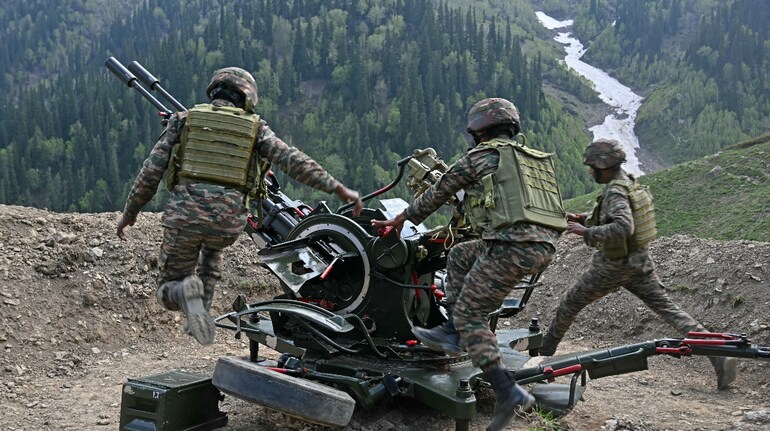

The year 2025 marked a decisive shift in India's military posture, with the Indian Army demonstrating not just preparedness but credible, controlled and decisive application of force. At the centre of this transformation stood Operation Sindoor, a joint, precision military response that reinforced deterrence, showcased integrated command and validated years of doctrinal and technological evolution. Beyond the operation, 2025 saw accelerated modernisation, deep indigenisation, new force structures, enhanced firepower, and expanded global military engagement-cementing the Indian Army's readiness for future conflict across domains.
1. Operation Sindoor
Launched in May 2025 following the Pahalgam terror attack, Operation Sindoor became a defining operational benchmark. Planned entirely by the Military Operations Branch and executed under real-time oversight from the DGMO's Ops Room, the operation saw nine terror camps across the border destroyed-seven by the Indian Army and two by the Indian Air Force. The strikes were time-bound, precise and calibrated, reinforcing deterrence while preventing escalation. Pakistan's subsequent drone retaliation attempts on 7-10 May were fully neutralised by Indian Army Air Defence units, highlighting the effectiveness of integrated Counter-UAS and layered air defence systems. Sustained ground-based strikes along the Line of Control dismantled over a dozen terror launch pads, disrupting infiltration networks. The operation culminated on 10 May 2025, when Pakistan sought a ceasefire through DGMO-level engagement-underscoring India's operational dominance.
2. Long-Range Precision Firepower Comes of Age
2025 saw significant strides in deep-strike and stand-off capabilities. A combat launch of BrahMos by Southern Command in December validated high-speed accuracy under simulated battle conditions, while work on extended-range variants continued. Simultaneously, the Pinaka rocket force expanded, with two additional regiments operationalised in June and the successful test of the Pinaka Long Range Guided Rocket (≈120 km) in December-marking a major leap in precision fires and future deep-strike potential.
3. Army Aviation Strengthened with Apache Induction
The long-awaited induction of AH-64E Apache attack helicopters into the Army Aviation Corps materialised in 2025. The first three helicopters were inducted in July, followed by the remaining three in December-significantly boosting the Army's close air support, armour-hunting and battlefield dominance capabilities.
4. New Battlefield Organisations for Future Wars
The Indian Army transitioned from concept to capability with the rollout of Bhairav Battalions and Ashni Drone Platoons. A major demonstration in Rajasthan in October showcased their integrated employment alongside new technologies. Plans to operationalise 25 Bhairav light commando battalions, along with Ashni platoons across infantry units, reflected a clear push towards agile, tech-enabled combat formations. New structures such as Shaktibaan Regiments and Divyastra Batteries, equipped with UAVs and loiter munitions, further addressed emerging battlefield challenges.
5. Accelerated Procurement and Indigenisation Push
Building on the "Years of Tech Absorption" initiative (2024-25), the Army focused on integrating technology at scale. Key highlights included the induction of six Apache helicopters, achievement of 91% indigenisation in ammunition, and large-scale induction of unmanned systems-including nearly 3,000 RPAs, tethered drones, swarm drones, logistics drones for high altitudes and kamikaze drones. Defence Acquisition Council approvals in August and December reflected a clear tilt towards unmanned systems, counter-UAS and precision fires.
6. Digital Transformation and Tech Enablement
2025 added momentum to the Army's digital transformation. Edge Data Centres were established to shorten data-to-decision cycles at the tactical level, while a suite of in-house software solutions-including the Equipment Helpline and Sainik Yatri Mitra App-enhanced operational responsiveness and soldier-centric support systems.
7. Doctrinal Refinement and Readiness Reviews
The Army Commanders' Conference, held in Jaisalmer in October 2025, focused on Grey Zone Warfare, jointness, and Aatmanirbharta-driven innovation. These deliberations aligned doctrine, force structure and preparedness with lessons drawn from recent operations, including Operation Sindoor.
8. Expanded Military Diplomacy and Joint Exercises
The Indian Army deepened interoperability and regional partnerships through major exercises with key partners, including France, the US, Australia, the UK, UAE, Sri Lanka and Thailand. Exercises such as Yudh Abhyas (Alaska), AustraHind (Perth) and Desert Cyclone-II (Abu Dhabi) sharpened counter-terror, urban warfare and joint operational capabilities.
9. Strategic Thought Leadership and Defence Dialogue
The Chanakya Defence Dialogue 2025 emerged as the Army's flagship strategic platform. Through the Young Leaders Forum, a high-level Curtain Raiser podcast, and the main dialogue themed on "reform-to-transform", the Army reinforced its role as a driver of strategic thinking for a secure and developed India.
10. Innovation and Atmanirbhar Momentum: Inno-Yoddha
The Inno-Yoddha 2025-26 edition saw a record 89 innovations submitted, with 32 selected for further development and fielding. The initiative strengthened bottom-up innovation, ensuring that battlefield-driven ideas translate into indigenous, deployable capabilities.
Discover the latest Business News, Sensex, and Nifty updates. Obtain Personal Finance insights, tax queries, and expert opinions on Moneycontrol or download the Moneycontrol App to stay updated!
Find the best of Al News in one place, specially curated for you every weekend.
Stay on top of the latest tech trends and biggest startup news.





